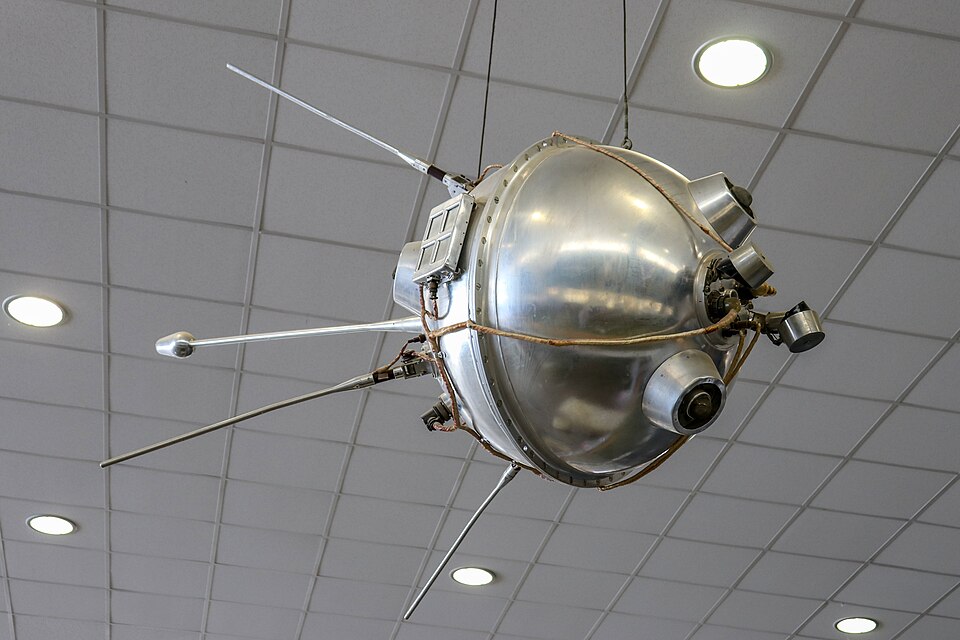
It was supposed to hit the Moon. It missed by 5,995 kilometers — and in doing so became one of the most consequential spacecraft ever built.
On January 2, 1959, the Soviet Union launched a small spherical probe from the Baikonur Cosmodrome in Kazakhstan aboard a three-stage 8K72 rocket. The probe weighed 361 kilograms, carried five science instruments, and had a single mission objective: impact the surface of the Moon, becoming the first human-made object to reach another world. A programming error in the third stage burn time caused the spacecraft to miss. Instead of striking the Moon, it passed within 5,995 kilometers of the lunar surface on January 4, continued outward, and entered a permanent orbit around the Sun between Earth and Mars — where it remains today, circling silently every 450 days, the first artificial planet.
The Soviets named it Mechta. Dream.
The Race to the Moon
Luna 1 flew eighteen months after Sputnik — the first artificial satellite, launched October 4, 1957 — had announced to the world that the Soviet Union had the rocket technology to place objects in orbit. The space race was already underway, defined less by scientific objectives than by the imperative to demonstrate technological supremacy during the Cold War. The Americans had attempted their own lunar missions with the Pioneer program; all had failed to reach the Moon. Luna 1 was the Soviet Union’s fourth attempt — three previous missions had failed at launch.
The 8K72 that carried Luna 1 was a modified R-7 intercontinental ballistic missile — the same rocket that had launched Sputnik, and the same fundamental design that, in evolved form, would carry Soviet cosmonauts into orbit and eventually launch Yuri Gagarin in 1961. Adding an upper stage to the R-7 gave it the velocity needed to achieve escape velocity from Earth — the first time any rocket had done so. Luna 1, riding that upper stage, became the first human-made object to break free of Earth’s gravitational hold entirely.
62 Hours That Changed History
Luna 1’s active mission lasted approximately 62 hours from launch to loss of radio contact. During that time it transmitted a continuous stream of data that transformed our understanding of the space environment between Earth and the Moon.
On January 3, 1959, while 119,500 kilometers from Earth, the spacecraft released a cloud of sodium gas — approximately one kilogram — that glowed orange in sunlight and was visible to ground-based observers as a faint artificial comet trailing across the sky. It was the first time a spacecraft had intentionally released a visible tracer in space, an experiment designed both for scientific tracking purposes and, characteristically for the era, to demonstrate the achievement to anyone watching.
The most scientifically significant result came from Luna 1’s magnetometer. Scientists at the time debated whether the Sun continuously emitted a stream of charged particles — the solar wind — or whether energetic particles only radiated outward during solar events. Luna 1’s instruments detected a continuous flux of ionized plasma flowing outward from the Sun, providing the first direct confirmation and measurement of the solar wind. The finding settled a fundamental question about the nature of the space environment that Earth and all the planets inhabit.
Luna 1 also measured the Van Allen radiation belts with greater precision than the American Explorer satellites had achieved, and detected no significant magnetic field around the Moon — the first indication that the Moon, unlike Earth, lacked a global magnetic field.
The Miss That Made History
The programming error that caused Luna 1 to miss the Moon was, in retrospect, one of the most consequential mistakes in space history. Had the spacecraft hit the Moon as intended, it would have been remembered as a successful impactor — notable but unremarkable beyond its primary achievement. Instead the miss transformed it into something more: the first spacecraft to escape Earth’s gravity, the first to fly past the Moon, and the first to enter heliocentric orbit. Three firsts that no successful impact would have generated.
The Soviet Union, characteristically, did not publicize the miss as a failure. Luna 1 was presented as a triumph — which, in nearly every meaningful sense, it was. It had demonstrated that a rocket could accelerate a payload to Earth escape velocity. It had survived the passage through the Van Allen belts and the interplanetary environment. It had confirmed the existence of the solar wind. And it had shown the world that the Soviet space program could reach beyond Earth orbit — even if it had overshot its intended target by six thousand kilometers.
The First Human Made Object Beyond LEO
Luna 1 holds a distinction that no subsequent mission can claim: it was the first human-made object to travel beyond low Earth orbit. Everything on this site — every spacecraft profiled here, every mission to Mars, Jupiter, Saturn, and the edges of the solar system — followed the path Luna 1 opened on January 2, 1959.
It weighed 361 kilograms, carried instruments powered by batteries, and communicated with Earth using radio equipment that would be considered primitive by any modern standard. It had no cameras. It was not designed to return data for long. It flew for 62 hours and missed its target by six thousand kilometers.
And it changed everything.
Mechta — Dream — is still out there, orbiting the Sun between Earth and Mars, as it has been for 67 years. It will continue to do so long after every person who built it, launched it, and tracked its brief journey has been forgotten.