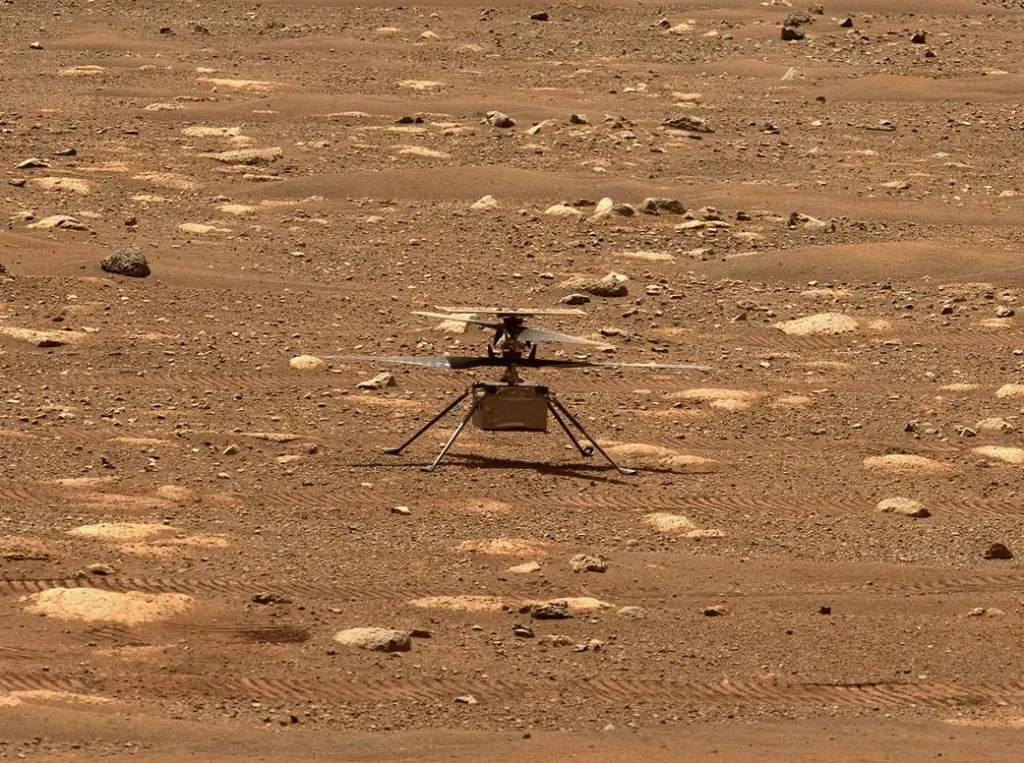
It was designed to fly five times. It flew seventy-two.
When NASA engineers at the Jet Propulsion Laboratory conceived Ingenuity, they were careful to call it what it was: a technology demonstration. Not a science mission. Not an explorer. A proof of concept — a small, 1.8-kilogram rotorcraft attached to the belly of the Perseverance rover, designed to show that powered, controlled flight in the Martian atmosphere was physically possible. Five flights over thirty days. That was the plan.
Nobody told Ingenuity.
The Challenge of Flying on Mars
Flying on Mars is extraordinarily difficult. The Martian atmosphere is only about 1 percent as dense as Earth’s at sea level — thinner than the air at 100,000 feet above Earth’s surface, far beyond the ceiling of any conventional aircraft. To generate lift in air that thin, a helicopter needs rotors that spin much faster than any terrestrial design, or much larger rotors, or both. Ingenuity’s twin counter-rotating carbon fiber blades span 1.2 meters tip to tip and spin at approximately 2,400 revolutions per minute — roughly five times faster than a helicopter on Earth. The vehicle must be extraordinarily light, which is why it weighs less than two kilograms despite its wingspan.
The thin atmosphere also means that aerodynamic control surfaces are far less effective than on Earth, and the communication delay between Mars and Earth — up to 24 minutes each way — makes real-time piloting impossible. Ingenuity flies entirely autonomously, executing pre-planned flight commands while its onboard computers handle stabilization and navigation in real time. It takes images of the ground below it at 30 frames per second during flight, comparing successive frames to track its position — a technique called terrain-relative navigation that has since been adopted for larger future missions.
None of this had ever been done on another planet. The Wright Brothers’ first powered flight on Earth in 1903 lasted 12 seconds and covered 37 meters. A small piece of the fabric from their Flyer is attached to Ingenuity — a deliberate homage from the engineers who built the first aircraft on another world.
Flight One
Ingenuity arrived on Mars tucked beneath Perseverance’s belly, shielded from the harsh Martian environment during the rover’s February 18, 2021 landing. It was deployed to the surface on April 3, 2021, at a flat area in Jezero Crater the team named Wright Brothers Field. On April 19, 2021 — after weeks of preparation, software uploads, and rotor spin tests — Ingenuity lifted off for the first time.
It rose to three meters altitude, hovered for 30 seconds, rotated, descended, and touched down. The flight lasted 39.1 seconds total. The data took several minutes to arrive at Earth. When mission control confirmed the flight had succeeded, the room erupted. NASA Administrator Bill Nelson called it an “Wright Brothers moment.”
It was also, as it turned out, just the beginning.
From Technology Demo to Scout
The original five-flight demonstration plan was completed in May 2021. Ingenuity had proven controlled flight was possible. The mission could have ended there, declared a complete success, and retired the helicopter. Instead, NASA extended the mission — and then extended it again, and again, and again. Ingenuity transitioned from technology demonstration to operational asset, flying ahead of the Perseverance rover to scout terrain, identify obstacles, and find traversable routes across the Jezero Crater floor that would have taken the rover weeks to survey from ground level.
The aerial perspective proved immediately valuable. Ingenuity could see over ridges, across gully systems, and around obstacles that were invisible to Perseverance’s ground-level cameras. Scientists used its images to identify scientifically interesting rock formations and to plan the rover’s route through terrain that would otherwise have required risky blind navigation. The helicopter became an indispensable part of Mars operations — a capability nobody had planned for and everyone came to rely on.
Over three years, Ingenuity flew 72 times, covering 17 kilometers in total — more than 14 times the distance originally planned. It accumulated over two hours of total flight time. It flew in all Martian seasons, survived a Martian winter with temperatures that dropped its batteries to dangerous lows, weathered dust storms, and operated in conditions that were almost universally more demanding than its designers had expected. It flew at altitudes up to 24 meters. It reached speeds of up to 10 meters per second. On one flight, a software glitch caused it to oscillate alarmingly in flight — it landed safely anyway, then flew again.
The Final Flight
On January 18, 2024, Ingenuity lifted off for the 72nd time from a location in Jezero Crater the team had named Valinor Hills — after the fictional paradise in J.R.R. Tolkien’s Middle-earth mythology, a place of rest at the end of a long journey. The flight reached 12 meters altitude, hovered briefly, then descended.
During the landing, something went wrong. Without sufficient visual reference features on the flat terrain below, Ingenuity’s navigation system lost track of its position and the helicopter touched down harder than intended, damaging one or more rotor blades. Images returned by Ingenuity’s own camera confirmed the damage. The helicopter remained upright and in communication with Earth — but it would never fly again.
NASA officially ended the Ingenuity mission on January 25, 2024. It sits today at Valinor Hills, its rotor blades broken, alone on the floor of Jezero Crater. Perseverance has driven on — it was too far away to photograph the helicopter at its final landing site. Ingenuity will remain where it landed, a small monument on a cold, thin-aired planet, until someone comes to get it.
What It Started
Ingenuity’s success prompted NASA to include two upgraded scout helicopters — provisionally called Mars Chopper — on the Mars Sample Return campaign, assigned to help retrieve the sample tubes that Perseverance is caching across Jezero Crater. The Dragonfly mission to Saturn’s moon Titan, which you’ll find elsewhere on this site, is a direct descendant of the aerial exploration capability Ingenuity demonstrated. The question Ingenuity answered — can we fly on another world — opened a door that the next generation of planetary scientists is already walking through.
It was designed for five flights over thirty days. It flew seventy-two flights over nearly three years. On a planet 225 million kilometers from Earth, a 1.8-kilogram helicopter with a piece of the Wright Flyer attached to it rewrote what was thought possible.
Flags: