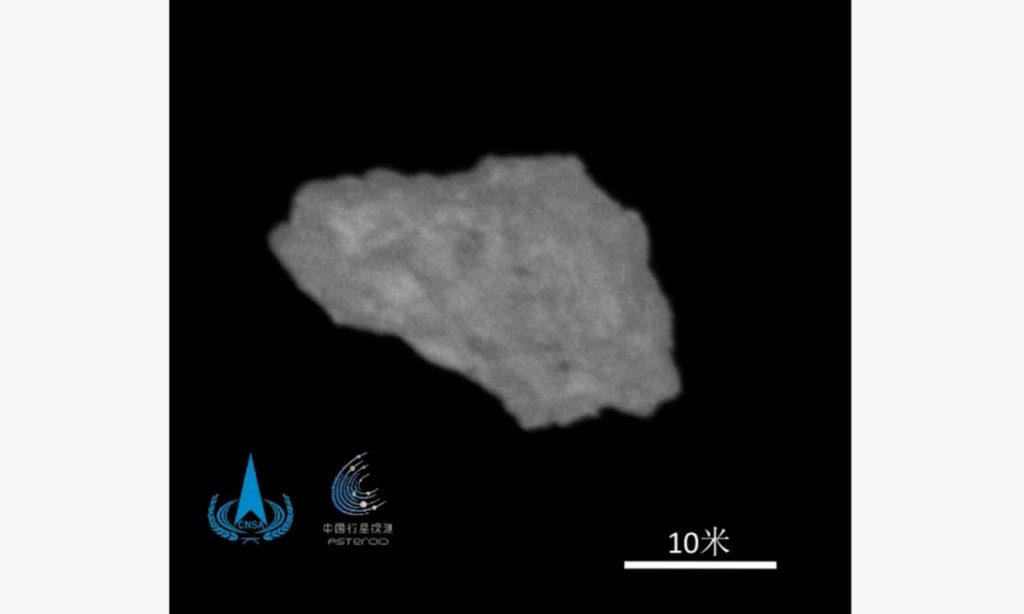
Earth has one Moon. Everyone knows this. But Earth also has something else — a small, rocky companion that has been quietly following our planet around the Sun for at least a million years, oscillating in a looping orbit that never brings it close enough to be gravitationally bound like the Moon, but never lets it drift far away either. It is called Kamoʻoalewa — a Hawaiian word meaning “oscillating celestial object” — and it is one of the strangest objects in the solar system.
What makes Kamoʻoalewa genuinely remarkable is the question of where it came from. Spectroscopic observations from ground-based telescopes suggest its surface reflects light in a pattern consistent with lunar silicate rocks — not asteroid belt material, not primitive carbonaceous material, but rocks similar to those brought back by the Apollo missions. The leading hypothesis, advanced by researchers at the University of Arizona, is that Kamoʻoalewa is a fragment of the Moon — a piece blasted off the lunar surface by a large impact millions of years ago and captured into its current quasi-satellite orbit. If true, it would be the only known natural Earth satellite besides the Moon, composed of actual lunar material.
China’s Tianwen-2 mission, now in active operations at Kamoʻoalewa, is going to find out.
The Mission
Tianwen-2 launched on May 29, 2025, from the Xichang Satellite Launch Center on a Long March 3B rocket. It spent just over a year in cruise, first optically detecting Kamoʻoalewa on June 6, 2026, and progressively closing in before a rendezvous burn on June 7, 2026, brought it into proximity with the asteroid. Orbital insertion into a formal close approach was confirmed on July 4, 2026. The spacecraft has been operating near Kamoʻoalewa ever since.
The mission is China’s second asteroid sample return campaign following the Chang’e sample return programs from the Moon, and marks a significant expansion of CNSA’s planetary science ambitions. Hayabusa and Hayabusa2 established Japan as the world leader in asteroid sample return; OSIRIS-REx proved the United States could do it too. Tianwen-2 positions China in the same company — and does so with a target uniquely interesting to Chinese scientists because of its possible lunar connection.
The Target
Kamoʻoalewa — formally designated 469219 Kamoʻoalewa, provisional designation 2016 HO3 — is a small asteroid between 40 and 100 meters across, roughly the length of a football pitch. It completes one rotation every 28 minutes, spinning rapidly for its size. Its orbit is resonant with Earth’s, meaning it completes one circuit of the Sun in almost exactly one year, keeping it perpetually in Earth’s vicinity — sometimes closer, sometimes further — in a looping, oscillating path that never escapes our gravitational neighborhood but never truly falls into it either. It is one of seven known quasi-moons of Earth.
From Earth’s surface, Kamoʻoalewa is extremely faint — roughly 20th magnitude, requiring large telescopes to observe. Ground-based spectroscopy has been limited by this faintness, which is why the question of its composition and origin has remained open. Tianwen-2’s cameras are now observing it from a few kilometers away, and its sampling instruments will touch the surface directly — providing physical material for laboratory analysis that no telescope, however large, could match.
Sampling Kamoʻoalewa
Tianwen-2 carries three different sampling systems, a design choice driven by uncertainty about what the asteroid’s surface is actually like. The team doesn’t know whether the surface is loose regolith, consolidated rock, or something in between — the weak gravity means surface conditions could be entirely unlike any previously sampled body. Three sampling methods — touch-and-go collection, hovering collection, and anchored drilling — provide redundancy to ensure material is collected regardless of surface properties.
The spacecraft will collect at least 100 grams of surface material and seal it in a vacuum container. Close approach operations will be conducted from progressively lower altitudes — 20 kilometers, 3 kilometers, 600 meters, 300 meters — before sample collection attempts. The entire asteroid operations phase spans from July 2026 to April 2027, giving the team nine months of observation and multiple sampling opportunities.
The Earth Return and What Comes Next
On November 29, 2027, Tianwen-2 will pass by Earth and eject its sample return capsule into the atmosphere. The capsule will reenter at approximately 12 kilometers per second — significantly faster than the Chang’e lunar sample returns due to the higher energy of the asteroid’s orbit — before landing at a designated recovery zone in China. The samples will then be distributed to Chinese research institutions and, likely, to international partners.
But Tianwen-2 itself will not stop there. After releasing the sample capsule, it will use Earth’s gravity to perform a slingshot maneuver that redirects it toward the main asteroid belt and its second target: comet 311P/PANSTARRS, an unusual active asteroid that displays cometary behavior despite orbiting within the asteroid belt. Tianwen-2 will reach 311P around 2035 and conduct a close observation and landing campaign — making it China’s first comet mission and one of only a handful of spacecraft ever to visit a comet.
The two-target architecture mirrors ESA’s Rosetta mission, which orbited Comet 67P and deployed the Philae lander, and Japan’s Hayabusa2, which visited Ryugu before being redirected toward two additional asteroid targets. Tianwen-2 extends this multi-target approach to an entirely new combination: a quasi-moon of Earth and a main-belt active comet.
The Science
The most eagerly anticipated result from Tianwen-2 is the answer to Kamoʻoalewa’s origin question. If the samples show lunar silicate composition matching Apollo samples, it would confirm the asteroid as a genuine fragment of the Moon — the first known natural Earth satellite besides the Moon itself, and a window into the history of lunar impacts and the delivery of material between planetary bodies. If the samples show asteroid belt composition, it would mean the spectroscopic similarity to lunar rocks was coincidental and the object has a conventional origin.
Either answer advances planetary science. The confirmed identification of a lunar fragment in a quasi-satellite orbit would have implications for understanding how material is exchanged between the Moon, Earth, and the near-Earth asteroid population — relevant to the history of Earth’s own geological record and the delivery of water and organic material in the early solar system. A conventional asteroid belt origin would instead refine our understanding of the dynamical mechanisms that place objects into quasi-satellite orbits.
The comet 311P science in 2035 will address different questions — the nature of active asteroids, which display cometary outgassing despite orbiting in the asteroid belt where ice should be unstable, is one of the more puzzling problems in small body science. A spacecraft landing on one would be unprecedented.
China launched its first Mars mission in 2020. It landed on Mars in 2021. It returned samples from the lunar far side in 2024. It arrived at a near-Earth quasi-moon with a sample return spacecraft in 2026. The pace of Chinese planetary science has been remarkable — and Tianwen-2 suggests it is not slowing down.