It was planned for two years. It has been watching the Sun for thirty-one.
When ESA and NASA launched the Solar and Heliospheric Observatory on December 2, 1995, the goal was straightforward: study the Sun from its deep interior to its outer atmosphere, from a stable vantage point at the Sun-Earth Lagrange Point 1 where it could observe our star around the clock without interruption. The original mission was supposed to end in 1997. SOHO is still transmitting science data in 2026 — 11,000 mission days and counting — having survived a crisis that nearly destroyed it, discovered more comets than any instrument in history, and transformed our understanding of the star that makes all life on Earth possible.
The Observatory
SOHO carries twelve science instruments organized around three broad science areas. The helioseismology instruments — GOLF, VIRGO, and MDI/HMI — study the Sun’s interior by measuring oscillations on the solar surface, the same way seismologists use earthquake waves to probe Earth’s interior. Sound waves propagating through the Sun’s interior carry information about temperature, density, and motion at depths utterly inaccessible to any other observation technique. SOHO’s helioseismology data produced the first detailed maps of the Sun’s interior structure and dynamics — revealing the differential rotation of the solar interior, where different layers spin at different speeds, and identifying the global plasma conveyor belt that carries material from the equator to the poles and back on timescales of decades.
The atmosphere remote sensing instruments — EIT, UVCS, SUMER, CDS, and LASCO — study the solar atmosphere from the surface through the corona. The EIT extreme ultraviolet imager produces the iconic full-disk images of the Sun in ultraviolet wavelengths that show the corona’s complex structure — active regions, filaments, coronal holes, and the vast looping structures of magnetic field lines made visible by the plasma trapped within them. LASCO — the Large Angle Spectrometric Coronagraph — blocks the Sun’s disk with an artificial occulter and images the surrounding corona, watching as material is ejected into space in the coronal mass ejections that drive Earth’s most severe space weather events.
The in-situ instruments — CELIAS, COSTEP, and ERNE — measure the solar wind and energetic particles in the immediate environment of the spacecraft, complementing the remote sensing observations with direct sampling of the material flowing outward from the Sun.
The Near-Death of SOHO
In the summer of 1998, SOHO nearly died. During a routine gyroscope maintenance procedure on June 24, a sequence of errors led to the spacecraft losing its orientation, pointing its solar panels away from the Sun and cutting off power. Contact was lost completely. For weeks the spacecraft drifted in darkness, batteries depleted, systems shut down by the cold.
NASA’s Deep Space Network eventually picked up a faint signal from the tumbling spacecraft in late July, using the Arecibo radio telescope to boost the signal enough to confirm SOHO was still there and still intact. A recovery team at ESA and NASA spent weeks carefully warming the spacecraft, restoring power, and re-initializing its systems one by one. By October 1998, all twelve science instruments had been successfully reactivated.
The recovery was considered one of the most remarkable spacecraft rescues in ESA history. The cause — a procedural error during a routine gyroscope test — led to changes in SOHO’s operations procedures and ultimately to the development of gyroless operations mode, which SOHO has been using since 2003 when its last operational gyroscope failed. Flying without gyroscopes for more than two decades while continuing to point precisely at the Sun is itself a remarkable engineering achievement.
The Unexpected Comet Hunter
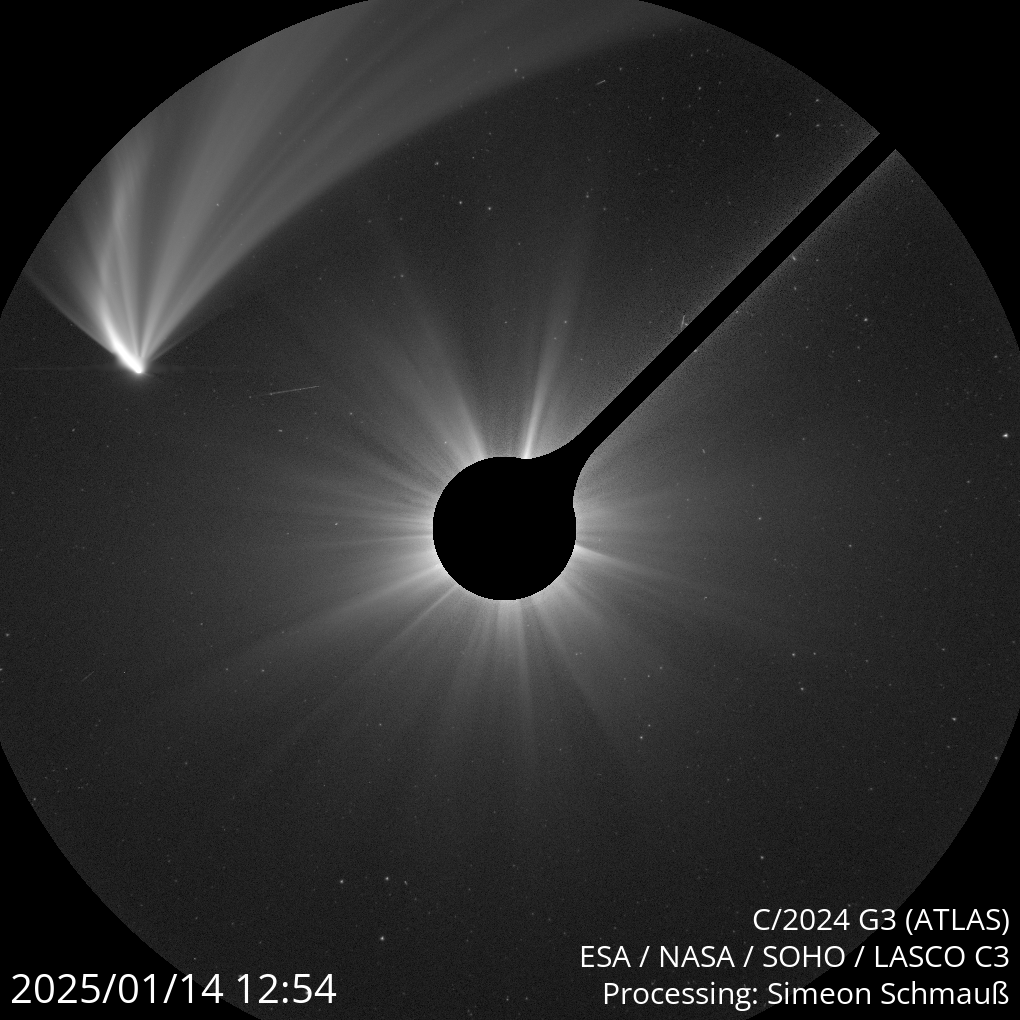
Nobody planned for SOHO to become the most productive comet-finding instrument in history. The LASCO coronagraph was designed to study the solar corona — specifically the large-scale structure of the corona and the eruptions of plasma that produce coronal mass ejections. To do this it images a wide field of view around the blocked solar disk, and in doing so it captures everything else in that field of view — including, as it turned out, comets.
Most of SOHO’s comets are sungrazers — comets on extremely tight trajectories that pass extremely close to the Sun, often within a few solar radii of the surface, frequently disintegrating in the process. Before SOHO, only a few dozen sungrazers were known. The LASCO images, posted publicly online in near-real time, attracted a community of volunteer comet hunters who learned to recognize the faint smudges of sungrazing comets moving through the coronagraph images — and began reporting them in extraordinary numbers.
In March 2024 SOHO discovered its 5,000th comet — a milestone that would have been unimaginable at launch. More than 75 percent of those discoveries were made not by professional astronomers but by volunteers around the world working through the Sungrazer Project run by the Naval Research Laboratory. SOHO has discovered more comets than all other sources in history combined. It is the most successful comet-hunting instrument ever built, despite this never having been part of its mission design.
Thirty-One Years of Solar Watching
SOHO’s longevity has given it a unique scientific capability: it has now observed the Sun through more than two complete solar cycles — the approximately 11-year rhythm of sunspot activity that governs the Sun’s behavior. No other solar observatory has continuous observations spanning this length of time with consistent instrumentation. The long baseline has allowed scientists to study how the Sun changes from cycle to cycle, why some cycles are stronger than others, and what drives the long-term variability of solar output — questions that have direct implications for understanding climate on Earth over centennial timescales.
SOHO’s observations of Solar Cycles 22, 23, 24, and now 25 have documented dramatic differences between cycles. Solar Cycle 24 — which ran from approximately 2008 to 2019 — was the weakest in a century, with remarkably low sunspot activity and reduced solar wind output. Cycle 25, which began in 2019, has been notably more active than predicted, with Solar Maximum arriving in 2024. SOHO observed both extremes with the same instruments, providing a directly comparable dataset that climate scientists and heliophysicists continue to mine.
As of 2026, SOHO operates in gyroless mode, uses its high-gain antenna carefully to work around a pointing restriction imposed by the stuck motor that emerged in 2003, and continues to return science data on Mission Day 11,000 and beyond. Its instruments remain functional. Its coronagraph continues to watch the Sun — and every few days, catches another comet.
Two years was the plan. Thirty-one years is the reality. There is nothing quite like SOHO in the history of solar science.