It was designed for five years. It has enough fuel to keep flying until 2074.
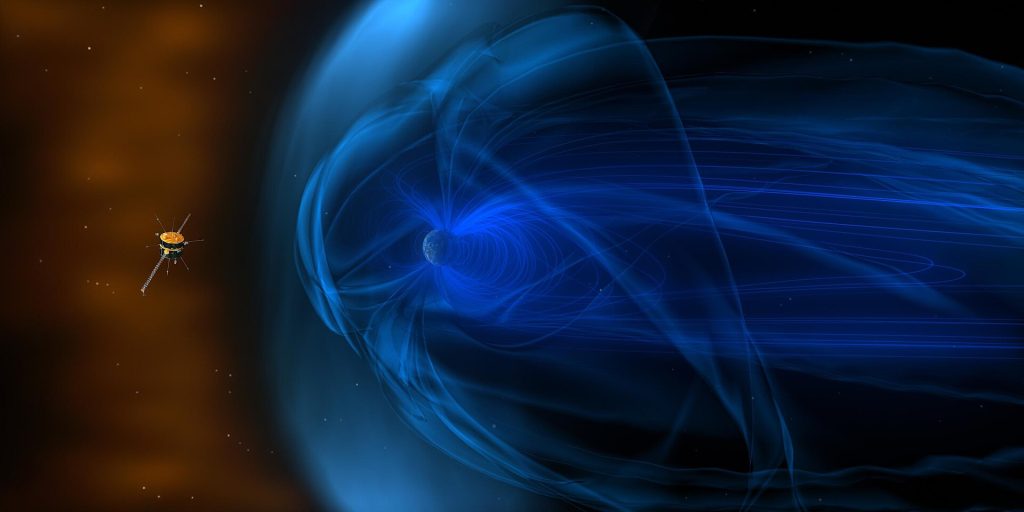
NASA’s Wind spacecraft launched on November 1, 1994, on a Delta rocket from Cape Canaveral — the first of two spacecraft in NASA’s Global Geospace Science program, and one of five missions in the broader International Solar Terrestrial Physics program that also included Japan’s Geotail, NASA’s Polar, and ESA/NASA’s SOHO. Its assignment was straightforward and fundamental: measure the solar wind upstream of Earth as completely as possible, characterizing the constant stream of charged particles flowing outward from the Sun before it reaches our planet and interacts with Earth’s magnetosphere.
Thirty-two years later, Wind is still at L1, still measuring, and still producing science that is actively used by researchers worldwide.
An Unusual Journey to L1
Wind’s path to its permanent station at L1 was anything but direct. The original plan called for the spacecraft to move immediately to the Sun-Earth Lagrange Point 1 and begin solar wind monitoring operations. But when SOHO was designated for L1 operations, and later ACE, mission planners realized they had an opportunity: rather than parking Wind at L1 alongside other solar wind monitors, they could take advantage of Wind’s unique instrument suite by flying it in a series of complex orbits that sampled the solar wind across a much wider range of positions than any fixed L1 orbit could provide.
From 1994 to 2004, Wind executed an extraordinary orbital campaign — 67 petal-shaped orbits through the Earth’s magnetosphere and surrounding space, 10 Earth-Moon wake crossings, and a period at the L2 point on the opposite side of Earth from the Sun. Each orbital variation placed Wind in a different region of near-Earth space, allowing its instruments to characterize the solar wind and its interactions from multiple perspectives that no single fixed orbit could have sampled. The campaign produced a dataset of the solar wind environment around Earth that remains unmatched in its spatial coverage.
The key to Wind’s extraordinary orbital campaign was not fuel but physics. Almost every maneuver in that ten-year program was executed using gravity assists from the Moon and Earth rather than onboard propulsion — a technique called double lunar swingby. Wind would fly past the Moon, use lunar gravity to bend its trajectory, swing out to a large apogee, fall back toward Earth, pass the Moon again from a different angle, and be redirected to an entirely new region of space — essentially for free. The Moon’s gravity was the engine. Mission designers at Goddard became extraordinarily skilled at calculating sequences of lunar flybys that sent Wind almost anywhere in the Earth-Moon neighborhood without spending significant propellant. This is the same principle as the planetary gravity assists used by Voyager and Cassini, applied at a much smaller scale. The fuel saved by flying on gravity rather than thrusters is precisely why Wind still has enough propellant to operate until 2074 — thirty-two years of science, and fifty more years of fuel remaining.
In 2004, with the initial science campaign complete, Wind settled into a permanent halo orbit around L1 — where it has remained for more than twenty years.
Eight Instruments, Eight Thousand Papers
Wind carries eight science instruments covering every aspect of the solar wind environment. The Solar Wind Experiment measures the bulk properties of the solar wind plasma — speed, density, temperature, and flow direction. The Magnetic Field Investigation uses dual triaxial fluxgate magnetometers to measure the interplanetary magnetic field with high precision. The WAVES radio and plasma wave experiment — built by French scientists as the first foreign instrument to fly on a US spacecraft — measures radio and plasma waves across frequencies from a few Hz to 14 MHz, detecting the radio emissions produced by solar energetic particle events, planetary auroras, and plasma instabilities in the solar wind itself. The 3-D Plasma and Energetic Particles experiment, the Energetic Particles Acceleration Composition and Transport investigation, the Solar Wind and Suprathermal Ion Composition instrument, and the Transient Gamma-Ray Spectrometer complete the suite.
Together these instruments provide what scientists describe as a complete characterization of the plasma environment at L1 — every physical parameter needed to understand what the solar wind is doing as it approaches Earth. No other spacecraft has matched Wind’s breadth of simultaneous measurements at a single location.
The scientific output has been extraordinary. By the end of 2025, Wind data had been used in more than 8,515 refereed scientific publications — an h-index of 145, meaning at least 145 Wind papers had each been cited at least 145 times. These numbers place Wind among the most scientifically productive spacecraft in NASA’s history, rivaling missions far larger and more expensive. The spacecraft costs approximately $3 million per year to operate — a scientific return on investment that is essentially without parallel in heliophysics.
What Wind Has Found
Wind’s science contributions span fundamental plasma physics, space weather, and our understanding of how the Sun communicates with Earth. Its WAVES instrument detected for the first time electromagnetic whistler waves propagating in the solar wind — a type of plasma wave previously known only in Earth’s magnetosphere, found by Wind to exist throughout the interplanetary medium. Its plasma instruments characterized the detailed structure of interplanetary shocks — the blast waves driven ahead of coronal mass ejections as they plow through the solar wind — with a precision that has informed every subsequent model of CME propagation.
Wind’s comprehensive plasma measurements have made it the standard reference dataset for heliophysics research. When scientists study events in the solar wind — a magnetic field reversal, an energetic particle burst, the passage of a CME — they routinely turn to Wind data to characterize the ambient conditions surrounding the event. Its long, continuous dataset spanning more than three decades of solar activity captures two complete solar cycles, allowing researchers to study how the solar wind properties change from solar minimum to solar maximum and back again in ways that shorter missions cannot reveal.
The spacecraft’s large halo orbit at L1 — significantly larger than ACE’s orbit — gives it a different vantage point on the solar wind, allowing multi-point studies when combined with ACE, SOHO, and more recently IMAP. Three-point observations of the same solar wind feature from different positions reveal its spatial structure in ways that single-spacecraft measurements cannot.
A Spacecraft Built to Last
Wind was built with longevity in mind from the beginning. Every effort was made during design to reduce stress on its instruments and maximize operational lifetime. The result is a spacecraft that, after 32 years, still has seven of its eight instruments operating largely or fully functionally. The eighth — the Transient Gamma-Ray Spectrometer — completed its primary mission and was powered down. Every particle and fields instrument remains active.
The fuel situation is remarkable. Wind has enough propellant to maintain its L1 orbit until approximately 2074 — fifty more years from today. The limiting factor on Wind’s mission will not be fuel, not power, not instrument degradation, but eventually the slow failure of electronics that no amount of engineering can indefinitely forestall. When Wind finally falls silent, it will have been the longest-operating heliophysics mission in history by a very wide margin.
As of 2026, Wind continues to operate in good health, returning approximately 9,400 datasets per day to NASA’s Space Physics Data Facility. Its data are freely available online, downloaded thousands of times per day by researchers on every continent. A spacecraft launched the year after the World Wide Web went public, designed to last five years, is still doing science that nobody has found a way to replicate — and will likely still be doing it when everyone working on it today has retired.