There is a ghost around Earth. You cannot see it. Most people have never heard of it. But it is there — a vast, tenuous cloud of hydrogen atoms extending from roughly 300 miles above Earth’s surface out past the Moon, glowing faintly in ultraviolet light, shaped and reshaped by the solar wind and by the same atmospheric chemistry that produces water and methane at lower altitudes. It is called the geocorona, and for most of the history of space exploration it has been essentially invisible — glimpsed a handful of times, never continuously observed, never fully mapped.
George Carruthers saw it first.
The Man Who Built the First Lunar Observatory
George Robert Carruthers was born in Cincinnati, Ohio, on October 1, 1939. His father was a civil engineer at Wright-Patterson Air Force Base. He was obsessed with science from childhood — building his first telescope at age ten from cardboard tubes and mail-order lenses, spending hours in the Chicago public library reading everything he could find about astronomy and rockets. He was quiet and focused in school, performing better in science fairs than in classrooms. He enrolled at the University of Illinois Urbana-Champaign, earning a bachelor’s degree in physics in 1961, a master’s in 1962, and a doctorate in aeronautical and astronautical engineering in 1964.
After a postdoctoral fellowship funded by the National Science Foundation, Carruthers joined the Naval Research Laboratory in Washington — where he would spend his entire career, working until his retirement in 2002. In an era when the doors of American science were frequently closed to Black researchers, Carruthers built instruments that looked at the universe in ways nobody else had thought to look.
His specialty was ultraviolet astronomy — observing the cosmos at wavelengths blocked by Earth’s atmosphere, accessible only from space. In 1969 his rocket-borne ultraviolet camera made the first detection of molecular hydrogen in interstellar space — a fundamental discovery about the composition of the medium between the stars. But his most significant instrument came three years later.
In April 1972, Apollo 16 astronaut John Young carried a gold-plated Far Ultraviolet Camera/Spectrograph onto the lunar surface and set it up in the shadow of the lunar module. The camera had been designed and built by George Carruthers at the Naval Research Laboratory. From its vantage point on the Moon — far enough from Earth to see it whole — it captured the first view of Earth’s geocorona: a diffuse ultraviolet glow surrounding the planet, extending far further into space than anyone had expected. It was the first astronomical observatory ever operated on the surface of another world.
That camera is still on the Moon. It has been sitting at the Apollo 16 landing site in the Descartes Highlands since April 1972, more than fifty years ago.
George Carruthers died of congestive heart failure on December 26, 2020. He never knew a spacecraft would bear his name.
The Geocorona
Solar ultraviolet radiation breaks apart water and methane molecules in Earth’s upper atmosphere, releasing hydrogen atoms light enough to escape into the exosphere. Once there, those hydrogen atoms are illuminated by the Sun’s Lyman-alpha ultraviolet emission and glow faintly — a ghostly halo extending past the Moon and possibly beyond. This is the geocorona. It is what Carruthers photographed from the Moon in 1972, and what the observatory named after him is now watching continuously from L1.
From Earth’s surface, the geocorona is invisible — the atmosphere itself blocks the ultraviolet wavelengths at which it emits. From low Earth orbit, the perspective is too close to see it whole, like trying to see a fog bank from inside the fog. The global view requires distance — at minimum several hundred thousand kilometers, ideally more than a million. The Sun-Earth L1 point, approximately 1.5 million kilometers from Earth, is the ideal vantage.
The Carruthers Geocorona Observatory’s principal investigator, Lara Waldrop of the University of Illinois Urbana-Champaign — George Carruthers’ alma mater — described the measurement gap plainly: “We’ve never had a mission before that was dedicated to making exospheric observations.” Carruthers’ Apollo 16 camera saw it once, from one vantage point. This mission will watch it continuously.
The Spacecraft and Its Instruments
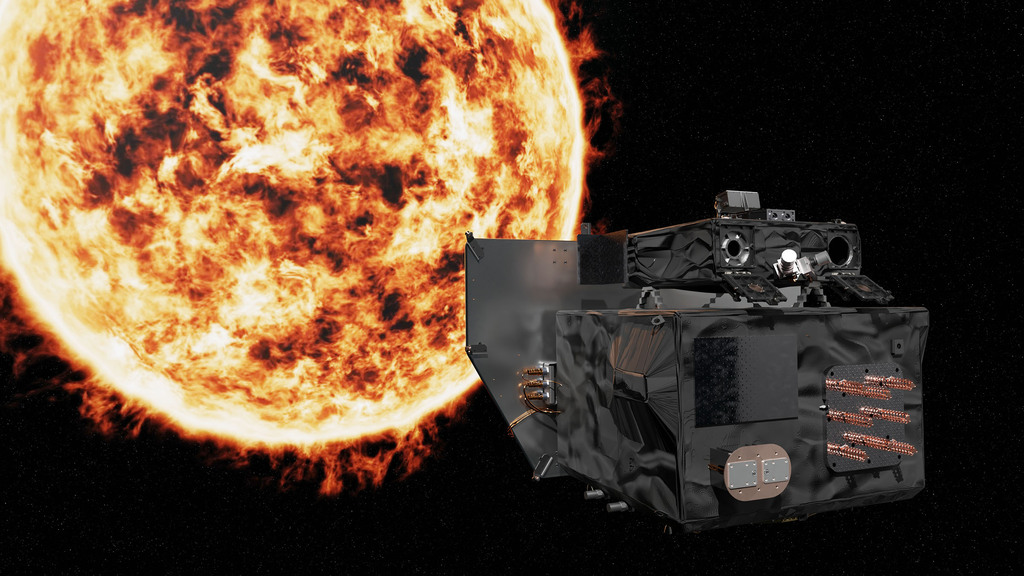
The Carruthers Geocorona Observatory is a SmallSat — a small satellite approximately the size of a loveseat, weighing 240 kilograms, built by BAE Systems. It is the first NASA SmallSat ever to operate at L1 — a milestone that reflects both the maturation of small satellite technology and NASA’s growing confidence in deploying capable science instruments on compact platforms.
The observatory carries two ultraviolet imagers: a narrow-field camera for detailed close-up observations of specific exospheric structures, and a wide-field camera for global context — capturing the full extent of Earth’s hydrogen halo in a single image. Together they allow Waldrop’s team at the University of California Berkeley mission operations center to produce what she describes as continuous ultraviolet movies of the geocorona — tracking how it expands and contracts, brightens and dims, responds to solar storms and seasonal changes in real time.
The data transmission cadence is modest by modern standards — the spacecraft sends data to Earth twice per week through NASA’s Deep Space Network — but the science it carries is rich. Each transmission brings new frames in a film of Earth’s invisible atmosphere that has never been shot before.
Science Phase
The Carruthers Geocorona Observatory launched on September 24, 2025, deployed from the same Falcon 9 upper stage as IMAP and SWFO-L1, and successfully acquired signal the same day. After cruising to L1 and completing instrument checkouts, it began full science operations in March 2026 — as planned.
Early results reported at the NOVAC public meeting in March 2026 by PI Waldrop confirmed the spacecraft was obtaining both narrow- and wide-field images of the ultraviolet geocorona at unprecedented spatial resolution and temporal cadence. The first false-color close-up images of Earth’s outer atmosphere had already been returned by late 2025, showing the structure of the hydrogen halo in detail that no previous observation had approached.
The primary mission is planned for two years — through 2027 — though the spacecraft carries enough fuel to operate for ten years or longer. If the instruments remain healthy, the Carruthers Geocorona Observatory could observe the exosphere through an entire solar cycle, watching how Earth’s invisible halo responds to the Sun’s 11-year rhythm of activity across its full range.
Why It Matters
Understanding the exosphere matters for several reasons that extend beyond pure science. The geocorona interacts directly with the solar wind and with Earth’s magnetosphere — understanding its structure and dynamics is relevant to space weather modeling and to understanding how Earth’s atmosphere slowly loses material to space over geological time. The hydrogen in the exosphere was once water and methane in the lower atmosphere. Tracking it reveals something about the long-term water cycle at planetary scales.
The mission also has implications for the search for life beyond Earth. By studying the physics and atmospheric signature of the one planet we know supports life — including the exospheric glow that is one of its observable characteristics — Carruthers provides a template for what to look for when future telescopes examine the atmospheres of Earth-like exoplanets. Understanding what Earth’s own outer atmosphere looks like from outside is the necessary first step toward recognizing it somewhere else.
George Carruthers spent his career looking at the universe in ultraviolet — the invisible light that reveals what ordinary telescopes cannot see. The camera he built for Apollo 16 showed for the first time that Earth has a halo. The spacecraft bearing his name is now watching that halo from a million and a half kilometers away, continuously, for the first time in history.
His camera still sits on the Moon. His observatory circles the L1 point. The work continues.