On September 1, 1859, a telegraph operator in Pittsburgh watched sparks fly from his equipment, set fire to his paper tape, and disconnected from the system. Similar scenes played out at telegraph offices across North America and Europe. The culprit was a coronal mass ejection — a billion-ton cloud of magnetized plasma ejected from the Sun that struck Earth’s magnetic field and triggered the most powerful geomagnetic storm in recorded history. It is called the Carrington Event, and if it happened today, it would be a civilization-altering catastrophe.
The modern world is far more vulnerable to space weather today than during the telegraph era. Power grids spanning continents can be induced to failure by geomagnetic currents. GPS satellites can be disrupted. Communications satellites can be damaged or destroyed. Airlines reroute polar flights to avoid radiation exposure. Astronauts shelter in shielded modules. The economic cost of a Carrington-scale event has been estimated in the trillions of dollars.
The only defense is warning. And warning requires a sentinel at L1.
The Space Weather Forecasting Problem
Earth’s space weather forecasting infrastructure has long depended on a chain of aging satellites at the Sun-Earth Lagrange Point 1 — the gravitationally stable position approximately 1.5 million kilometers toward the Sun where spacecraft can continuously monitor the solar wind before it reaches Earth. The solar wind, traveling at 400–800 kilometers per second, takes between 10 and 60 minutes to cover that final stretch from L1 to Earth. That window is all the warning available before a geomagnetic storm arrives.
For decades, NASA’s Advanced Composition Explorer — ACE, launched in 1997 — was the primary source of solar wind data at L1. NOAA’s DSCOVR satellite, launched in 2015, took over as the primary operational space weather monitor. Both grew old. ACE’s instruments degraded. DSCOVR experienced technical issues. The gap between their capabilities and the needs of modern space weather forecasting grew year by year.
NOAA’s response was the Space Weather Follow On program — a new generation of operational space weather satellites designed specifically for the forecasting mission, with next-generation instruments offering improved performance, faster data delivery, and redundant monitoring capability. The first of these — originally called SWFO-L1, renamed SOLAR-1 upon reaching operational orbit — launched on September 24, 2025.
The Spacecraft
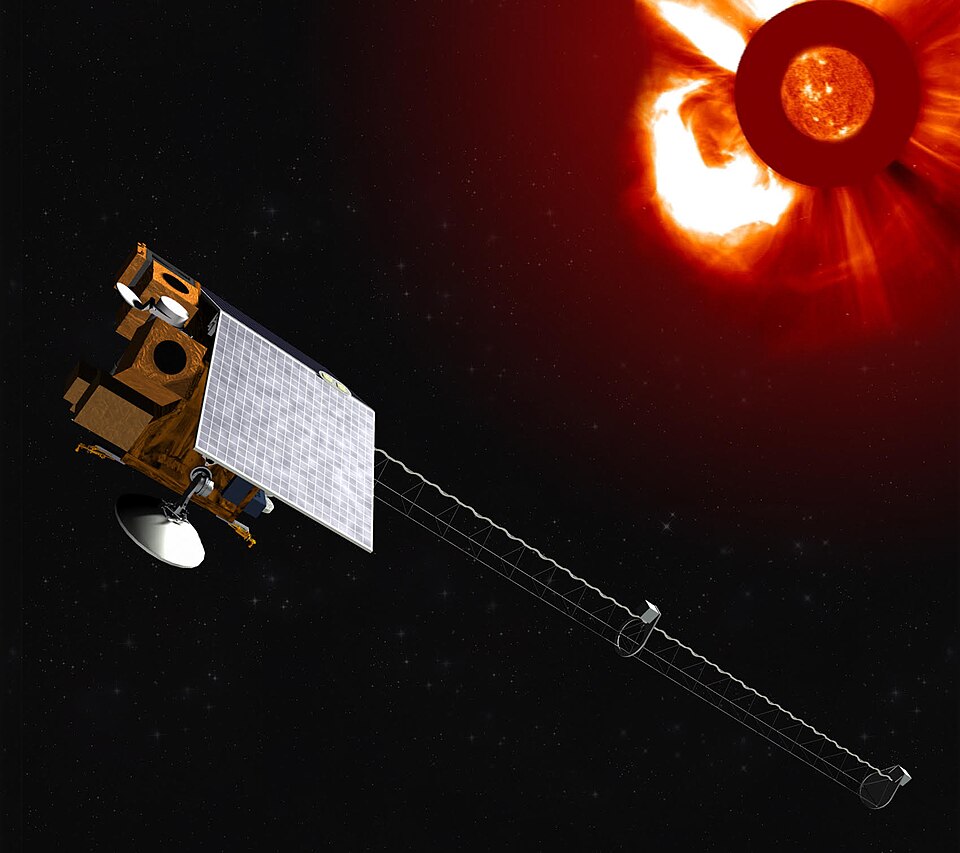
SOLAR-1 was built by BAE Systems and weighs 377 kilograms at launch — compact and efficient, designed specifically for operational rather than research purposes. Where research satellites often carry complex instruments optimized for scientific discovery at the cost of operational simplicity, SOLAR-1 carries four instruments chosen for reliability, data quality, and the specific needs of the space weather forecasters who will use its data in real time.
The Space Weather Instrument Suite — SWIS — comprises three instruments that together characterize the solar wind environment. The Solar Wind Plasma Sensor — SWiPS — measures the bulk properties of the solar wind plasma: speed, density, and temperature, the fundamental parameters that determine how energetic an incoming storm will be. The SupraThermal Ion Sensor — STIS — measures higher-energy ions that are the leading edge of solar energetic particle events — the radiation bursts that pose the most immediate threat to astronauts and high-altitude aircraft. The Magnetometer — MAG, developed with contributions from the Institute for Space Research in Graz, Austria — measures the interplanetary magnetic field carried by the solar wind, the single most important parameter for predicting the severity of a geomagnetic storm. When the magnetic field in the solar wind points southward — opposite to Earth’s own field — it connects with Earth’s magnetosphere and drives the most intense storms.
The fourth instrument is CCOR-2 — the Compact Coronagraph-2 — which blocks the Sun’s disk with an artificial occulter and images the surrounding corona, detecting coronal mass ejections as they leave the Sun and tracking them through the interplanetary medium toward Earth. Previous coronagraphs at L1 — principally SOHO’s LASCO — required large, complex optics. CCOR-2 is a compact design that achieves comparable capability in a fraction of the mass and volume, a testament to decades of miniaturization in space instrument technology.
From Launch to Operations
SOLAR-1 launched on September 24, 2025, as a rideshare payload on the same Falcon 9 that carried IMAP and the Carruthers Geocorona Observatory from Kennedy Space Center. Six days after launch, on September 30, the SWiPS instrument was powered on and returned its first solar wind plasma data — the first operational measurements from the new generation of L1 space weather monitoring.
The spacecraft reached its final orbital position at L1 on January 23, 2026, completing its final engine burn and entering the halo orbit it will maintain for the duration of its mission. On that date it was officially renamed SOLAR-1 — the first in a planned series of Space Weather Next observatories that NOAA intends to use to ensure continuous L1 monitoring for decades to come. The CCOR-2 coronagraph opened its door for the first time on January 21, beginning its imaging campaign of the solar corona.
In March 2026, NASA formally handed over operations to NOAA, transitioning the mission from development and launch phase to full operational status. NOAA’s Space Weather Prediction Center in Boulder, Colorado — the 24/7 operational center that issues watches, warnings, and alerts for space weather events — began incorporating SOLAR-1 data into its official forecasts in spring 2026. The aging ACE and DSCOVR satellites, their operational roles now transferred, were formally stood down from primary space weather monitoring duties on June 30, 2026.
The Warning Window
From its position at L1, SOLAR-1 sees the solar wind approximately 10 to 60 minutes before it reaches Earth — the exact lead time depending on the speed of any particular solar wind stream or coronal mass ejection. Ten to sixty minutes is not much time. It is enough to issue alerts to power grid operators, who can pre-position their systems to reduce vulnerability to geomagnetically induced currents. It is enough for satellite operators to put their spacecraft in safe mode. It is enough for airline dispatchers to reroute polar flights away from radiation exposure. It is enough for the International Space Station to shelter its crew.
What it is not enough for is comprehensive preparation against a Carrington-scale event. A storm of that magnitude arriving with 30 minutes of warning would still cause enormous damage to an unprepared grid. NOAA’s longer-term space weather architecture envisions solar wind monitors positioned much further from Earth — at sub-L1 positions achieved by solar sails, which could provide hours rather than minutes of warning. SOLAR-1 is a critical first step and a significant improvement over its predecessors; it is also the current best available tool in a field that knows it needs better ones.
SOLAR-2 and Beyond
SOLAR-1 is the first of a planned series. SOLAR-2 and subsequent observatories in NOAA’s Space Weather Next program will extend and expand the operational monitoring capability at L1 and potentially at other vantage points, ensuring that the warning chain is never broken by a single point of failure. The lesson of ACE and DSCOVR — that aging operational satellites with no confirmed replacements create dangerous gaps in critical infrastructure monitoring — has been clearly internalized.
In 1859 there was no warning. The telegraph operators felt the sparks and disconnected. Today, a sentinel 1.5 million kilometers from Earth watches the solar wind continuously, measures the magnetic field that determines whether a storm will be mild or severe, and sends its data to Boulder where forecasters issue the warnings that protect the grid, the satellites, and the people who depend on both.
The Carrington Event will happen again. The question is whether we will see it coming.