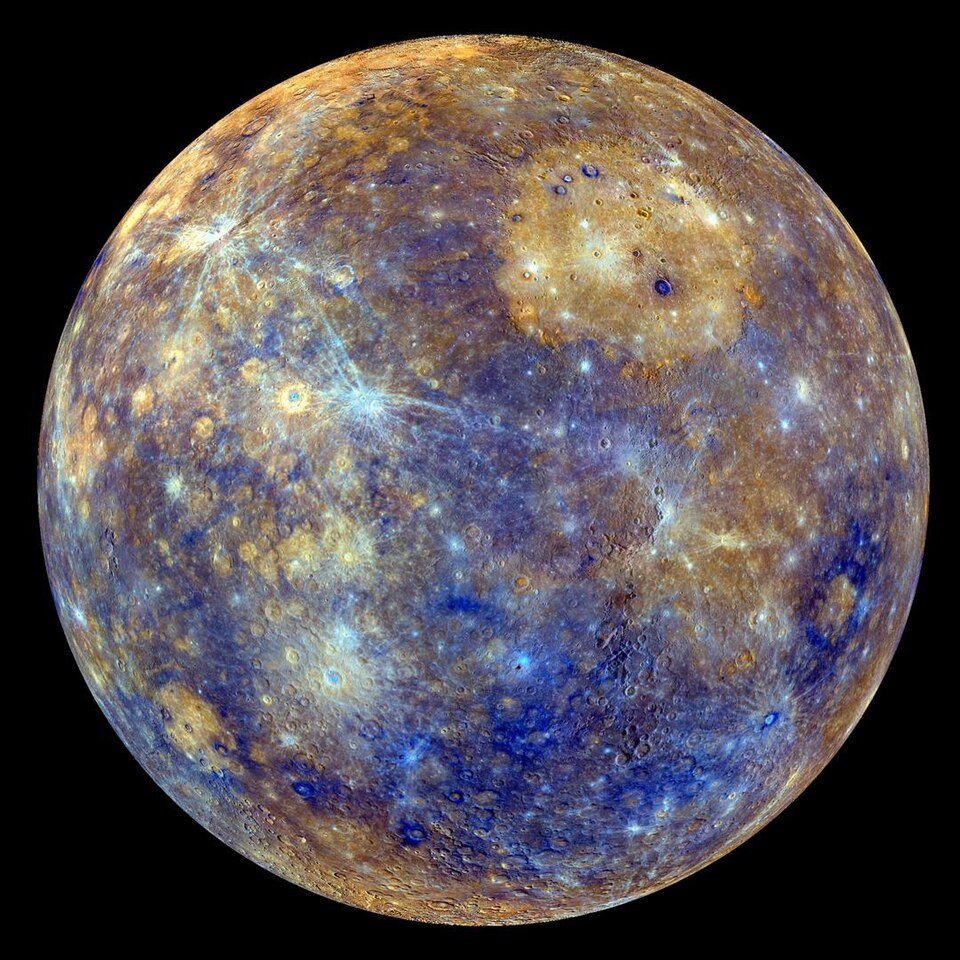
Mercury is the closest planet to the Sun, and one of the hardest to reach. For three decades after Mariner 10 flew past it in the 1970s, more than half of its surface had never been seen. NASA’s MESSENGER changed that. Launched in 2004, it spent nearly seven years working its way inward through the solar system, became the first spacecraft ever to orbit Mercury in 2011, and spent four years revealing a planet far stranger than anyone expected. Then, out of fuel, it crashed into the surface it had mapped.
A name with two meanings
MESSENGER stands for MErcury Surface, Space ENvironment, GEochemistry, and Ranging, and it’s also a nod to Mercury, the messenger of the Roman gods. The spacecraft was designed and built by the Johns Hopkins University Applied Physics Laboratory (APL) in Maryland, which also ran mission operations. Sean Solomon of the Carnegie Institution of Washington led the science team. The mission cost under $450 million, inexpensive for a planetary mission.
The hard part: slowing down
Reaching Mercury is not mainly a problem of distance; it’s a problem of speed. A spacecraft heading toward the Sun falls deeper into its gravity, speeding up all the way. To enter orbit around a small planet moving that fast, a spacecraft has to shed an enormous amount of velocity, more than any rocket could provide on its own.
MESSENGER’s solution was a long, looping route with six gravity assists. After launching on a Delta II rocket from Cape Canaveral on August 3, 2004, it swung past Earth in August 2005, Venus in October 2006 and June 2007, and then Mercury itself three times, in January 2008, October 2008 and September 2009. Each encounter traded away some of its speed. During the second Mercury flyby, MESSENGER passed within 199.4 km of the surface, just 0.6 km from its target altitude.
The flybys did science, too. They imaged large stretches of the planet that Mariner 10 never saw.
On March 18, 2011, after a journey of about 7.9 billion kilometers, MESSENGER fired its engine and became the first spacecraft to orbit Mercury.
Surviving the heat
At Mercury, sunlight is up to 11 times more intense than at Earth. MESSENGER’s main defense was a ceramic-cloth sunshade, 2.5 meters tall and 2 meters wide, that kept the spacecraft body in shadow. Its seven science instruments, along with a radio science experiment, worked behind that shield: cameras, a laser altimeter to measure the terrain, a magnetometer, and spectrometers that read the chemical makeup of the surface and thin atmosphere.
What MESSENGER found
Ice on the hottest planet’s doorstep. Mercury’s surface can top 400°C, yet MESSENGER confirmed water ice in polar craters whose floors never see sunlight. Some of that ice is covered by a dark layer, about 20 to 30 centimeters thick according to Solomon, of material rich in organic compounds.
A planet full of volatiles. Scientists expected a planet so close to the Sun to be baked dry of easily vaporized elements. Instead, MESSENGER found a surface rich in sulfur, potassium, sodium and chlorine, with less iron than expected. That surprised theorists who had argued Mercury formed in, or was scorched by, extreme heat.
Hollows. MESSENGER discovered bright, shallow depressions ranging from about 18 meters to more than a kilometer across. They look younger than the craters they sit in, and may form as heat and solar activity break down freshly exposed surface material. Nothing like them is known elsewhere in the solar system.
A shrinking world. Long cliffs, called fault scarps, crossing the surface show that Mercury has contracted as its large iron core cooled, more than scientists had estimated.
An off-center magnetic field. Mercury’s magnetic field turned out to be offset far to the north of the planet’s center, a puzzle for theories of how planetary magnetic fields are generated.
Volcanoes and a comet-like tail. Deposits from explosive eruptions show that volcanism shaped Mercury over much of its history. The planet also trails a thin atmosphere with a comet-like tail.
Extra innings and a final plunge
MESSENGER was designed to work for one year in orbit. Its primary mission ended on March 17, 2012; NASA extended it twice, eventually into 2015. By the end, it had completed 4,105 orbits and returned about 10 terabytes of data, including more than 200,000 images taken from orbit.
In its final months, MESSENGER flew lower and lower, capturing its sharpest views of the surface. It ran out of hydrazine propellant on April 6, 2015. Engineers then used leftover helium pressurant gas as makeshift thrust to keep it aloft a few weeks longer.
On April 30, 2015, at about 19:26 UTC, MESSENGER struck Mercury’s northern hemisphere at roughly 14,000 km/h, on the far side from Earth. NASA’s science chief John Grunsfeld described it as “going out with a bang.” The impact likely left a crater about 16 meters across.
Legacy
MESSENGER turned Mercury from the least-known rocky planet into a world with an atlas, a chemistry and a geologic history. Its discoveries shaped the questions for the next mission: Europe and Japan’s BepiColombo, now arriving at Mercury, which may even spot the small crater MESSENGER left behind.