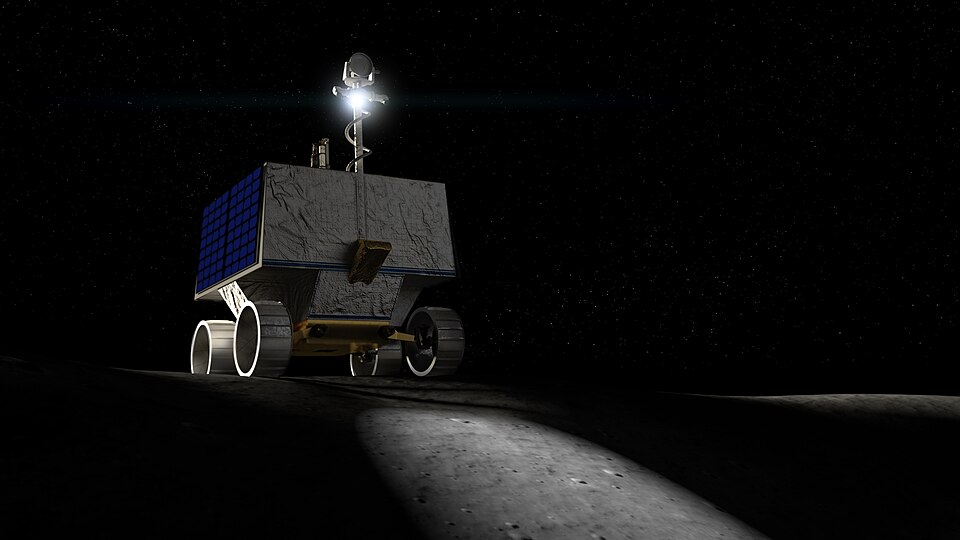
Every plan for living on the Moon comes back to one question: where is the water? Water ice, if there’s enough of it in the right places, could give future astronauts drinking water, breathable oxygen and even rocket fuel, without hauling it all up from Earth. Orbiting spacecraft have found strong signs of ice in craters near the lunar south pole. But nobody has driven up to that ice and measured it.
That’s VIPER’s job. NASA’s Volatiles Investigating Polar Exploration Rover is designed to drive into the Moon’s permanently shadowed craters and find out how much ice there is, where it is, and whether it’s worth digging up. It’s also the rover that almost didn’t fly: canceled in 2024 after it was already built, and brought back a year later.
Why the south pole?
The Moon’s axis is barely tilted, so near the poles the Sun always sits low on the horizon. The floors of some craters there haven’t seen sunlight in billions of years, and they’re among the coldest places in the solar system. Water molecules that drift into them freeze and stay put.
Missions like NASA’s Lunar Reconnaissance Orbiter and India’s Chandrayaan-1 found evidence of ice from orbit. What they couldn’t tell scientists is how the ice is spread out. Is it in thick sheets or scattered grains? Right at the surface or buried? Pure or mixed with soil? Those answers decide whether ice is a resource or a curiosity. VIPER is designed to answer them on the ground.
The rover
VIPER is about the size of a golf cart and weighs 430 kg. It was managed by NASA’s Ames Research Center in California, with the rover itself designed at NASA’s Johnson Space Center in Houston. It will spend about 100 Earth days on the surface.
It carries four science instruments:
- Neutron Spectrometer System (NSS): detects hydrogen beneath the surface, a sign of water, as VIPER drives, flagging places worth a closer look.
- TRIDENT: a drill, built by Honeybee Robotics, to bring up soil from below the surface for analysis.
- Near InfraRed Volatiles Spectrometer System (NIRVSS): identifies water and other compounds in the soil and the drilled material.
- Mass Spectrometer Observing Lunar Operations (MSolo): measures gases released from the soil, revealing what volatiles are present.
Working at the south pole takes some unusual design choices. With the Sun so low and shadows so long, VIPER will need to carry its own power into shadowed areas, running on its batteries alone until it drives back into sunlight to recharge. It is also the first rover to carry its own headlights, so it can see where it’s going in places that are permanently dark.
Canceled and revived
VIPER grew out of an earlier NASA concept called Resource Prospector, which was canceled in 2018. NASA announced VIPER in October 2019 at an estimated cost of $250 million, and in 2020 it chose Astrobotic’s Griffin lander to deliver it. As the work went on, costs and schedules grew. By 2021, NASA’s estimate for the full mission had risen to $433.5 million.
In July 2024, NASA canceled the project, citing cost increases and launch delays. By then, the rover was fully assembled, though not yet fully tested. NASA had spent about $450 million on it and expected to save $84 million by stopping.
The reaction was swift. Scientists objected that NASA was abandoning a finished rover just short of launch; an open letter gathered more than 2,500 signatures, and a House committee asked NASA to explain. In early 2025, NASA asked companies for proposals to fly the existing rover. On September 19, 2025, it selected Blue Origin, under a task order worth up to $190 million, to deliver VIPER to the Moon on a second Blue Moon MK1 lander.
Griffin, the lander originally built for VIPER, kept its contract with a new rover on board. It now flies as NASA’s Moon Base II.
Not a done deal yet
There’s an important condition. NASA has so far funded only the first part of Blue Origin’s contract: designing how the lander will carry VIPER and safely lower it to the surface. NASA will decide whether to go ahead with the delivery itself after reviewing that work, and after Blue Origin’s first Blue Moon MK1 lander flies. That first flight is Moon Base I, now expected no earlier than early 2027.
Timing matters too. NASA says VIPER has to land by late 2027 to make its science window, when sunlight and communication conditions at the landing site suit a 100-day mission. That leaves little room for further delays.
Destination: Mons Mouton
VIPER is headed for Mons Mouton, a broad mountain near the western edge of Nobile Crater in the south pole region. That’s the same neighborhood where Griffin is now heading as Moon Base II. From there, VIPER is to drive to several small, permanently shadowed regions to measure the ice directly.
NASA says the data will help inform future astronaut landing sites, and that’s the bigger point. NASA plans to build its Moon base near the south pole. Knowing exactly where the water is could help decide exactly where to build it.
One of three rovers
VIPER is the first of three very different rovers in NASA’s lunar plans. It’s robotic and goes first, as a scout. Next, astronauts will get an open, Apollo-style rover for short drives near their landers. Later, Japan’s pressurized Lunar Cruiser will let crews travel far from base for weeks at a time.
| VIPER | Lunar Terrain Vehicle | Lunar Cruiser | |
|---|---|---|---|
| Built by | NASA | Commercial companies for NASA | JAXA and Toyota |
| Crew | None (robotic) | 2 astronauts in spacesuits | 2 astronauts, no spacesuits inside |
| Enclosed? | — | No, open like Apollo’s rover | Yes, pressurized cabin |
| Arrives | Late 2027 | 2028, for Artemis V | No earlier than 2032 |
| Job | Find and map water ice | Short drives near the landing site | Trips of up to 30 days |
Together they form a sequence: VIPER shows where the resources are, the Lunar Terrain Vehicle lets astronauts start working near their landing sites, and the Lunar Cruiser lets them range across the south pole region.
What’s riding on it
VIPER is a test of more than ice. Its revival is a test of NASA’s commercial approach to the Moon: a government-built science rover riding on a privately owned lander. If Moon Base I succeeds and VIPER lands on schedule, NASA will finally get the measurement it has wanted for more than a decade. If it doesn’t, the most capable ice-prospecting rover ever built could end up in storage for good.