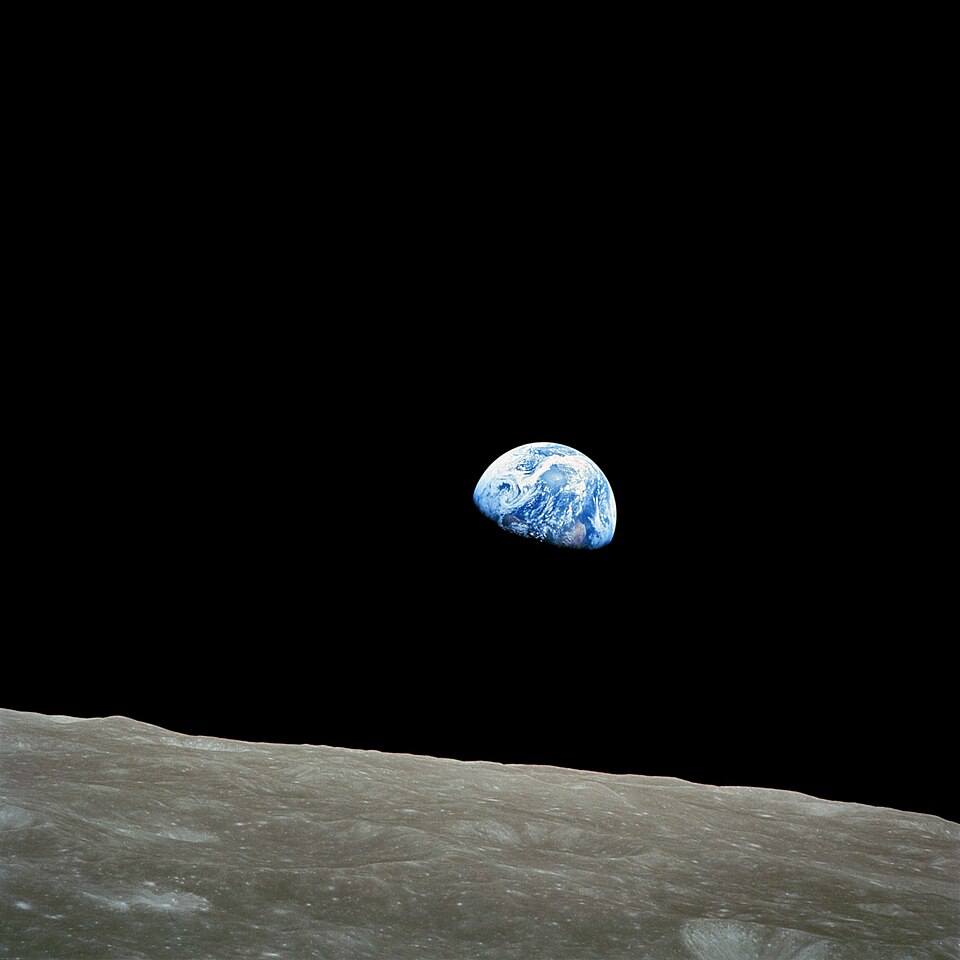
Until December 1968, every human who had ever flown in space had stayed close to home, no more than a few hundred kilometers above the planet. Then three astronauts rode the most powerful rocket ever built away from Earth entirely, crossed nearly 400,000 kilometers of empty space, and swung into orbit around the Moon on Christmas Eve. Apollo 8 was the first time people saw the Earth as a whole world hanging in the dark, and the photograph they brought back changed how many people thought about their planet.
A mission rewritten in a hurry
Apollo 8 was never meant to go to the Moon. In the original plan, it would test the lunar module, the spidery craft that would one day land astronauts, in orbit around Earth. But in June 1968 the lunar module arrived at Kennedy Space Center with more than a hundred significant defects. It clearly wouldn’t be ready that year.
NASA was also under pressure. In January 1967, a fire during a launch rehearsal had killed the three-man crew of Apollo 1, and the program had spent most of the year since recovering. Meanwhile, the Soviet Union was flying its Zond spacecraft around the Moon. In September 1968, Zond 5 carried tortoises and other living creatures around the Moon and returned them safely to Earth, and many suspected a crewed Soviet flight could follow.
In August 1968, NASA manager George Low proposed a bold change: since the command and service module would be ready well before the lunar module, why not send it to the Moon without one? NASA Administrator James Webb approved it. With only about four months’ notice, Apollo 8 became the first crewed mission to the Moon.
The crew
Commander Frank Borman led the mission. Jim Lovell, the command module pilot, served as navigator, and Bill Anders, officially the lunar module pilot despite having no lunar module, handled the spacecraft’s systems. Borman and Lovell had flown together for two weeks on Gemini 7; Anders was making his first flight.
Riding the Saturn V
On December 21, 1968, at 7:51 a.m. Eastern time, Apollo 8 lifted off from Launch Complex 39A at Kennedy Space Center. It was the first time astronauts had flown on the Saturn V, and only the third Saturn V launch ever. The previous flight, uncrewed, had suffered serious vibration problems. Few missions have asked more of a crew’s trust in a machine.
After less than three hours in Earth orbit, the third stage fired again to send the spacecraft toward the Moon. For the first time, people left Earth’s orbit, passed through the radiation belts that surround the planet, and watched Earth shrink behind them.
Behind the Moon
On December 24, Apollo 8 passed behind the Moon. Out of radio contact with Earth, the crew fired the engine to slow down and enter lunar orbit. If the burn failed, they would have no way to tell Mission Control, which waited in silence until the spacecraft reappeared on schedule.
Over the next 20 hours, Apollo 8 circled the Moon 10 times, as low as about 110 km above the surface. The crew became the first humans to see the far side with their own eyes, and they photographed the surface, including possible landing sites for future missions. Their descriptions were not romantic. The Moon, Lovell said, was “essentially gray, no color.”
Earthrise
On the fourth orbit, as the spacecraft came around from behind the Moon, Earth rose over the lunar horizon. “Oh my God,” Anders said, “look at that picture over there!” He grabbed a camera loaded with black-and-white film, then scrambled for color film and took the shot.
“Earthrise” shows a blue and white Earth, half in shadow, above the barren gray surface of the Moon. It became one of the most reproduced photographs in history; Life magazine later called it the first of its “100 Photographs That Changed the World.” Many people credit it with helping inspire the modern environmental movement. “We came all this way to explore the Moon,” Anders said later, “and the most important thing is that we discovered the Earth.”
A Christmas Eve broadcast
On their ninth orbit, on Christmas Eve, the crew made a live television broadcast. After describing the view, the three astronauts took turns reading the opening verses of the Book of Genesis. Borman closed with: “Good night, good luck, a Merry Christmas and God bless all of you, all of you on the good Earth.”
At the time, it was the most-watched television broadcast in history. Estimates suggest about a quarter of the people alive on Earth saw it, live or later.
Coming home
Early on Christmas Day, again behind the Moon, the crew fired the engine to head home. When the spacecraft came back into contact, Lovell announced: “Please be informed, there is a Santa Claus.” Capsule communicator Ken Mattingly replied, “That’s affirmative. You are the best ones to know.”
On December 27, Apollo 8 hit Earth’s atmosphere at nearly 40,000 km/h, the fastest humans had ever traveled, and splashed down in the Pacific Ocean southwest of Hawaii. The aircraft carrier USS Yorktown recovered the crew. The flight had lasted just over six days.
Legacy
Apollo 8 proved that people could fly to the Moon, navigate there and back, and survive the journey. It cleared the way for the landing seven months later. Time magazine named Borman, Lovell and Anders its “Men of the Year” for 1968, a year otherwise marked by war, assassinations and unrest in the United States. One of the best-remembered reactions came in a telegram the crew received after their return: “Thank you, Apollo 8. You saved 1968.”