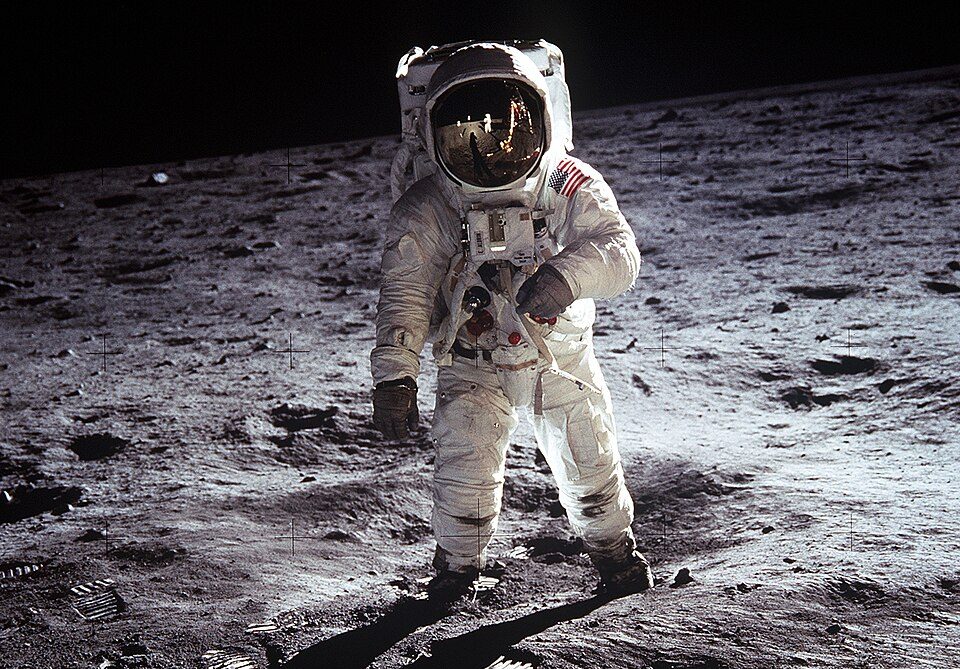
On May 25, 1961, President John F. Kennedy asked Congress to commit the United States to “landing a man on the Moon and returning him safely to the Earth” before the decade was out. At the time, America’s total experience of human spaceflight was a single 15-minute suborbital hop. Eight years and two months later, Neil Armstrong stepped off a ladder onto the Sea of Tranquility. Apollo 11 remains the most famous space mission ever flown, and the moment when humans first set foot on another world.
The crew and their spacecraft
Commander Neil Armstrong, a former test pilot, had flown Gemini 8 and calmly saved it from a dangerous spin. Lunar module pilot Buzz Aldrin, who had a doctorate from MIT on orbital rendezvous, had set a spacewalking record on Gemini 12. Command module pilot Michael Collins had also flown on Gemini and would stay in lunar orbit while the other two landed.
They named their spacecraft for the occasion. The command module was Columbia, after Jules Verne’s fictional moonship Columbiad. The lunar module was Eagle, the national bird.
Launch
On July 16, 1969, at 9:32 a.m. Eastern time, the Saturn V lifted off from Kennedy Space Center’s Launch Complex 39A, watched in person by an estimated million people around the Cape. Three days later, the spacecraft entered lunar orbit, and on July 20, Armstrong and Aldrin climbed into Eagle, undocked from Columbia, and began their descent.
Thirteen minutes to Tranquility
The descent nearly went wrong several times. Communication with Earth kept dropping out. Then the lunar module’s computer flashed alarms, codes 1202 and 1201, that the crew didn’t recognize. The computer was overloaded with tasks; it was designed to drop the less important ones and keep flying. In Mission Control, young guidance officer Steve Bales, backed by computer specialist Jack Garman, judged it safe and called “Go.”
Closer to the surface, Armstrong saw that the computer was steering them toward a crater strewn with boulders the size of cars. He took semi-manual control and flew Eagle beyond it, looking for a clear spot, while fuel ran low. Mission Control called out warnings as the propellant dropped. Controllers believed about 25 seconds of fuel remained before the crew would have to abort; later analysis showed it was closer to 50.
At 4:17 p.m. Eastern time on July 20, 1969, Eagle touched down. “Houston, Tranquility Base here,” Armstrong reported. “The Eagle has landed.” Capsule communicator Charlie Duke answered: “You got a bunch of guys about to turn blue. We’re breathing again.”
One small step
About six and a half hours after landing, Armstrong climbed down Eagle’s ladder. At 10:56 p.m. Eastern time, he placed his left boot on the Moon and said: “That’s one small step for [a] man, one giant leap for mankind.” The word “a” is hard to hear in the recording. Armstrong always said he meant to say it.
About 600 million people watched the grainy black-and-white television broadcast live, the largest audience in history at the time. Aldrin joined Armstrong about 20 minutes later and described the view as “magnificent desolation.”
Two and a half hours on the surface
Their moonwalk lasted 2 hours and 31 minutes. They planted an American flag, took photographs, collected rocks and soil, and set up experiments. A seismometer listened for moonquakes. A laser retroreflector, a panel of mirrors, is still there today, and observatories on Earth still bounce lasers off it to measure the distance to the Moon to within centimeters. They took a phone call from President Richard Nixon. Before climbing back into Eagle, they left behind a plaque mounted on the lander’s leg:
“Here men from the planet Earth first set foot upon the Moon July 1969, A.D. We came in peace for all mankind.”
In all, they collected 21.55 kg of lunar material, the first samples of another world ever brought to Earth.
The loneliest man
While Armstrong and Aldrin were on the surface, Collins circled the Moon alone in Columbia. Every two hours he passed behind the Moon, out of contact with everyone. He later wrote that he felt not loneliness but awareness and satisfaction, and he knew that if anything went wrong on the surface, he would have to fly home alone.
Homecoming
After more than 21 hours on the Moon, Eagle’s ascent stage lifted off on July 21 and rejoined Columbia in orbit. On July 24, Columbia splashed down in the Pacific Ocean southwest of Hawaii. The crew was recovered by the USS Hornet, where President Nixon greeted them through the window of a quarantine trailer; because no one could be certain the Moon held no germs, the astronauts were isolated for about three weeks.
Legacy
Apollo 11 met Kennedy’s goal with five months to spare. It ended the race to the Moon and showed what people could do with determination, engineering and enormous public investment. Five more Apollo crews would land through 1972, but the first footprints set the image the world remembers. More than half a century later, as Artemis prepares to send astronauts back to the Moon, Apollo 11 is still the benchmark every lunar mission is measured against.