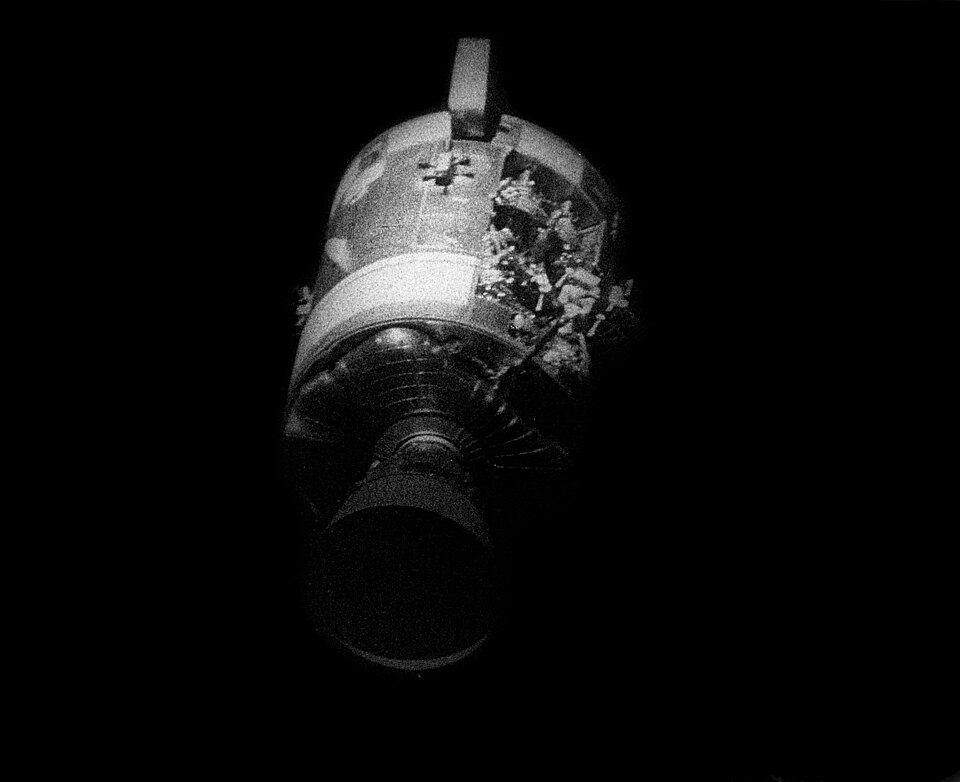
By April 1970, America had landed on the Moon twice in four months, and much of the public had already stopped paying attention. Apollo 13 was supposed to be the third landing, and the TV networks didn’t even carry the crew’s broadcast live. Then, almost 56 hours into the flight and about 330,000 kilometers from Earth, an oxygen tank exploded inside the spacecraft. For the next four days, the world watched as three astronauts tried to get home in a spacecraft that was losing power, water and heat.
A crew changed at the last minute
The commander was Jim Lovell, a veteran of Apollo 8 and the first person to fly into space four times. Fred Haise would land with him as lunar module pilot. The command module pilot was supposed to be Ken Mattingly.
A week before launch, backup crew member Charlie Duke came down with German measles. Mattingly had never had the disease and wasn’t immune, and NASA couldn’t risk him falling ill alone in lunar orbit. Two days before launch, he was replaced by his backup, Jack Swigert. Mattingly never got sick.
Trouble from the start
Apollo 13 launched from Kennedy Space Center at 2:13 p.m. on April 11, 1970. Five and a half minutes into the flight, the center engine of the Saturn V’s second stage shut down two minutes early, shaken by violent vibrations called “pogo.” The remaining engines burned longer to make up the difference, and the spacecraft reached orbit close to plan. It was a scare, but it turned out to be the smaller of the mission’s problems.
The crew were headed for Fra Mauro, a hilly region the scientists wanted because its rocks were thought to have been blasted out by the impact that formed the giant Imbrium basin.
“Houston, we’ve had a problem”
On the evening of April 13, Mission Control asked Swigert to do a routine chore: turn on the fans that stirred the supercritical oxygen in the service module’s tanks because without gravity it tended to separate into layers. At 55 hours, 54 minutes and 53 seconds into the mission, the crew heard a loud bang. The spacecraft shook, and warning lights came on.
“Okay, Houston, we’ve had a problem here,” Swigert said. When Mission Control asked him to repeat it, Lovell answered: “Houston, we’ve had a problem. We’ve had a Main B Bus undervolt.”
Within minutes it was clear how bad it was. Oxygen tank 2 had failed, and tank 1 was leaking. Lovell looked out the window and saw a cloud of gas venting into space. That oxygen fed the fuel cells, which produced the command module’s electricity and water. Without it, the command module Odyssey had only a few hours of battery power, and those batteries had to be saved for reentry.
The Moon landing was over. The question now was whether the crew could get home at all.
The lifeboat
The answer was the lunar module, Aquarius. It had its own batteries, oxygen and water, all designed to support two men for about two days on the Moon. Now it had to support three men for about four days.
The crew powered down Odyssey and moved into Aquarius. Before the command module’s computer shut down, Lovell had to transfer its navigation alignment to the lunar module’s computer by hand. He did the arithmetic himself, and Mission Control checked it.
In Houston, flight director Gene Kranz and his team began working out how to stretch every amp of power and every ounce of water. Engineers ran simulations around the clock to test procedures before reading them up to the crew. Mattingly, the astronaut left on the ground, worked in the simulators to develop the procedure for restarting the frozen command module before reentry.
Around the Moon and back
Apollo 13 had left the “free-return” path to aim for Fra Mauro, so on its own it would loop around the Moon and miss Earth. About five and a half hours after the explosion, the crew fired the lunar module’s descent engine, the one meant to land them on the Moon, to put the spacecraft back on course for home.
On April 14, Apollo 13 swung around the far side of the Moon at a distance of 400,171 kilometers from Earth. No humans had ever been farther from home, and none would be again for 56 years, until Artemis II in 2026. Two hours after that, the crew fired the descent engine again, a burn of 4 minutes and 23 seconds that cut about 12 hours off the trip and moved the splashdown to the Pacific, where the recovery ships were.
Duct tape and plastic bags
Then came a new threat: carbon dioxide. The lunar module’s air filters, canisters of lithium hydroxide, were meant for two men for two days, and they were running out. The command module had plenty of spare canisters, but they were square, and the lunar module’s openings were round.
Engineers on the ground built an adapter using only items the crew had on board: plastic bags, cardboard from the flight plan covers, a hose from a spacesuit, and duct tape. Astronaut Joseph Kerwin read the step-by-step procedure up to Swigert and Haise, who built the “mailbox,” as it became known. The carbon dioxide levels started to drop.
Cold, thirsty and exhausted
To save power, almost everything was turned off, including the heaters. The temperature in the cabin dropped to 38°F (3°C), and water condensed on every wall. Sleep was almost impossible. The crew cut their water to six ounces each per day, about a fifth of the normal amount. Haise developed a fever and a urinary infection. Together, the crew lost 31.5 pounds, nearly 50 percent more than any other Apollo crew.
Coming home
On April 17, the crew released the damaged service module and saw for the first time what had happened. A whole side panel was gone. “There’s one whole side of that spacecraft missing,” Lovell radioed. They photographed the damage, then powered up Odyssey from its batteries, a restart no one had ever tried in flight. They climbed back into the command module and let Aquarius go.
Odyssey splashed down in the South Pacific at 1:07 p.m. Houston time, about 6.5 kilometers from the recovery ship USS Iwo Jima. The crew had been in space for nearly six days.
What went wrong
NASA’s review board, which included Neil Armstrong, traced the explosion to a chain of problems that began years earlier. Oxygen tank 2 had originally been installed in Apollo 10’s service module and was damaged when it was removed. Later, during a test on the launch pad, the tank’s heaters were run on 65 volts, though its thermostatic switches had been designed for 28. The switches welded shut, and wiring inside the tank was heated to around 1,000°F, damaging the Teflon insulation. When Swigert turned on the fans in flight, the bare wires sparked and set the tank on fire.
All later Apollo flights carried a redesigned oxygen tank with improved switches and wiring, plus a third tank in a separate bay of the service module.
A successful failure
President Nixon awarded the Presidential Medal of Freedom to the crew and to the Mission Operations Team in Houston. Lovell, who never got another chance to walk on the Moon, called Apollo 13 a “successful failure.” It never landed, and it brought back no Moon rocks. What it showed was how NASA handled a crisis: the engineers, flight controllers and crew solved one problem after another until all three astronauts were safely home.
Apollo 14 landed at Fra Mauro nine months later, in February 1971.