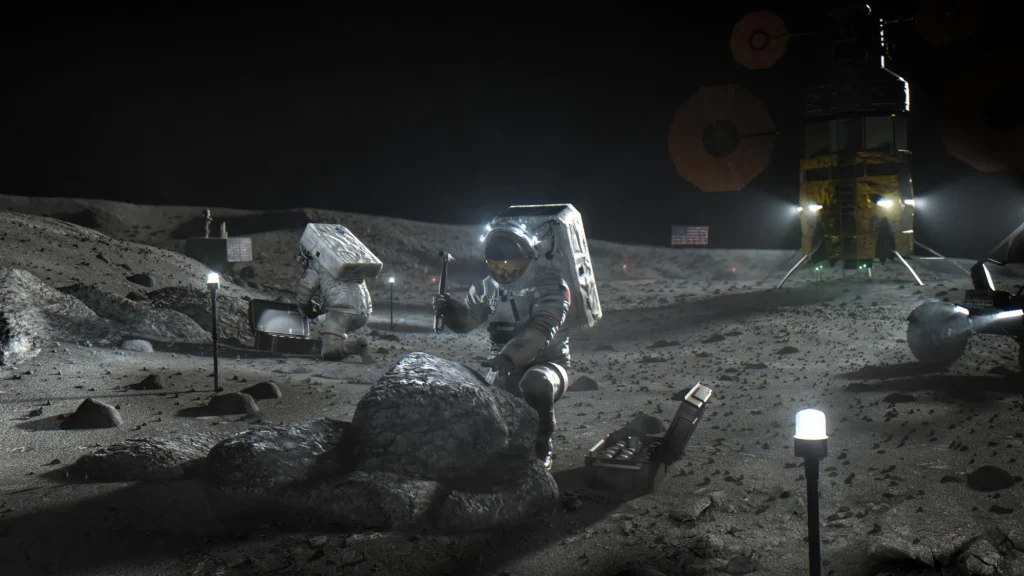
When Apollo ended in 1972, it ended with a final landing and no plan to come back. Artemis is being built the opposite way. Under the plan NASA laid out in 2026, the first Artemis landing in early 2028 is meant to be followed within months by a second one, and the second one is where the real work begins. Artemis V, targeted for late 2028, is the mission NASA expects to start building its permanent base on the Moon.
A mission rewritten
Artemis V has changed more than almost any mission in the program. Until early 2026, it was planned for no earlier than 2030 as the program’s third landing. Its crew would first fly to Gateway, a small space station planned for orbit around the Moon, and install two new pieces of hardware there: ESA’s ESPRIT refueling and communications module and Canada’s Canadarm3 robotic arm. Only then would two astronauts head down to the surface.
That plan disappeared in two steps. On March 3, 2026, NASA restructured Artemis. It added a new test mission in Earth orbit, renumbered the missions that followed, and set an aggressive new pace: “one lunar mission per year” after the 2027 test flight. Three weeks later, on March 24, Administrator Jared Isaacman paused Gateway and redirected the program toward a base on the lunar surface.
Artemis V came out of the restructuring two years earlier and with a different purpose. NASA now “anticipates launching this lunar surface mission by late 2028,” and says it is “when NASA is expected to begin building its Moon base.”
Where it fits
Artemis II, flown in April 2026, sent four astronauts around the Moon and back, the first humans beyond low Earth orbit since 1972. Artemis III, now planned for no earlier than late 2027, stays close to home: astronauts in Orion will practice docking with one or both of the commercial lunar landers in Earth orbit. Artemis IV, targeted for early 2028, is the first Artemis landing.
Artemis V follows as the second landing, and will be the first one that isn’t primarily a test.
The hardware
The crew will launch from Kennedy Space Center’s Launch Complex 39B on NASA’s Space Launch System. Starting with Artemis IV, NASA is standardizing SLS, replacing the temporary upper stage used on the first three flights with a new one, and dropping plans for the larger Exploration Upper Stage. Reports in March 2026 said NASA had selected United Launch Alliance’s Centaur V for that role.
The crew rides in Orion, built by Lockheed Martin, with a European Service Module built by Airbus for ESA providing power and propulsion. Orion carries the astronauts to the Moon, where two of them transfer to a lander for the trip down to the surface and back.
Which lander hasn’t been decided. NASA has contracts with both SpaceX, for a lunar version of Starship, and Blue Origin, for its Blue Moon lander. “Lander readiness will determine which provider will safely carry them to the surface,” NASA says. Artemis III’s Earth-orbit docking tests are meant partly to answer that question.
On the surface
The two astronauts will land in the lunar south polar region and spend about a week on the surface. They’re expected to have NASA’s Lunar Terrain Vehicle waiting for them: an open, unpressurized rover, similar in concept to Apollo’s lunar rover but built to work in the harsh conditions of the south pole. NASA plans to deliver its first Lunar Terrain Vehicles in 2028 aboard Blue Origin cargo landers.
The south pole is the reason for the whole effort. Some of its craters never see sunlight and are thought to hold water ice, which future crews could turn into drinking water, breathable oxygen and rocket fuel. Nearby high ground gets sunlight for long stretches, which helps with solar power.
Starting the base
NASA hasn’t said exactly what the Artemis V crew will build. Its Moon Base plan describes a three-phase effort. Phase 1, running through 2028, focuses on reliable access to the surface, with up to 21 robotic cargo landings, early rovers and hopping drones, and communications satellites. Phase 2, from 2029 to 2032, brings crewed missions every six months, surface solar arrays, radioisotope power units, communications towers, and JAXA’s pressurized rover, the Lunar Cruiser. Phase 3, from 2033, adds habitats and the use of lunar resources.
Artemis V sits at the hinge between the first two phases: the point where landings stop being primarily about getting there and start being about staying.
The Mission After the First
The second mission to anywhere tends to get less attention than the first. Apollo 12 is far less famous than Apollo 11. But for Artemis, the second landing may matter more than the first one. If Artemis V flies on schedule, only months after Artemis IV, it will show that NASA can return to the Moon as a routine, rather than an event, and that is what a base requires.