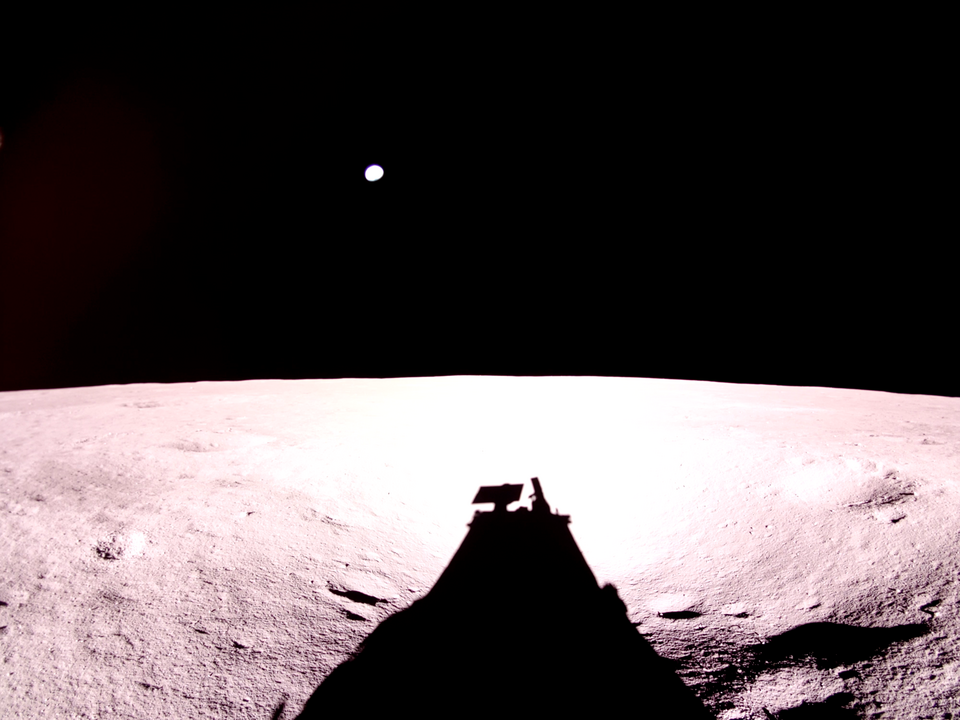
Two private companies had attempted to land on the Moon before Firefly Aerospace. One crashed. One tipped over. On March 2, 2025, Firefly Aerospace became the first commercial company to complete a fully successful soft landing on the lunar surface — touching down precisely, staying upright, activating every payload, and operating for a complete lunar day before the Sun set and the batteries faded.
The mission was called Ghost Riders in the Sky. It worked perfectly.
The Lander
Blue Ghost is a compact, four-legged lunar lander designed and built entirely by Firefly Aerospace at its facilities near Austin, Texas. It stands roughly two meters tall, weighs approximately 550 kilograms, and is powered by solar panels generating up to 400 watts — enough to operate the lander’s systems and all 10 science payloads simultaneously during the lunar day. Its main engine and attitude thrusters handle the powered descent from lunar orbit to the surface; its navigation system uses optical terrain relative navigation to identify its exact position in the final descent and land within a 100-meter target zone.
The lander launched on January 15, 2025, from Space Launch Complex 40 at Cape Canaveral on a SpaceX Falcon 9. After separating from the upper stage, it spent approximately 45 days in a series of increasingly lunar-targeted orbits — a fuel-efficient trajectory that required patience but preserved propellant for the final descent. On March 2, 2025, at 2:34 a.m. CST, Blue Ghost touched down in Mare Crisium near the ancient volcanic feature Mons Latreille — within its 100-meter landing ellipse, upright, and in communication with Earth.
Mare Crisium
Mare Crisium — the Sea of Crises — is one of the most visually distinctive features on the lunar near side, a dark oval basin roughly 500 kilometers wide that stands out clearly to the naked eye on the right edge of a rising full Moon. It formed approximately 3.9 billion years ago when an enormous impact excavated a vast basin that was subsequently filled with basaltic lava — the dark volcanic rock that defines the lunar maria. Its relatively flat, smooth floor made it an ideal landing site for a first commercial mission: fewer boulders, fewer slopes, fewer risks.
The landing site near Mons Latreille was selected specifically for its geological interest — Mons Latreille is a small volcanic dome, and the surrounding terrain preserves a record of ancient volcanic activity and the processes that have shaped Mare Crisium over billions of years.
Ten Payloads, Ten Successes
Blue Ghost carried 10 NASA science and technology demonstration payloads — every one of which activated successfully after landing, a record for any lunar mission of this complexity.
The Lunar GNSS Receiver Experiment — LuGRE, developed jointly by NASA and the Italian Space Agency — detected GPS and Galileo signals at the lunar surface for the first time in history, demonstrating that Earth’s navigation satellite constellations can be used to provide position, navigation, and timing services at the Moon. The finding has direct implications for future crewed Artemis missions, which will require precise navigation on the lunar surface.
Stereo Cameras for Lunar Plume-Surface Studies — SCALPSS — imaged the interaction between Blue Ghost’s engine exhaust and the lunar surface during the final descent, characterizing how rocket plumes disturb and redistribute lunar regolith. This data is critical for designing landing pads and surface infrastructure that won’t be sandblasted by incoming spacecraft.
The Lunar Magnetotelluric Sounder — LMS — measured the Moon’s electrical conductivity at depth, probing the subsurface structure and thermal state of the lunar interior in ways that complement seismic data.
Lister — a drill mounted on the bottom of the lander — drilled into the lunar regolith and measured subsurface thermal properties, characterizing how heat flows through the lunar soil — information essential for understanding the thermal environment that future astronauts and habitats will need to manage.
The Heliospheric X-ray Imager — LEXI — captured X-ray images of Earth’s magnetosphere from the lunar surface — the first time the boundary between Earth’s magnetic field and the solar wind had been imaged in X-ray from another world.
The Radiation-tolerant Computer — RadPC — operated throughout the transit and surface mission, demonstrating computing hardware that can withstand the radiation environment of deep space and the lunar surface — critical for future long-duration missions.
Additional payloads characterized lunar dust behavior, measured surface electrostatic properties, and demonstrated new power and communications technologies. Every one returned data. Over 14 days of surface operations, Blue Ghost transmitted more than 110 gigabytes of science data to Earth.
The Eclipse
On March 14, 2025 — 12 days into the surface mission — Blue Ghost witnessed something no spacecraft had ever photographed from the lunar surface: a total lunar eclipse, as seen from the Moon. From the Moon’s perspective, a lunar eclipse is a solar eclipse — Earth passes directly between the Moon and the Sun, blocking sunlight and casting a shadow across the lunar surface. Blue Ghost’s cameras captured high-definition imagery of Earth’s shadow moving across the Moon, and Earth itself silhouetted against the Sun — a view of our planet’s atmosphere glowing red around its edges as it refracted the light of every sunrise and sunset on Earth simultaneously.
The images were among the most visually striking ever returned from the lunar surface — and a reminder that science and beauty are not mutually exclusive.
The End
Blue Ghost was designed to operate for one lunar day — approximately 14 Earth days. It operated for 14 days and five hours, pushing slightly past the design point into the lunar night before the solar panels could no longer generate power and the batteries depleted. Last contact was received on March 16, 2025 at 23:25 UTC.
The lander remains at its landing site in Mare Crisium — precisely located, intact, a permanent fixture of the lunar landscape. It was the first fully successful commercial soft landing on the Moon. It won’t be the last — Firefly is already preparing Blue Ghost Mission 2 for the far side.