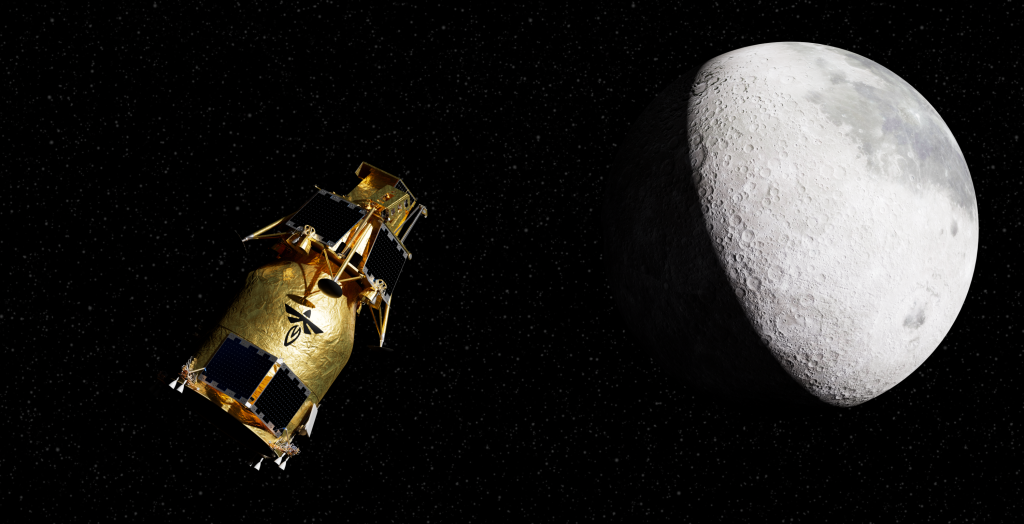
Firefly Aerospace landed on the Moon for the first time on March 2, 2025. The Blue Ghost lander touched down at Mare Crisium on the near side, completed 14 days of surface operations — the longest commercial mission on the lunar surface to date — and declared the mission a complete success. Less than two years later, Firefly is going back. This time, it is going to the other side.
Blue Ghost Mission 2 — funded under NASA’s Commercial Lunar Payload Services program at $112 million — will attempt the first commercial landing on the Moon’s far side, carrying a radio telescope that wants to hear the universe’s first light, a rover from the United Arab Emirates, a seismic experiment from Australia, and a European communications relay that will stay in orbit long after the lander’s mission is complete. It is one of the most internationally diverse lunar missions ever assembled, and its primary science payload will attempt something no instrument has ever done: listen to the cosmic Dark Ages from the only place on Earth’s neighborhood that is quiet enough to hear them.
The Three-Spacecraft Architecture
Blue Ghost Mission 2’s architecture is more complex than its predecessor. Where the first Blue Ghost mission flew as a single lander, Mission 2 stacks three spacecraft together for launch:
Elytra Dark is Firefly’s new orbital transfer vehicle — a reusable space tug designed to carry payloads from Earth orbit to their final destinations. For this mission, Elytra will carry the entire stack into a lunar transfer trajectory and then into lunar orbit, where it will release ESA’s Lunar Pathfinder satellite and then provide the communications relay that Blue Ghost’s far side landing will require.
ESA’s Lunar Pathfinder is a small communications relay satellite built by SSTL in the United Kingdom and funded by ESA’s commercialization initiative. Once released by Elytra into lunar orbit, it will provide continuous communications services for missions on the lunar far side and south pole — locations that have no direct line of sight to Earth and depend on orbital relays to transmit data. In exchange for a free ride to lunar orbit on the CLPS contract, ESA is giving NASA access to Lunar Pathfinder’s relay services. The satellite is designed to support multiple future missions and is planned to operate for at least seven years.
Blue Ghost is the lander — a Firefly-designed, 550-kilogram vehicle with four landing legs, a main engine, attitude thrusters, and a payload deck capable of carrying up to 150 kilograms to the lunar surface. After Elytra delivers it to lunar orbit, Blue Ghost will separate and execute its own powered descent to the far side surface, operating for more than 10 days before the lunar night ends operations.
The Far Side Problem
The Moon’s far side is permanently turned away from Earth — a consequence of tidal locking that has kept one hemisphere hidden from our planet since the Moon formed. This creates a fundamental communications problem: no signal from the far side can reach Earth directly. Radio waves do not bend around the Moon. A spacecraft on the far side is in complete communication blackout with Earth unless an orbital relay is in position overhead.
China solved this problem for its Chang’e 4 mission in 2019 by placing the Queqiao relay satellite at the Earth-Moon Lagrange Point 2 before landing the first spacecraft ever on the far side. Blue Ghost Mission 2 solves it differently: Elytra Dark and Lunar Pathfinder together provide the relay infrastructure that allows Blue Ghost to operate on the far side and transmit its data home.
The far side is also scientifically distinguished from the near side in a way that makes it uniquely valuable for radio astronomy. Earth is a noisy planet — the electromagnetic cacophony of radio transmissions, radar systems, satellites, and electrical infrastructure blankets the near side of the Moon with radio frequency interference that drowns out the faintest signals from the universe. The far side, permanently shielded by 1,700 kilometers of rock from all of Earth’s noise, is the most radio-quiet environment accessible to any instrument within the inner solar system. For a radio telescope trying to detect signals from the earliest epoch of the universe, the far side of the Moon is the best address available.
LuSEE-Night: Listening for the First Light
The primary science payload on Blue Ghost Mission 2 is LuSEE-Night — the Lunar Surface Electromagnetic Experiment at Night, developed by a partnership of NASA, the Department of Energy’s Brookhaven National Laboratory, and the University of California Berkeley. It is a radio telescope designed to operate during the two-week lunar night, when the absence of solar radiation allows its extremely sensitive antennas to listen for signals that are otherwise completely overwhelmed.
The signals LuSEE-Night is trying to detect are ancient beyond imagination. The cosmic Dark Ages were the period between approximately 380,000 years and one billion years after the Big Bang — the era before the first stars and galaxies formed, when the universe was filled with neutral hydrogen gas that absorbed almost all light. The only radiation that emerged from this period was the faint 21-centimeter emission line of neutral hydrogen, redshifted by cosmic expansion to frequencies between 10 and 200 MHz — frequencies easily observable from the far side of the Moon but completely buried under terrestrial radio interference from anywhere on Earth.
If LuSEE-Night can detect this signal, it would provide the first observational window into the Dark Ages — the period that bridged the hot plasma of the early universe and the first luminous structures. It would constrain models of primordial structure formation, dark matter, and the physics of the epoch of reionization when the first stars ionized the surrounding hydrogen gas. The Department of Energy describes it as an attempt to make “first-of-its-kind measurements of the so-called Dark Ages of the Universe.”
A common misconception is that the Moon’s far side is permanently dark — it is not. The Moon rotates on its axis once every 27.3 days, the same period as its orbit around Earth, which is why we always see the same face. But that rotation means the far side receives a full lunar day of sunlight followed by a full lunar night of darkness, cycling continuously just like the near side. LuSEE-Night takes advantage of both phases. During the 14-Earth-day lunar day, its solar panels recharge the batteries while the instrument remains dormant — solar radiation creates interference that would overwhelm the faint signals it is trying to detect. During the 14-Earth-day lunar night, with no solar interference and the Moon blocking all noise from Earth, LuSEE-Night activates and begins its observations. The name says it directly: this is a night instrument. Over a planned two-year mission — roughly 26 day-night cycles — it will accumulate the observation time needed to attempt detection of the 21-centimeter hydrogen signal from the Dark Ages.
The mission plan calls for Blue Ghost to power down all of its systems at the end of the first lunar day — about 14 Earth days — and for LuSEE-Night to continue operating autonomously for up to two years, powered by its own batteries during the lunar night and recharging during the day, transmitting data through the Lunar Pathfinder relay overhead.
The International Passengers
Blue Ghost Mission 2 carries two additional science payloads from international partners — making it one of the most globally collaborative lunar surface missions since Apollo.
The UAE’s Rashid 2 rover, developed by the Mohammed Bin Rashid Space Centre in Dubai, is a small robotic vehicle equipped with multiple cameras and scientific probes. It will test lunar surface mobility on the far side and evaluate the durability of different wheel materials when exposed to lunar dust — the fine, abrasive, electrostatically charged regolith that has proven to be one of the most significant engineering challenges for lunar surface operations. Rashid 2 builds on the UAE’s Rashid 1 rover, which was lost when the Israeli Beresheet lander crashed in 2023, demonstrating the small Gulf nation’s continued commitment to lunar exploration.
Australia’s SPIDER payload — the Seismic Payload for Interplanetary Discovery, Exploration and Research, built by Fleet Space — will measure seismic activity on the far side of the Moon, contributing to the global picture of lunar interior structure. Combining seismic data from multiple locations across the lunar surface is essential for building accurate models of the Moon’s interior, which in turn informs our understanding of how the Moon formed and how it has evolved.
Building the Far Side Infrastructure
Blue Ghost Mission 2 is significant not just for its own science but for what it establishes. Lunar Pathfinder in orbit, once commissioned by this mission, will be available to support multiple subsequent far side and south pole missions for years. The User Terminal payload from JPL — delivered to Firefly for integration in April 2026 — will demonstrate new communications capabilities for the far side environment.
The Moon’s far side has been visited by only one successful lander — China’s Chang’e 4 in January 2019, supported by the Queqiao relay. Blue Ghost Mission 2, if successful, will be the second soft landing on the far side ever, and the first by a commercial operator from outside China. It will demonstrate that commercial lunar access can extend to the most challenging and scientifically valuable real estate on the Moon — not just the near-side highlands and plains that have dominated commercial lunar missions so far.