On August 23, 2023, India became only the fourth country in history to land a spacecraft on the Moon — and the first to do so near the lunar south pole. The Chandrayaan-3 lander touched down at a location ISRO named Shiv Shakti Point, deployed the Pragyan rover, and spent fourteen Earth days conducting science before the Martian winter ended its operations. The mission was an unqualified triumph, erasing the failure of Chandrayaan-2’s crash landing four years earlier and establishing India as a genuine lunar power.
ISRO was not finished. Within a year of Chandrayaan-3’s landing, the Indian government approved its most ambitious space mission ever: Chandrayaan-4, a lunar sample return mission that will attempt to collect rocks and soil from the same south polar region, seal them in a vacuum container, launch them off the Moon, rendezvous with a waiting spacecraft in lunar orbit, and bring them home to Indian soil. If it succeeds, India will become only the fourth country in history to return samples from the Moon — joining the United States, the Soviet Union, and China — and the first to retrieve material from the lunar polar region.
Why Sample Return
Lunar samples are among the most scientifically valuable materials in existence. The 382 kilograms of rocks and soil returned by the Apollo missions between 1969 and 1972 transformed our understanding of the Moon’s formation and history — they confirmed the giant impact hypothesis, established the age of the lunar surface, revealed the absence of water in the samples (later contradicted by orbital observations), and provided a geological record unavailable from any other source. The Soviet Luna program returned smaller quantities in the 1970s, and China’s Chang’e 5 returned 1.7 kilograms of near-side material in 2020 — the first new lunar samples in 44 years.
None of those samples came from the poles. The lunar south pole is scientifically distinct from the equatorial regions sampled by Apollo and Luna — it is ancient, heavily cratered, and potentially rich in water ice in permanently shadowed craters. Understanding its geology and composition could answer fundamental questions about the delivery of water to the inner solar system, the bombardment history of the Earth-Moon system, and the resources available for future human presence on the Moon. Chandrayaan-4 will return the first samples ever collected from this region.
A Mission Unlike Any ISRO Has Attempted
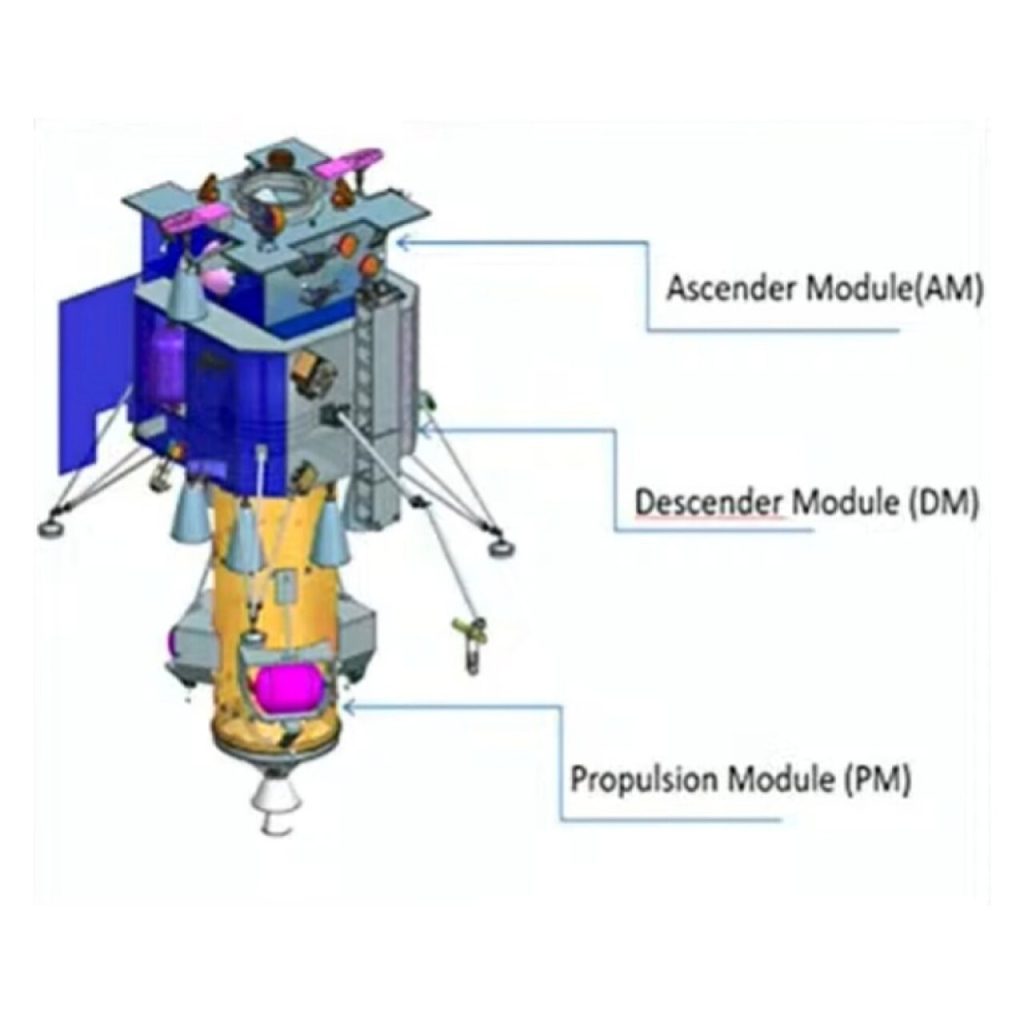
Chandrayaan-4’s architecture is the most complex mission profile in Indian space history — not one spacecraft but five modules, requiring two separate launch vehicles, an in-orbit assembly and docking sequence, a lunar landing, an ascent from the lunar surface, a rendezvous in lunar orbit, and a precisely targeted Earth reentry. Every one of these operations has to succeed for the samples to reach the laboratory.
The Cabinet-approved architecture calls for two separate LVM-3 launches from the Satish Dhawan Space Centre at Sriharikota. The LVM-3 — formerly known as the GSLV Mk III — is ISRO’s most powerful operational rocket, the same vehicle that launched Chandrayaan-3. The first launch will carry the Descender Module and Ascender Module — the lander-ascent vehicle stack — into lunar orbit. The second launch will carry the Propulsion Module, Transfer Module, and Re-entry Module into lunar orbit separately.
Once both launches have placed their payloads in lunar orbit, the modules will rendezvous and dock in orbit — a capability India has never demonstrated before. The docked stack will then perform a powered descent to the lunar surface near Shiv Shakti Point, the Chandrayaan-3 landing site. Surface operations are planned to last one lunar day — approximately 14 Earth days — during which a robotic arm will collect up to 3 kilograms of lunar regolith and seal it in a vacuum container.
The Ascender Module will then fire its engine and lift off from the lunar surface — the first time any Indian spacecraft will have launched from the surface of another world. It will rendezvous and dock with the Transfer Module waiting in lunar orbit, transfer the sample container, and the Transfer Module will begin the journey back to Earth. As it approaches Earth, the Re-entry Module will separate and enter the atmosphere at high speed, protected by a heat shield, before landing the sample capsule on Indian soil.
The Technologies at Stake
Each phase of Chandrayaan-4 requires technologies that ISRO is developing for the first time. Lunar orbit rendezvous and docking — the same technique that made the Apollo missions possible — has never been demonstrated by an Indian spacecraft. Surface sample collection by robotic arm, ascent from the lunar surface, and high-velocity Earth reentry from lunar distance are all new capabilities for the Indian space program.
This is deliberate. Chandrayaan-4 is not merely a science mission — it is a capability demonstrator for India’s broader human spaceflight ambitions. ISRO is developing the Bharatiya Antariksh Station, India’s own space station, and has announced plans for an Indian crewed lunar mission in the 2040s. The technologies required for Chandrayaan-4 — rendezvous and docking, lunar ascent, Earth reentry at lunar return velocity — are precisely the technologies a crewed lunar program needs. Chandrayaan-4 is building the foundation.
India’s private sector is also involved for the first time in a lunar mission. ISRO has engaged Indian industry partners in the development of several subsystems, reflecting the broader opening of the Indian space sector to private participation that has accelerated since the establishment of IN-SPACe, India’s space regulatory body, in 2020.
What Comes Next
India is simultaneously developing the LuPEx mission — the Lunar Polar Exploration mission — in collaboration with JAXA, Japan’s space agency. LuPEx will launch on a Japanese H3 rocket and land a rover at the lunar south pole to investigate water ice deposits in permanently shadowed craters. The two missions are complementary: LuPEx will characterize the surface environment and ice deposits, while Chandrayaan-4 will return physical samples for laboratory analysis.
Together they represent the most ambitious phase of Indian planetary science since the Mars Orbiter Mission in 2014 — and a clear statement that the country that landed at the lunar south pole in 2023 intends to keep going back.
Shiv Shakti Point is waiting. This time, India is bringing something home.