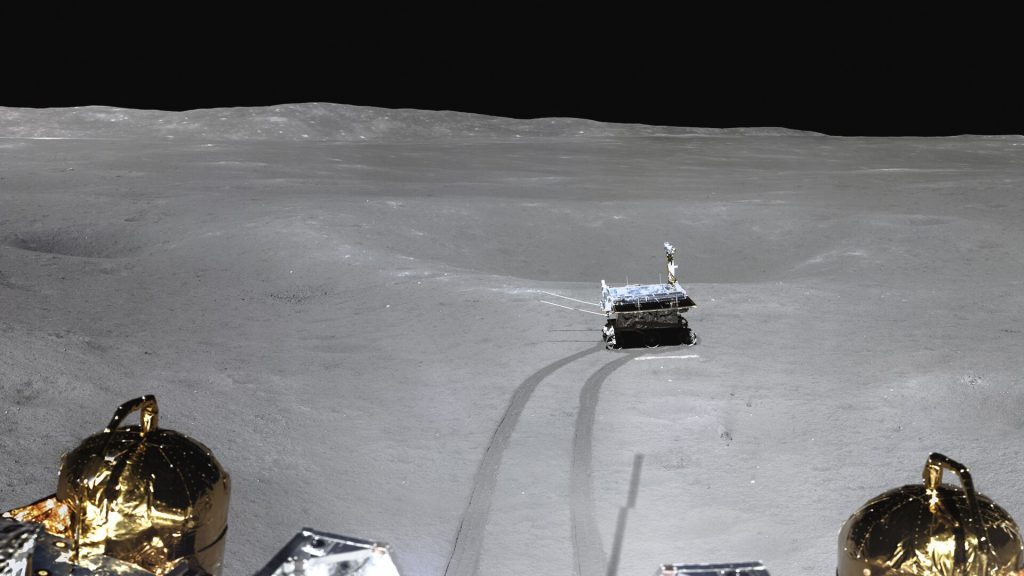
The Moon always shows Earth the same face. Its far side, which never faces us, stayed out of reach for six decades of lunar exploration. Spacecraft had photographed it from orbit, but none had landed there. The problem was not distance; it was communication. With the Moon’s bulk between a lander and Earth, there is no direct line for radio signals. On January 3, 2019, China’s Chang’e-4 became the first spacecraft to land on the far side. Its rover, Yutu-2, went on to become the longest-working rover in lunar history.
A backup becomes a pioneer
Chang’e-4 started out as the backup to Chang’e-3, which landed on the near side in 2013. Once Chang’e-3 succeeded, China repurposed the spare hardware for a far more ambitious target.
To solve the communication problem, China first launched a relay satellite. Queqiao, meaning “Magpie Bridge,” lifted off on May 21, 2018, and reached a halo orbit around the Earth-Moon L2 point on June 14, 2018, about 65,000 km beyond the Moon. From there, it could see both the far side and Earth. Two small satellites, Longjiang-1 and Longjiang-2, launched with it. Longjiang-1 failed to enter lunar orbit, but Longjiang-2 worked until July 31, 2019, when it was deliberately crashed onto the Moon.
Launch and landing
Chang’e-4 launched on a Long March 3B from Xichang on December 7, 2018 (December 8, Beijing time). It weighed 3,780 kg at launch: a 3,640 kg lander and the 140 kg Yutu-2 rover.
On January 3, 2019, the lander touched down in Von Kármán crater, inside the South Pole–Aitken Basin, one of the largest and oldest impact structures in the solar system. Scientists chose the site because an impact that large may have dug deep enough to expose material from the Moon’s mantle. About 12 hours after landing, Yutu-2 rolled down onto the surface.
The instruments
The lander carries landing and terrain cameras, a low-frequency radio spectrometer, and the Lunar Lander Neutrons and Dosimetry experiment, built by Kiel University in Germany. Yutu-2 carries a panoramic camera, a ground-penetrating radar, a visible and near-infrared spectrometer for studying minerals, and a Swedish instrument that measures how the solar wind interacts with the lunar soil.
Both vehicles run on solar power. They shut down during the two-week lunar night, when temperatures drop to about −173°C, and wake up again at sunrise.
Seeds on the Moon
The lander also carried a 3 kg sealed biosphere holding seeds and insect eggs, among them cotton, potato, rapeseed and fruit fly eggs. On January 15, 2019, Chinese scientists reported that cotton, rapeseed and potato seeds had sprouted, though only images of cotton were released. These were the first plants to germinate on the Moon. The experiment ended the next day: once the lunar night set in, temperatures inside fell to −52°C and the biosphere could not be warmed. It ran 9 days of a planned 100.
What Chang’e-4 found
In 2019, a team at the National Astronomical Observatories of China reported in Nature that Yutu-2’s spectrometer had detected olivine and pyroxene at the landing site, minerals they interpreted as coming from deep in the Moon’s mantle. Later studies refined that picture. They traced much of the rover’s surrounding material to debris thrown out by the nearby Finsen crater, and showed that the site had been reshaped by repeated impacts and lava eruptions.
Yutu-2’s radar looked beneath the surface. Its higher-frequency channel reached about 40 meters deep, more than three times deeper than Chang’e-3’s rover managed, and revealed layer upon layer of debris from ancient impacts.
The German radiation instrument measured a surface dose 2 to 3 times higher than astronauts receive on the International Space Station. That number matters for planning longer human stays on the Moon.
A record-breaking rover
Yutu-2 was designed to work for three months. On November 21, 2019, it passed the Soviet Lunokhod 1 rover’s record of 322 Earth days on the Moon, a mark that had stood since 1971. By September 2024, it had completed 71 lunar days and driven 1,613 meters.
Its pace slowed over the years. Planetary scientist Phil Stooke, analyzing images from NASA’s Lunar Reconnaissance Orbiter, found that drives shrank from 7 to 8 meters at a time to just 3 or 4 meters around February 2023. The Planetary Society reports that the rover did not appear to move at all after March 2024. Later orbital images reportedly showed small movements again in 2025.
Where things stand
China rarely announces mission status, and the last official update came in September 2024, when the rover was reported still working. The lander is believed to be continuing its science operations. Queqiao, the relay that made it all possible, still links the far side to Earth, and has since been joined by Queqiao-2.
Chang’e-4 showed that the far side could be reached and worked from for years. Five years later, Chang’e-6 went back and brought far-side samples home.