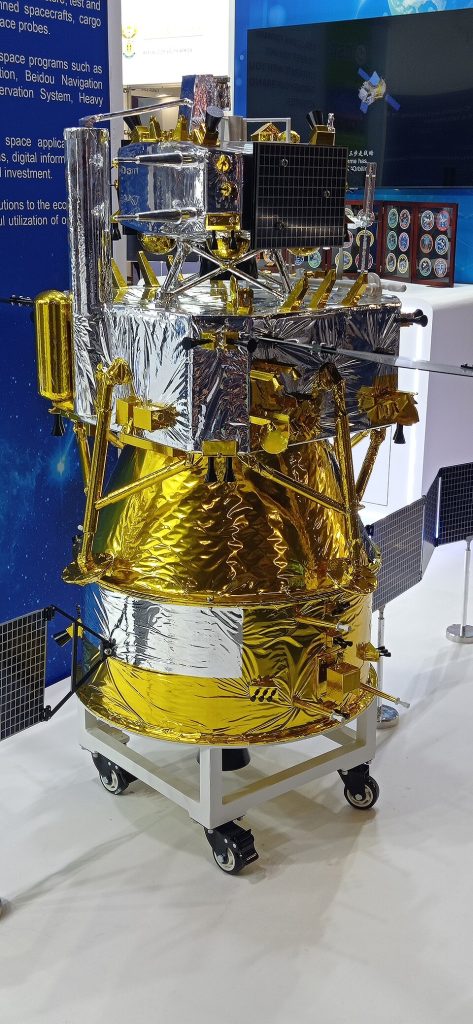
The Moon always shows Earth the same face. Every Apollo crew, every Soviet Luna sample-return probe, and China’s own Chang’e-5 brought rocks home from that familiar near side. The far side — rougher, more heavily cratered, and strangely different in composition — was known only from orbit and from China’s Chang’e-4 lander, which explored it in 2019 but brought nothing back. Chang’e-6 changed that in 2024 by returning the first material ever collected from the hidden hemisphere.
Built on a proven design
Chang’e-6 was the sixth robotic lunar mission in the Chinese Lunar Exploration Program, and the second to return samples. It used essentially the same architecture as Chang’e-5, which brought back 1,731 grams from the near side in December 2020. The spacecraft was a four-part stack: an orbiter, a lander, an ascender and a reentry module.
What made Chang’e-6 harder was the destination. On the far side, the Moon itself blocks any direct radio link to Earth. So China launched the Queqiao-2 relay satellite on March 20, 2024 — six weeks ahead — to provide continuous communications coverage for far-side operations. Without Queqiao-2, the mission could not have happened.
Launch and landing in the Moon’s oldest basin
Chang’e-6 lifted off on a Long March 5 heavy-lift rocket from Wenchang on Hainan Island on May 3, 2024. The lander and ascender touched down on June 1, 2024, at the southern edge of the Apollo crater, inside the South Pole–Aitken Basin.
The landing site was chosen for good reason. The South Pole–Aitken Basin is the Moon’s largest, deepest and oldest known impact structure, about 2,500 kilometers across. An impact that size may have dug deep into the Moon’s crust, giving scientists access to material that records the Moon’s earliest history.
49 hours on the far side
The lander worked on the surface for 49 hours, using a robotic arm with a scoop for surface soil and rocks and a drill for subsurface material. It also planted a flag — the first national flag ever deployed on the lunar far side.
On June 3, 2024, the ascender lifted off with the samples and carried them into lunar orbit — the first launch from the far side of the Moon in history. It docked with the orbiter on June 6, transferred the sample container to the reentry module, and the orbiter began the trip home.
On June 25, 2024, the reentry capsule landed by parachute in Inner Mongolia, ending a mission of about 53 days. China became the first nation to bring back samples from the far side.
Three days later, CNSA announced the total: 1,935.3 grams. Mission spokesperson Ge Ping noted the far-side samples were stickier than earlier lunar soil, with visible clumps.
International passengers
Chang’e-6 also carried science from other countries. China committed 10 kilograms of payload capacity on the lander and another 10 on the orbiter for international partners. France’s DORN instrument measured radon gas escaping from the lunar crust — France’s first scientific instrument on the Moon’s surface. The NILS instrument, from Sweden with ESA support, measured negative ions reflected off the surface. Italy contributed a passive laser retroreflector, and Pakistan’s ICUBE-Q cubesat, built with Shanghai Jiao Tong University, carried two cameras to image the Moon from orbit.
On the surface, DORN operated for 32 hours and NILS for 3 hours and 50 minutes. China delivered ICUBE-Q data to Pakistan on May 10, before the lander even touched down.
What the samples revealed
In July 2025, Chinese researchers published the first major results as four cover articles in Nature. Together they answered questions that remote sensing alone could not.
Volcanism lasted far longer than expected. The samples showed two distinct volcanic phases on the far side, about 4.2 billion and 2.8 billion years ago — volcanic activity lasting at least 1.4 billion years.
The Moon’s magnetic field had a second wind. For the first time, scientists recovered ancient magnetic field information from the far side. Basalt fragments recorded a possible rebound in field strength around 2.8 billion years ago, suggesting the lunar dynamo flickered episodically rather than simply fading away.
The two hemispheres hold different amounts of water. The far-side mantle turned out to be significantly drier than the near-side mantle, adding another layer to the long-standing mystery of why the Moon’s two faces differ so much.
The mantle beneath the basin is extremely depleted. The far-side basalts came from a mantle source stripped of incompatible elements — possibly primordial, or possibly the result of massive melting triggered by giant impacts like the one that formed the basin itself.
The orbiter’s job didn’t end when the capsule landed. After releasing it on June 25, 2024, the orbiter fired its engines to avoid reentering Earth’s atmosphere and set off on a new path. By September 2024, amateur trackers had found it at Sun-Earth L2, about 1.5 million kilometers from Earth — the same region occupied by the James Webb Space Telescope. CNSA has never announced what it is doing there. The likely explanation is practice: China plans to send its Earth 2.0 exoplanet telescope to L2 in 2028, and the Chang’e-5 orbiter before it was repurposed for a similar extended trip to Sun-Earth L1. Whether the Chang’e-6 orbiter is still operating today is unknown.
What comes next
Chang’e-6 was a stepping stone. China plans to use Chang’e-7 to survey the lunar south pole region and Chang’e-8 to test lunar resource utilization, with the two forming the basic model of an international lunar research station by 2035. Both will rely on Queqiao-2 — and both will carry more international payloads, building on the cooperation Chang’e-6 began.
Meanwhile, nearly two kilograms of far-side Moon is being studied in laboratories, and scientists are only beginning to unlock what it can tell us about how the Moon formed and changed.