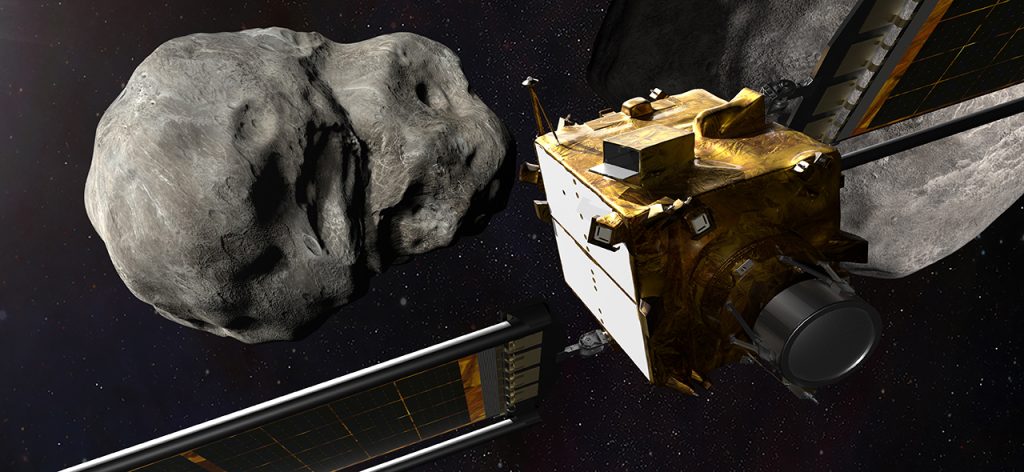
On the night of September 26, 2022, a spacecraft the size of a vending machine traveling at 6.14 kilometers per second (22,000 km per hour or 13,700 miles per hour – so very fast) slammed into an asteroid moonlet 11 million kilometers from Earth. The impact was deliberate. The asteroid was not on a collision course with Earth. Nobody was in danger. The point was to find out whether humanity could move an asteroid if one ever was.
The answer was yes — and by a much wider margin than anyone predicted.
NASA’s Double Asteroid Redirection Test — DART — was the first full-scale planetary defense mission in history: a real spacecraft, launched on a real rocket, sent to a real asteroid to test the most straightforward idea anyone had for deflecting an incoming impactor. Hit it. See if it moves. If it does, the technique is validated. If the technique is validated, the solar system becomes, in a meaningful sense, a safer place for everything living on Earth.
The Target
DART’s target was carefully chosen. Dimorphos is the small moonlet of a binary asteroid system called Didymos — the two rocks orbit each other as they travel through the inner solar system. Dimorphos is approximately 160 meters across, roughly the size of an Egyptian pyramid, and orbits Didymos every 11 hours and 55 minutes at a distance of about 1.2 kilometers. Neither Didymos nor Dimorphos poses any threat to Earth.
The binary system was ideal for a deflection test for a simple reason: by measuring how Dimorphos’s orbital period around Didymos changed after impact, scientists could precisely quantify the momentum transferred without needing to track the entire system’s path through the solar system — which would have required years of observation. The change in orbital period is directly related to how much the impact pushed Dimorphos, and that measurement could be made from ground-based telescopes within weeks.
The Spacecraft
DART was built and operated by the Johns Hopkins Applied Physics Laboratory in Laurel, Maryland — the same institution that built New Horizons, MESSENGER, and Parker Solar Probe. It was a compact, efficient spacecraft: roughly box-shaped, 1.2 meters on a side, with two solar arrays extending 8.5 meters from each side for power. Its single science instrument was DRACO — the Didymos Reconnaissance and Asteroid Camera for Optical navigation — a narrow-angle camera derived from the design of New Horizons’ LORRI instrument, used both for navigation and for imaging the target in the final approach.
DART also carried a passenger: LICIACube — the Light Italian Cubesat for Imaging of Asteroids, built by the Italian Space Agency. Fifteen days before impact, on September 11, 2022, DART deployed LICIACube to fly alongside and observe the impact from a safe distance, capturing images of the moment of impact and the resulting ejecta plume that DART itself could not survive to photograph.
The spacecraft launched on a SpaceX Falcon 9 from Vandenberg Space Force Base on November 24, 2021, and spent ten months on a transfer trajectory to intercept the Didymos system at the right moment in its orbit.
The Final Approach
As DART closed on Dimorphos in the final hours before impact, DRACO’s images became progressively sharper and more detailed. The autonomous navigation system — SMART Nav, the Small-body Maneuvering Autonomous Real Time Navigation system — locked onto Dimorphos and guided the spacecraft without any human input, since the communication delay between Earth and the spacecraft made real-time control impossible during the final approach.
The last complete image DRACO transmitted, sent just 2 seconds before impact from a distance of about 12 kilometers, showed the rocky surface of Dimorphos in extraordinary detail — boulders, ridges, and textures visible at a resolution of a few centimeters per pixel. Then the signal stopped. At 23:14 UTC on September 26, 2022, DART struck Dimorphos at 6.14 kilometers per second.
In mission control at APL, the room erupted. The crowd outside — the mission had attracted enormous public interest and was being streamed live — cheered. NASA Administrator Bill Nelson called it an unprecedented success for planetary defense and a mission of unity with a real benefit for all humanity.
LICIACube, flying safely past, captured the moment from outside: a brilliant flash, then a rapidly expanding cloud of debris — dust, rock, and gravel ejected from the impact site in a plume that stretched thousands of kilometers into space and was visible to ground-based telescopes worldwide.
The Result
Within two weeks, ground-based telescopes had measured what had happened to Dimorphos. The impact shortened its orbital period around Didymos by 33 minutes and 15 seconds — from 11 hours 55 minutes to 11 hours 22 minutes. The minimum success threshold NASA had set for the mission to be considered a success was 73 seconds. DART exceeded it by a factor of 25.
The larger-than-expected change revealed something important about the physics of kinetic impact. A spacecraft hitting an asteroid transfers momentum directly — but the ejecta cloud matters too. When DART struck Dimorphos, the impact ejected an enormous quantity of material from the surface, and that material flew away in one direction, pushing the asteroid in the opposite direction like a rocket exhaust. The ratio of momentum actually transferred to the momentum of the impactor — the beta factor, β — was measured at between 2.4 and 4.9, depending on estimates of Dimorphos’s mass. A β of 1 would mean only the spacecraft’s own momentum was transferred; values above 1 mean the ejecta amplified the push. The actual β of 2.4–4.9 was higher than most pre-impact models had predicted.
The finding has direct implications for future planetary defense planning. A real deflection mission would need to arrive at a threatening asteroid years before any predicted impact — the longer the lead time, the smaller the required velocity change. DART’s result shows that the ejecta amplification makes kinetic impactors significantly more effective than a pure momentum calculation would suggest, which means smaller spacecraft arriving earlier can do more than previously calculated.
What Comes Next
DART answered the first question: can we move an asteroid? Yes. ESA’s Hera mission, now en route and arriving at Dimorphos in November 2026, will answer the follow-up questions: what exactly did we do to it? What does the crater look like? What is Dimorphos actually made of? How did the interior structure affect the outcome? Hera carries two CubeSats and a suite of instruments designed to characterize the impact in detail — turning a dramatic single experiment into a fully understood, repeatable technique.
Together, DART and Hera constitute humanity’s first end-to-end planetary defense demonstration. DART hit the asteroid. Hera is going to examine the damage. Between them, they have changed what it means to live in a solar system full of rocks.