Most missions on Beyond LEO succeed or fail at launch. DRO-A and DRO-B did both. A rocket failure left the two small satellites stranded far short of the Moon — and then engineers spent months steering them, step by step, into one of the strangest orbits in the Earth-Moon system. More than two years later, they are still working there.
What is a distant retrograde orbit?
A distant retrograde orbit, or DRO, is a high, extremely stable orbit around the Moon. Seen from Earth, a spacecraft in DRO moves in the same direction as the Moon around Earth — but seen from the Moon, it travels backward, in a retrograde direction. The Chinese Academy of Sciences (CAS) describes the region as extending from near-Earth and near-lunar orbits out to about 2 million kilometers from Earth.
The appeal is stability. A DRO needs very little fuel to maintain, and spacecraft can enter Earth-Moon space with minimal energy and still reach many destinations from it. CAS researchers see DRO as a potential staging point for lunar bases, deep-space observatories and interplanetary missions. Their team began studying it in 2017 and has proposed a DRO-based spaceport.
China wasn’t new to this orbit. The Chang’e-5 orbiter moved into a lunar DRO by early 2022 on its extended mission — the first spacecraft known to do so. DRO-A and B were the first designed specifically to work there.
A three-satellite plan
In February 2022, CAS launched a plan for a three-satellite constellation spanning Earth-Moon space. The first piece, DRO-L, launched into a Sun-synchronous orbit around Earth on February 3, 2024 and began its experiments. DRO-A and DRO-B would join it from the Moon, linking the three by radio across hundreds of thousands of kilometers.
Launch — and failure
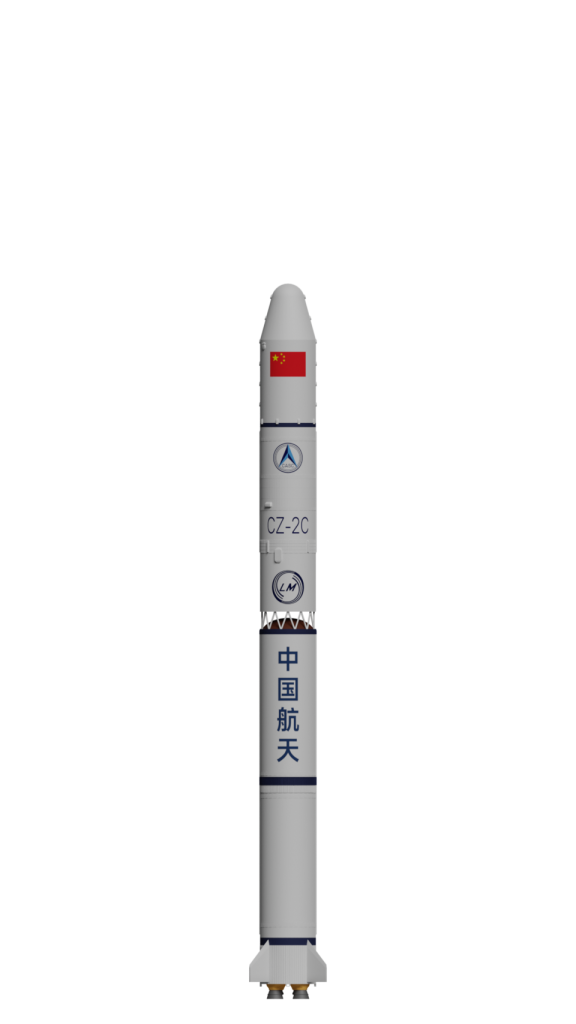
The pair lifted off from Xichang on a Long March 2C on March 13, 2024. The Yuanzheng-1S upper stage, meant to fire them toward the Moon, failed. Xinhua (the official news agency of the Peoples Republic of China) reported only that the stage had an abnormality and the satellites had not entered their planned orbit, with “relevant disposal work” underway. Chinese officials hadn’t even publicly said the satellites were Moon-bound; outside observers pieced that together from a 2023 journal paper.
The situation was dire. Small satellites carry little propellant, which made reaching lunar orbit unassisted from where they were stranded a very tall order. Worse, the satellites were spinning. The team first stopped the spin using DRO-B’s engines, and had only a few days to make the first maneuver if they still hoped to reach DRO.
The rescue
What followed was a feat of orbital mechanics. A conventional trip to the Moon burns a lot of fuel up front and again on arrival. That wasn’t an option. Instead, the team used a chaotic dynamical region around the Earth-Moon system to save propellant — a technique Japan used to rescue its Hiten probe in 1990, though Hiten went into a conventional lunar orbit.
The operation took five orbital maneuvers, five trajectory corrections, and three gravity assists from Earth and the Moon. Small burns at the lowest point of the orbit gradually raised the high point; once it was high enough, a larger burn sent the satellites on an unusual course toward the Moon. In total they traveled about 8.5 million kilometers.
Harvard-Smithsonian astronomer Jonathan McDowell called it a very impressive achievement, noting that replanning such a trajectory in a hurry must be a nightmare. As he explained, these orbit strategies trade time for fuel — and a small error means missing the target by a long way.
The satellites arrived in DRO and on August 28, 2024, separated from each other. Images released later showed the toll of the ordeal: DRO-A’s solar panels were bent nearly 90 degrees from the spinning, and DRO-B’s arrays looked like broken wings hanging by wires. Both kept working anyway.
What the constellation does
Once in place, DRO-A and DRO-B established K-band microwave links with DRO-L, testing how the three-satellite network operates. The constellation reached full operation in late August 2024.
The most striking result: using three hours of satellite-to-satellite measurements, the team determined orbits as precisely as two days of ground-based tracking would normally achieve. That matters for the future — the same idea CAPSTONE tested with the Lunar Reconnaissance Orbiter. Spacecraft that can track each other need less time on crowded ground antennas.
DRO-A also carries a science instrument: an all-sky monitor for gamma-ray bursts, particularly those tied to gravitational-wave events such as colliding black holes and neutron stars. Based on China’s GECAM mission in low Earth orbit, it benefits from deep space’s unobstructed view and lower interference.
Two years on
In March 2026, CAS announced that the constellation had been operating for two years and had verified stable residency and low-energy maneuvering in DRO. The two satellites are no longer side by side: DRO-A stays in DRO, while DRO-B has moved into maneuvering orbits around Earth-Moon space for further experiments.
CAS has said it will use DRO’s long-term stability for fundamental research in quantum mechanics and atomic physics. CAS called the three-satellite system crucial infrastructure for continuous human activity in Earth-Moon space.
Legacy
DRO-A and DRO-B may be best remembered not for their orbit but for how they got there. McDowell said the rescue shows China is now on par with the United States in managing complex astrodynamics. A mission that looked lost in March 2024 instead became the world’s first constellation reaching from Earth orbit to the Moon.