For all of human history, the Moon had been untouchable. It had hung above every civilization that ever existed — worshipped, studied, navigated by, written about in every language ever spoken — and remained beyond reach. On the night of September 13, 1959, that ended.
At 21:02:24 GMT, a 390-kilogram Soviet probe struck the lunar surface east of Mare Imbrium, near the craters Aristillus, Archimedes, and Autolycus. The signal that astronomers at Jodrell Bank Observatory in England had been tracking went silent. For the first time in the four-and-a-half-billion-year history of the Moon, an object built by human hands lay on its surface. Luna 2 had arrived.
A Direct Shot
Luna 2 launched from the Baikonur Cosmodrome on September 12, 1959, at 06:39:42 GMT — just eight months and ten days after Luna 1 had missed the Moon and drifted into solar orbit. The Soviets had learned from that miss and made no fundamental changes to the approach: Luna 2 flew a direct, brutal trajectory, straight up and straight in, with no propulsion system of its own after separating from its booster. It coasted to the Moon on pure ballistic momentum, a rock thrown across the solar system with extraordinary precision.
The journey took 33 hours and 31 minutes. At no point after booster separation did Luna 2 fire a thruster or correct its course. The navigation accuracy required to hit a target 384,000 kilometers away using 1959 computing technology (like the slide rule those of us born during those times learned to use at school), without any mid-course correction capability, was a remarkable engineering achievement — one the Western press struggled to fully credit at the time, with some initially doubting the mission had succeeded at all.
It was Bernard Lovell, director of Jodrell Bank Observatory in England, who confirmed the impact to the outside world. The British telescope — then the largest steerable radio telescope on Earth — had been tracking Luna 2’s signal throughout its transit. When the signal stopped at the predicted moment of impact, Lovell immediately understood what had happened and announced it publicly. The Soviet Union had hit the Moon.
What Luna 2 Carried
Luna 2 was not merely a ballistic projectile. It carried five science instruments — scintillation counters, Geiger counters, a magnetometer, Cherenkov detectors, and micrometeorite detectors — that gathered data throughout the 33-hour transit and transmitted it back to Earth until the moment of impact.
The most significant scientific results came from the magnetometer and radiation detectors. Luna 1 had suggested the Moon lacked a significant magnetic field and radiation belts; Luna 2 confirmed both findings with greater precision from a closer approach. The Moon had no global magnetic field comparable to Earth’s, and no Van Allen belt equivalents surrounding it. These were the first in-situ measurements ever made at another world — data gathered not by observing the Moon from a distance but by instruments physically present in its vicinity, then on its surface.
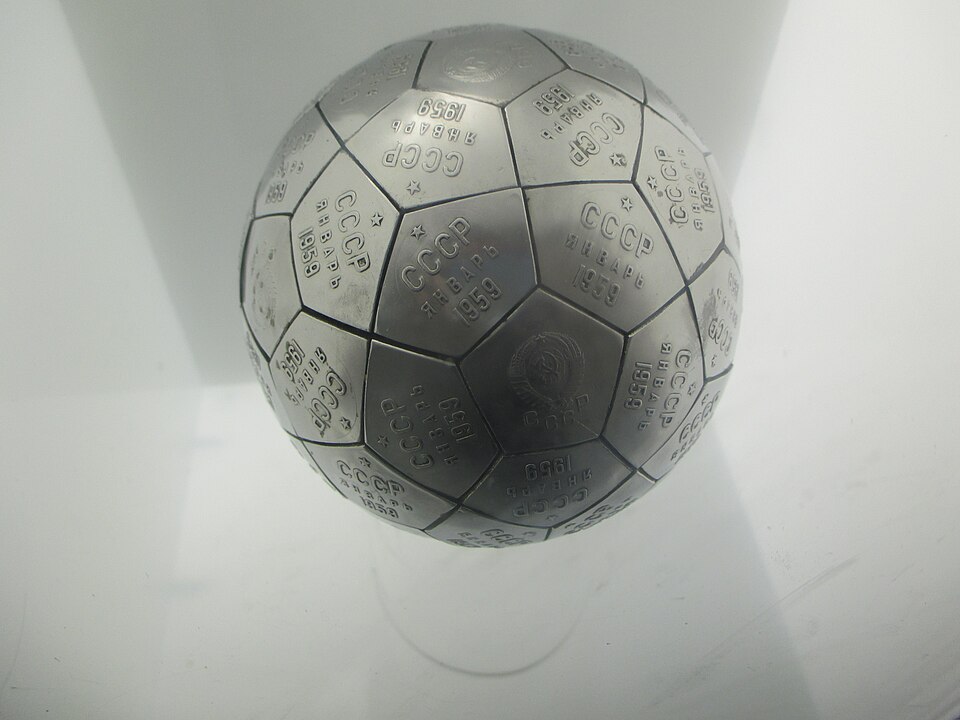
Luna 2 also carried two sphere-shaped pennants — hollow metal spheres covered with pentagonal medallions stamped with the Soviet coat of arms and the date 1959 — designed to scatter across the lunar surface on impact. The pennants were a deliberate statement of ownership, or at least of priority. The Soviet Union had arrived first, and it wanted to leave something behind to mark the fact.
Khrushchev’s Gift
The timing of Luna 2’s impact was not accidental in political terms. Soviet Premier Nikita Khrushchev had been scheduled to visit the United States for a landmark diplomatic trip — his first visit to America — and the impact on September 13 came the day before he arrived in Washington. Khrushchev walked into his meetings with President Dwight Eisenhower carrying a replica of one of the pennant spheres, which he presented as a gift. The original replica is now displayed at the Eisenhower Presidential Library in Kansas.
The gesture captured the spirit of the moment perfectly. The Soviet Union had placed an object on the Moon while the American space program was still struggling to reach Earth orbit reliably. Whatever was said in the diplomatic meetings, the pennant on the table made the balance of space power unmistakably clear.
What It Meant
Luna 2’s significance was not primarily scientific — though the confirmation of the Moon’s absent magnetic field and radiation environment was genuinely important for planning future missions. Its significance was navigational and historical. It proved that a spacecraft could be targeted at another celestial body and hit it. The precision required — threading a trajectory across 384,000 kilometers to strike within an expected impact zone — was the same fundamental problem that every subsequent lunar mission, crewed and robotic, would have to solve. Luna 2 solved it first.
It also permanently changed the psychological relationship between humanity and the Moon. The satellite that had been observed, worshipped, and theorized about for all of recorded history was now a place — a physical location that could be reached, that objects could be sent to, that footprints could eventually be left on. Ten years after Luna 2 struck the lunar surface near Mare Imbrium, Apollo 15 astronauts would walk on the Moon roughly 160 miles from its impact site. The distance between Luna 2 and Apollo 11 — the distance between an unmanned impactor and a crewed landing — was ten years of continuous effort, thousands of engineers, and the combined will of a civilization that had decided to go.
Luna 2 took 33 hours to cover that distance. It took humanity ten years to follow and walk on the moon.