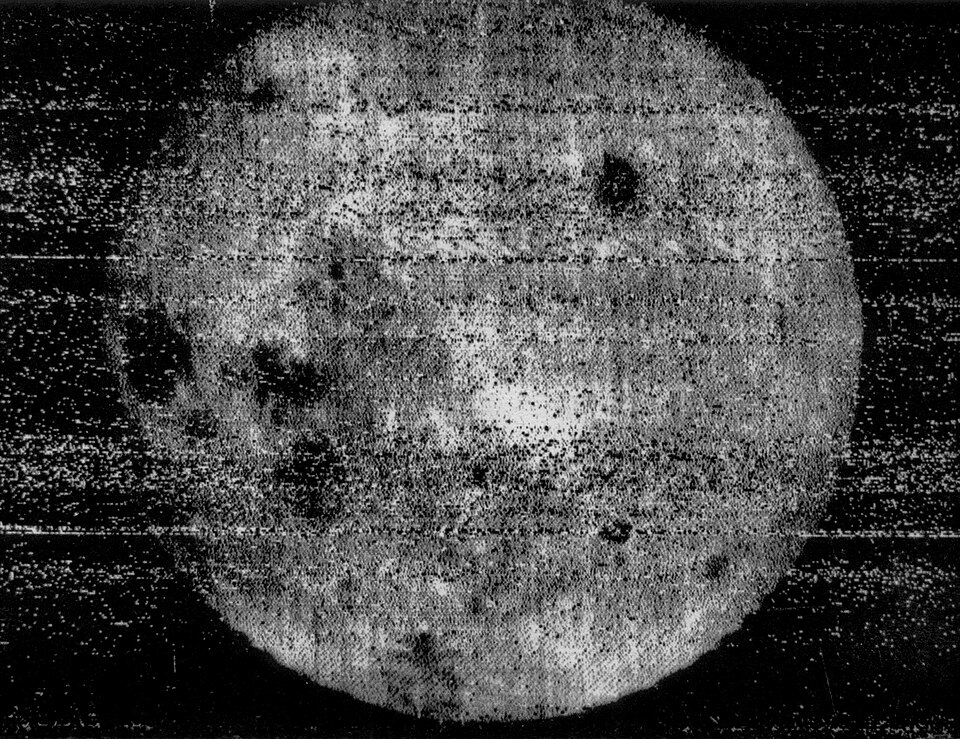
For all of human history, the Moon kept one face permanently turned away. Every civilization that ever looked up saw the same side — the same maria, the same craters, the same features that gave rise to myths of a man in the Moon, a rabbit, a woman’s face. The far side was invisible. Not merely unexplored — invisible, in the most literal sense. No telescope could see it. No observer on Earth could ever see it. It was the largest blank space in the known universe that was simultaneously close enough to touch.
On October 7, 1959, a Soviet spacecraft photographed it for the first time.
The Launch
Luna 3 launched from the Baikonur Cosmodrome on October 4, 1959 — exactly two years to the day after Sputnik had inaugurated the space age. The timing was not accidental. The Soviet space program understood the propaganda value of anniversaries, and the second birthday of Sputnik was the perfect occasion for the third mission of the Luna program.
Luna 1 had overshot the Moon earlier that year and drifted into solar orbit. Luna 2 had impacted the lunar surface on September 14, 1959 — becoming the first human-made object to reach another world. Luna 3 had a different objective: not to hit the Moon but to fly around it, look at its hidden face, and bring back photographs.
The spacecraft weighed 278 kilograms and looked nothing like the simple spherical probes of its predecessors. It was a cylindrical body approximately 1.3 meters long, covered in solar cells, with sensors and antennas protruding from its frame. At one end was a photocell that would detect sunlight on the far side of the Moon and trigger the camera system automatically. At the other end was the camera system itself — one of the most remarkable pieces of engineering ever sent into space.
The Camera in Space
Luna 3 carried a dual-lens camera loaded with 40 frames of specially treated 35mm film — the same ISOCHROME film used in U-2 spy plane reconnaissance, hardened against the radiation and temperature extremes of space. The camera had two lenses of different focal lengths — one wide-angle for context and one telephoto for detail — designed to photograph the same target simultaneously at different scales.
What made Luna 3’s imaging system extraordinary was what happened after the photographs were taken. The film was not returned to Earth. Instead, Luna 3 developed its own photographs in space — an onboard processing unit advanced the film through a chemical developer and fixer, producing negatives inside the spacecraft. Those negatives were then scanned by a photomultiplier tube, converted into electrical signals, and transmitted to Earth by radio. The entire darkroom existed inside a spacecraft orbiting the Moon in 1959.
The system was the product of Soviet engineers working under extraordinary time pressure with technology that had never been tested in space. It worked.
Around the Moon
Luna 3’s trajectory was carefully designed to take it around the southern limb of the Moon and over the far side while the Sun was illuminating it — a narrow geometrical window that required precise timing and navigation. The spacecraft passed within 6,200 kilometers of the Moon’s south pole at closest approach on October 6, 1959, then swung around and over the far side.
On October 7, the photocell detected sunlight on the far side surface and automatically triggered the camera sequence. For 40 minutes, Luna 3 photographed the hidden hemisphere from distances ranging from 63,500 kilometers down to 66,700 kilometers — not extremely close by later standards, but close enough to reveal the broad features of a terrain no human eye had ever seen. Twenty-nine photographs were taken, covering approximately 70 percent of the far side.
As Luna 3 began its return journey toward Earth, the onboard system developed the film. Then, as the spacecraft drew closer to Earth and radio transmission conditions improved, it began scanning and transmitting the images. Between October 18 and 18 October, seventeen usable photographs were received at Soviet ground stations — grainy, blurry by any modern standard, and extraordinary beyond measure.
What the Far Side Looked Like
The images revealed something that surprised everyone. The near side of the Moon — the face humanity had studied for millennia — is characterized by large dark regions called maria, ancient lava plains formed billions of years ago when enormous impacts melted the crust and allowed basaltic lava to flood the surface. They cover roughly 30 percent of the near side and give it the distinctive dark-and-light patterning visible to the naked eye.
The far side was almost completely different. It had almost no maria — just two small ones, which the Soviets named the Sea of Moscow and the Sea of Dreams. Instead it was a relentless, heavily cratered highland terrain, more ancient and more battered than anything on the near side. The dichotomy between the two faces of the Moon was stark and immediately apparent even in Luna 3’s blurry photographs.
Scientists are still debating the reason for this asymmetry decades later. One leading hypothesis — the collision theory — suggests that the Moon may have had a companion body early in its history that collided with the far side at low velocity, piling highland crust onto the far side and suppressing the volcanism that created the near-side maria. Another hypothesis invokes differential heating from the early Earth. The question is unresolved even today, a mystery made visible by Luna 3’s grainy photographs and still being investigated by missions like China’s Chang’e 4 and Queqiao-2.
The Naming of the Far Side
The photographs gave the Soviet Union something beyond scientific data: the right to name what they had found. Because Luna 3 was the first to photograph the far side, Soviet scientists and the USSR Academy of Sciences had the first opportunity to assign names to the features they identified. The craters, mountains, and the two small seas were given Russian names — honoring Soviet scientists, Russian scientists, and figures from Russian history and culture. Tsiolkovsky, the visionary theorist who first worked out the mathematics of rocketry. Lomonosov, the eighteenth-century polymath. Giordano Bruno. Jules Verne. The far side of the Moon is, in a very literal sense, a map of Soviet intellectual pride.
The USSR Academy of Sciences published the first Atlas of the Far Side of the Moon in November 1960, just over a year after Luna 3’s photographs were received. It catalogued 500 identified features of the lunar far side. International astronomical bodies eventually standardized the naming conventions, but the Russian names given to the most prominent features have remained — a permanent reminder of who looked first.
The First Gravity Assist
Luna 3 achieved something else that its designers recognized only partially at the time: it was the first spacecraft to use a gravity assist maneuver. Rather than flying directly to the Moon and back, its trajectory was designed to swing around the Moon using lunar gravity to redirect the spacecraft’s path — changing its velocity and direction without expending any fuel. This same technique would later be used by Mariner 10 at Venus, by Voyager at Jupiter and Saturn, and by virtually every interplanetary mission that followed. Luna 3 was not just the first spacecraft to photograph the far side of the Moon. It was the first to demonstrate that planets and moons could serve as gravitational slingshots for spacecraft — a concept that underpins the entire modern era of deep space exploration.
The End
Contact with Luna 3 was lost in late October 1959, restored briefly in subsequent months, and finally lost permanently around April 1960. The spacecraft, its orbit decaying from the combined effects of lunar and solar gravitational perturbations, reentered the Earth’s atmosphere and was destroyed — most likely sometime in spring 1960, though the exact date was never confirmed.
It had shown humanity something that had been hidden since the Moon formed 4.5 billion years ago. Grainy, blurry, incomplete — but real. The other side of the Moon, seen for the first time, by a spacecraft with a darkroom inside it, orbiting in the darkness between worlds.