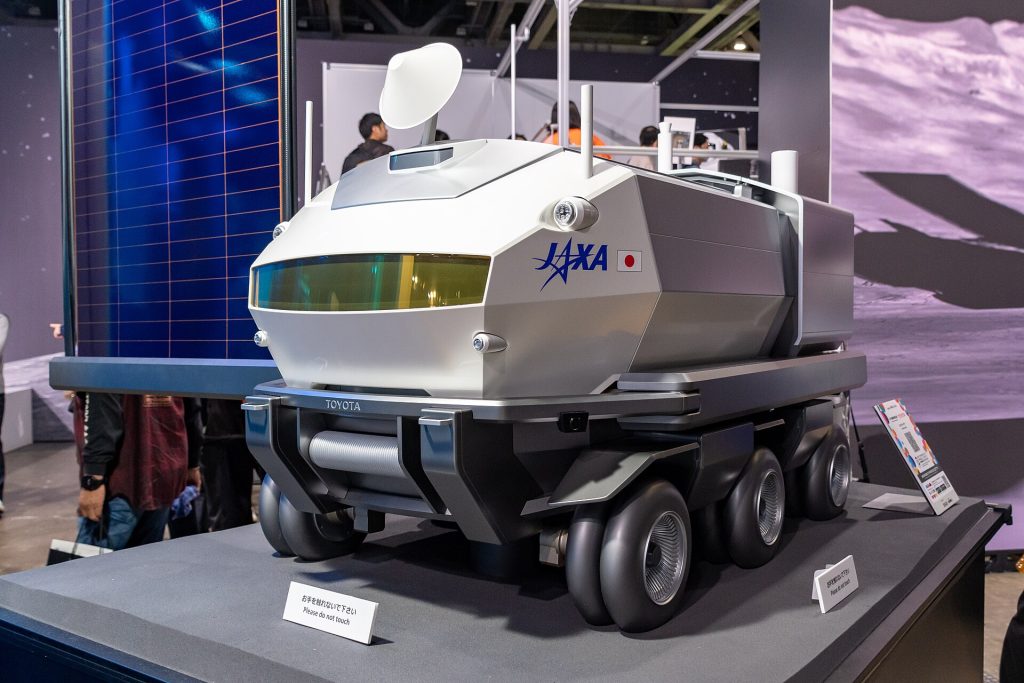
The last astronauts to drive on the Moon did it in an open-top buggy during the Apollo 17 mission in 1972. Apollo’s Lunar Roving Vehicle carried two astronauts in spacesuits for a few hours at a time, never straying far from their lander. The next generation of lunar driving looks very different. Japan’s space agency JAXA and Toyota are building a pressurized rover, nicknamed the Lunar Cruiser, that astronauts can live inside for up to a month. JAXA engineer Fumiya Tsutsui calls it “a spaceship that drives on the moon.”
Why a pressurized rover?
A spacesuit is a small spacecraft, and working in one is exhausting. Every excursion outside a lander or habitat costs time, oxygen and energy. Apollo’s three rover missions, Apollo 15, 16 and 17, covered a combined 90 kilometers of lunar ground.
A pressurized rover changes the math. Inside its cabin, astronauts can take off their suits, eat, rest and sleep, then suit up only when there is something worth stepping out for. That makes it possible to travel far from a base and stay out for weeks rather than hours.
From car company to spacecraft builder
Toyota began joint research with JAXA in 2019, and the official name of the vehicle is simply the “crewed pressurized rover.” The “Lunar Cruiser” nickname is a nod to Toyota’s famously rugged Land Cruiser. The joint research phase wrapped up in 2022, the same year a prototype driving system was built. Mitsubishi Heavy Industries then joined to work on system-level development, drawing on its experience building hardware for Japan’s Kibo module on the International Space Station.
It became a “Team Japan” effort. Bridgestone is developing airless tires made with stainless steel, since ordinary rubber tires would not survive lunar temperatures and radiation.
The design
The Lunar Cruiser is about 6 meters long, 5.2 meters wide and 3.8 meters tall, roughly the size of two minibuses side by side. It is designed for two astronauts, with room for four in an emergency. Much of the interior is taken up by life support systems and equipment.
The environment is brutal. The rover must work in one-sixth of Earth’s gravity, in a complete vacuum, with strong radiation, abrasive lunar dust, and surface temperatures ranging from about −170°C to 120°C.
For power, Toyota is drawing on the fuel-cell technology from its Mirai hydrogen car. Fuel cells combine hydrogen and oxygen to make electricity, with water as the only by-product. Mitsubishi is helping develop a unit to split that water back into hydrogen and oxygen, so the system can be recharged rather than relying only on fuel carried from Earth.
The NASA deal
On April 9, 2024, NASA Administrator Bill Nelson and Japan’s education and science minister, Masahito Moriyama, signed an agreement that made the Lunar Cruiser part of Artemis. Japan will design, develop and operate the rover. In return, NASA will launch it to the Moon and give Japanese astronauts two opportunities to land on the lunar surface.
NASA’s announcement said the rover will operate near the lunar south pole for about 10 years, carrying two astronauts on trips of up to 30 days. It can also drive without a crew, so it can reposition itself between crewed missions. Over its lifetime, the rover is expected to cover about 10,000 kilometers, more than 100 times the ground covered by all three Apollo rover missions combined.
The agreement also came with a shared goal announced by President Biden and Prime Minister Kishida: that a Japanese astronaut become the first non-American to land on the Moon, “assuming important benchmarks are achieved.”
Surviving the Artemis shake-up
NASA’s Moon plans changed dramatically in 2026. On March 24, Administrator Jared Isaacman announced that NASA was pausing the Gateway lunar space station and refocusing on a permanent base on the lunar surface. Many contracts were reshaped. The Lunar Cruiser was not one of the casualties: Isaacman named JAXA’s pressurized rover as one of the significant contributions from NASA’s partners.
Under the new plan, the rover belongs to Phase 2 of the Moon Base program, scheduled for 2029 to 2032, when NASA expects to establish initial landing sites and infrastructure and fly crewed missions twice a year. In a base-centered architecture, a vehicle that can carry astronauts hundreds of kilometers away and back becomes even more important.
From drawings to dirt
In May 2025, Toyota showed a prototype making its first open-air test drive. It looked very different from the polished renderings, a reminder that this is still engineering in progress. The flight vehicle has yet to be built.
NASA’s most recent public timeline puts the rover’s launch no earlier than 2032. The 2024 agreement tied it to Artemis VII, but mission numbering has changed since the 2026 restructuring, so the exact mission it will fly on remains to be confirmed.
What comes next
If it stays on track, the Lunar Cruiser will be the first vehicle to let astronauts live on the move on another world. It would also carry one of the first non-American astronauts to the lunar surface. Fifty years after the last Apollo rover parked for good, the next astronauts may cross the Moon by the hundreds of kilometers, with a Toyota under them.