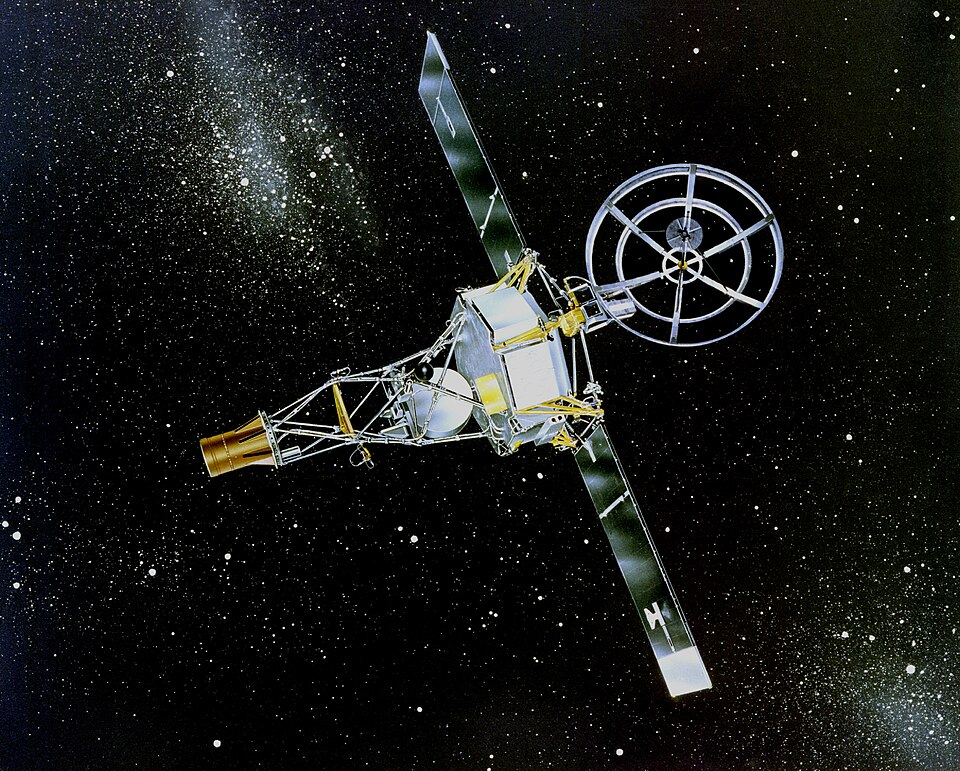
On December 14, 1962, a small American spacecraft swept past Venus at a distance of 34,773 kilometers and changed what humanity knew about the solar system forever. It was the first time any spacecraft had successfully reached another planet. Everything before Mariner 2 — every probe, every satellite, every rocket — had either stayed in Earth orbit, flown past the Moon, or failed entirely. Mariner 2 was the first to go further. The first to arrive somewhere else. The first to look back at another world from close range and send data home.
Jack James, the project manager at JPL who oversaw the mission, said afterward: “There will be other missions to Venus, but there will never be another first mission to Venus.” He was right on both counts.
A Year to Build, a Hyphen to Lose
The Mariner Venus program was conceived and executed at a pace that would be unrecognizable in modern spaceflight. NASA authorized the mission in August 1961. The first spacecraft, Mariner 1, launched on July 22, 1962 — less than a year later. It never reached space. Twenty-nine seconds after launch, the Atlas rocket’s guidance system began to malfunction. The Range Safety Officer destroyed the vehicle five minutes into the flight to prevent it from threatening shipping lanes.
The cause of Mariner 1’s failure has become one of the most famous bugs in the history of computing — a missing hyphen in the guidance software’s written specification that caused the autopilot to behave erratically when the radar tracking system dropped the signal. One missing punctuation mark destroyed a spacecraft. The total cost of Mariner 1 was approximately $18.5 million.
Mariner 2 was Mariner 1’s identical twin, built as the backup. Engineers corrected the software, ran the tests again, and on August 27, 1962 — 36 days after Mariner 1’s destruction — launched Mariner 2 from Cape Canaveral on an Atlas-Agena B rocket. This time the rocket performed perfectly. Mariner 2 separated cleanly, established communications with Earth, and began its 109-day journey to Venus.
The Journey
The spacecraft weighed 202 kilograms and carried six science instruments: a microwave radiometer and an infrared radiometer for measuring Venus’s temperature, a magnetometer for detecting magnetic fields, a solar plasma detector, a cosmic dust detector, and a cosmic ray telescope. It drew power from two solar panels — one on each side of the hexagonal magnesium frame — generating 220 watts at Venus encounter.
The journey was not straightforward. In October 1962, one of the solar panels failed entirely — the cause was never definitively determined, with leading theories including a short circuit from a particle impact or a failure in the panel’s electrical connections. The spacecraft continued on the remaining panel’s reduced power. Then temperatures aboard began rising as Mariner 2 drew closer to the Sun on its trajectory toward Venus. Engineers at JPL monitored the temperature readings with growing concern — the spacecraft was approaching the upper limits of what its electronics could tolerate.
In the final days before the Venus encounter, Mariner 2’s computer sequencer began behaving erratically. The team worked through the anomaly and restored normal operations just before closest approach. The spacecraft had been failing in multiple ways simultaneously, and it had kept going.
Venus Revealed
On December 14, 1962, Mariner 2 made its closest approach to Venus at 19:59:28 UTC. For 42 minutes its radiometers scanned back and forth across the planet as the spacecraft swept past, building up a strip map of temperature data that would answer questions astronomers had been arguing about for decades.
What the data showed was definitive and, to many scientists, deeply unwelcome. Venus was not the warm, possibly habitable world some had theorized. Its surface temperature was approximately 425 degrees Celsius — hot enough to melt lead, maintained by a thick carbon dioxide atmosphere trapping heat in a runaway greenhouse effect that left no part of the surface cool enough for liquid water, life, or anything familiar. The upper clouds, at about 60 kilometers altitude, were cold — but they were not water clouds. The surface below them was a furnace.
The magnetometer confirmed that Venus had no significant magnetic field — a finding that distinguished it sharply from Earth and raised questions about why two apparently similar planets had taken such different evolutionary paths. The radiometers revealed that Venus rotated in the retrograde direction — opposite to most planets in the solar system — a discovery later confirmed by radar observations from Earth. Improved measurements of the planet’s mass refined the value of the astronomical unit — the Earth-Sun distance — with greater precision than any previous method.
Beyond Venus itself, Mariner 2 made a discovery of equal scientific importance during its cruise phase. Luna 1 in 1959 had provided the first indirect evidence for a continuous solar wind flowing outward from the Sun. Mariner 2’s solar plasma detector made direct, continuous measurements of this wind throughout its journey — confirming that the solar wind was not an occasional phenomenon but a permanent feature of interplanetary space, flowing constantly at hundreds of kilometers per second. The implication was profound: the interplanetary medium was not empty. It was pervaded by a constant outflow of charged particles from the Sun, shaping the magnetic environments of every planet in the solar system.
The Last Signal
On January 3, 1963 — three weeks after its Venus flyby, 129 days after launch — Mariner 2 sent its last transmission. The batteries had depleted and the solar panel could no longer generate sufficient power. Communications ceased. The spacecraft, still in solar orbit, drifted on in silence.
It remains in that orbit today. The first spacecraft to successfully reach another planet is still out there, circling the Sun somewhere between the orbits of Earth and Venus, carrying its instruments and its solar panels and its memories of a December afternoon when it passed within 34,773 kilometers of a cloud-covered world and sent home the first close-range data from another planet.
There will be other missions to Venus. There was never another first.