Before July 14, 1965, nobody had ever seen another planet from close range. Mars was a reddish dot in the night sky, a disc in a telescope, a source of speculation that had occupied human imagination for centuries. Some scientists believed it had canals. Some believed it had vegetation that changed color with the seasons. Some believed, with more hope than evidence, that it might harbor some form of life. The question of what Mars actually looked like — what its surface was made of, what its atmosphere contained, whether anything lived there — remained genuinely open.
On the night of July 14, a spacecraft changed that. It took 22 photographs during a brief flyby and transmitted them back to Earth over the following weeks. They showed a cratered, barren, Moon-like landscape. They dashed a century of speculation in a matter of hours. And they launched the modern era of planetary science.
The Mission
Mariner 4 was the seventh attempt — by the United States and Soviet Union combined — to send a spacecraft to Mars. The Soviets had tried and failed five times between 1960 and 1964. NASA’s own Mariner 3, launched four weeks before Mariner 4, failed when its shroud didn’t separate properly after launch, sending the spacecraft tumbling uselessly into solar orbit.
Mariner 4 launched on November 28, 1964, from Cape Canaveral on an Atlas-LV3 Agena-D rocket. It weighed 261 kilograms and carried seven science instruments — a magnetometer, cosmic ray telescope, solar plasma probe, cosmic dust detector, trapped radiation detector, television camera, and an occultation experiment using the spacecraft’s radio signal to probe the Martian atmosphere as the spacecraft passed behind the planet.
The camera was almost not included. The original Mariner Mars 1964 design had no imaging system — the project was conceived primarily as a fields-and-particles mission. Three scientists at Caltech — Mert Davies, Robert Leighton, and Bruce Murray — argued forcefully that a camera should be added, that close-up photographs of Mars would answer scientific questions no other instrument could. They were eventually persuasive. The camera was built and installed. It would turn out to be the most consequential instrument ever flown on a planetary mission up to that point.
228 Days to Mars
Mariner 4 spent 228 days cruising to Mars — seven and a half months during which ground controllers performed a single mid-course correction maneuver on December 5, 1964, adjusting the trajectory to bring the spacecraft within imaging range of the planet. Navigation in 1964 had none of the GPS or deep space network precision of later missions; Mariner 4 was the first spacecraft to use a star as a navigational reference, tracking Canopus in the southern sky as a fixed orientation point for its attitude control system.
The spacecraft reached Mars on July 14, 1965. Its imaging sequence began on the night side approach, with the first photograph taken at a distance of approximately 17,000 kilometers. Over the next 25 minutes, Mariner 4 photographed strips of the Martian surface as it swept by at closest approach — 9,846 kilometers from the surface — before continuing on the other side. The 22 photographs covered approximately one percent of Mars’s total surface area, focused on the southern highlands.
The images were stored on an onboard tape recorder. Digital transmission back to Earth took weeks — each photograph was composed of 240 lines of 240 pixels, with each pixel encoded in 6-bit digital format, representing one of 64 shades of grey. Total data returned by the mission: 5.2 million bits. By comparison, a single modern smartphone photograph contains more data than the entire Mariner 4 dataset.
The Disappointing Truth
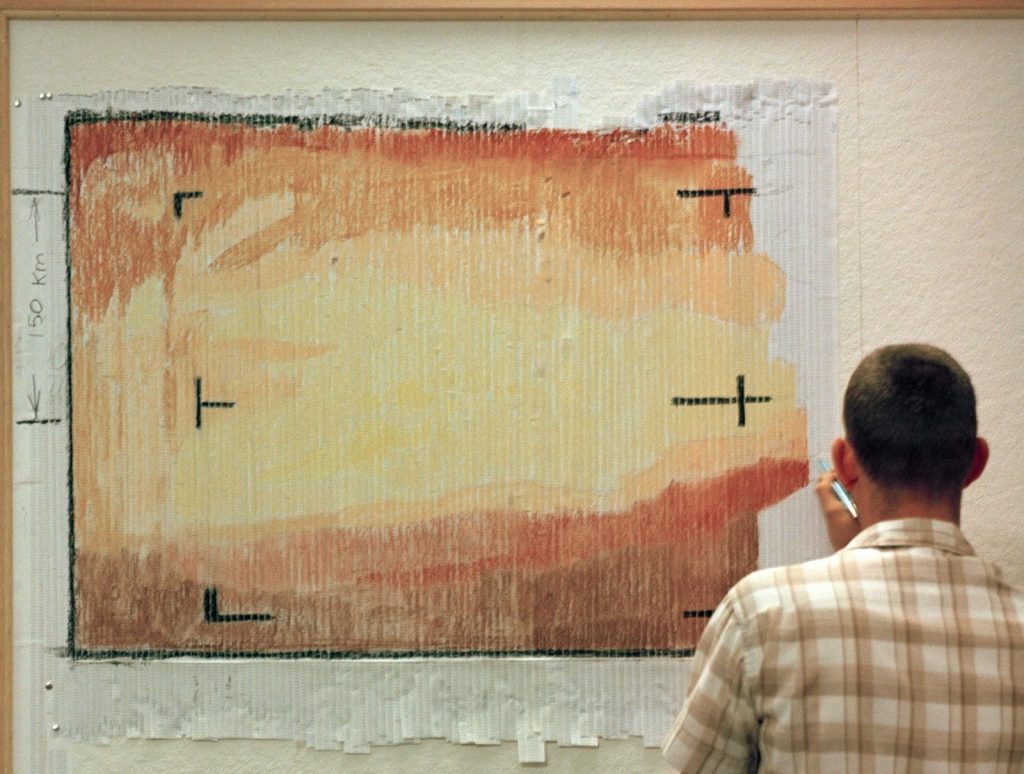
When the images arrived at JPL, scientists were initially so impatient that they printed the digital pixel values on strips of paper and colored them by hand with pastel chalks — the first human-made image of another planet, assembled by hand in a JPL conference room, hours before the computers could process the digital data into a proper photograph.
What the images showed was sobering. Mars was not the world of speculation. It had no canals — the “canals” had been a telescopic illusion, an artifact of the human tendency to connect dots of detail into patterns. It had no vegetation, no color changes, no sign of anything living. What it had was craters. Dozens of them, clearly visible in Mariner 4’s grainy black-and-white photographs — a heavily bombarded, ancient surface more reminiscent of the Moon than of the dynamic, potentially life-bearing world many had hoped for.
The atmospheric data made things worse. As Mariner 4 passed behind Mars, its radio signal passed through the Martian atmosphere and was bent and absorbed in ways that allowed scientists to calculate atmospheric pressure. The result: approximately 4 to 7 millibars — about one percent of Earth’s sea level pressure, far lower than even the most pessimistic estimates before the mission. Mars’s atmosphere was too thin to support liquid water on the surface. Too thin to breathe. Too thin to protect any surface life from cosmic radiation. It was, by every measurement Mariner 4 could make, a dead planet.
What It Actually Meant
The initial disappointment was real. Scientists who had harbored serious hopes for Martian life were forced to reconsider. Science fiction writers had to revise their versions of Mars. The public, which had been following the mission with genuine excitement, received the news with something like grief.
But the scientific significance of what Mariner 4 had actually accomplished was enormous — and in retrospect, its gloomy picture of Mars turned out to be incomplete rather than wrong. The one percent of Mars it photographed happened to be some of the oldest, most heavily cratered terrain on the planet — terrain that later missions would reveal was not representative of Mars as a whole. The vast volcanic provinces of Tharsis, the enormous canyon system of Valles Marineris, the ancient river channels that proved Mars once had liquid water flowing across its surface — none of these were in Mariner 4’s narrow photographic strip.
What Mariner 4 had proven, beyond the specific science, was that sending a spacecraft to another planet was possible. That the solar system could be explored by machine. That the investment in rockets, computers, communications systems, and the people who built and operated them could return actual data from actual worlds tens of millions of miles away. The seven previous attempts to reach Mars — five Soviet, two American — had all failed. Mariner 4 succeeded. It was the template for everything that followed.
After Mars
Following its Mars encounter, Mariner 4 sailed on into heliocentric orbit, continuing to return scientific data on the interplanetary environment for more than two years. In late 1965 it passed to the far side of the Sun as seen from Earth, establishing a communications distance record of 190 million miles. In 1967, a meteor swarm peppered its solar panels, reducing power available to the spacecraft. Communications were terminated on December 21, 1967 — three years and twenty-three days after launch. Mariner 4 is still out there, orbiting the Sun in silence.
The 22 photographs it returned changed what humanity knew about its nearest planetary neighbor. They were grainy, incomplete, and deeply disappointing to a generation that had hoped for canals and vegetation. They were also the first close-up photographs ever taken of another planet — a record that can never be broken, regardless of how many sharper, clearer, more detailed images follow. The first is always the first.