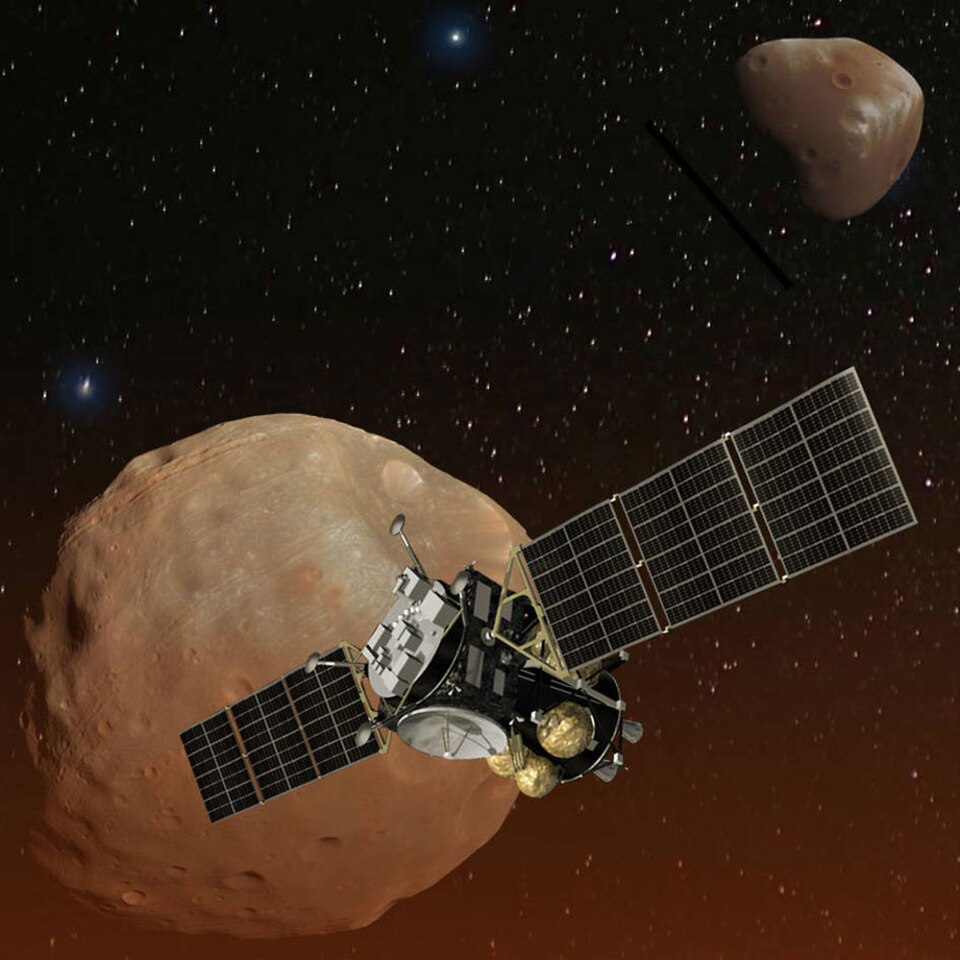
Mars has two moons. They are small, dark, irregularly shaped, and deeply strange — and after decades of observation from Earth and Mars orbit, nobody knows where they came from. Phobos, the larger, is only 27 kilometers across and orbits so close to Mars that it completes three orbits every Martian day, rising in the west and setting in the east. Deimos, the smaller, is barely 15 kilometers at its widest point — more potato than moon — orbiting quietly at a greater distance. Both are so dark they absorb nearly all the sunlight that hits them, and both appear to be made of material chemically similar to carbonaceous asteroids from the outer solar system.
That last point is the problem. If Phobos and Deimos look like asteroids, they might simply be asteroids captured by Mars’s gravity billions of years ago — wayward rocks from the asteroid belt or the outer solar system that happened to pass close enough to be caught. But their orbits don’t cooperate with that theory. Captured bodies typically end up in elliptical, inclined orbits. Phobos and Deimos orbit nearly in Mars’s equatorial plane, in nearly circular paths — exactly the configuration you’d expect from debris ejected from Mars itself by a massive ancient impact, not from captured interlopers. The appearance says asteroid. The orbit says impact debris. The question has been unresolved for more than forty years.
JAXA’s MMX mission — Martian Moons eXploration — is going to resolve it.
The Mission
MMX is JAXA’s most ambitious planetary science mission since Hayabusa2 returned samples from asteroid Ryugu in 2020. Like Hayabusa2, it is a sample return mission — but from a fundamentally more challenging destination. Phobos orbits inside Mars’s radiation belts, in a dynamic gravitational environment created by the competing pulls of Mars, the Sun, and the two moons themselves. Landing on a body with almost no gravity — surface gravity on Phobos is about one-thousandth of Earth’s — requires techniques that have never been attempted at such a distance from Earth.
The spacecraft consists of three modules. The Propulsion Module carries the fuel for the journey to Mars and the orbital maneuvers needed to operate in the Martian system for three years. The Return Module carries the sample container and will eventually leave Mars for Earth, landing in the Australian desert in 2031. The Exploration Module carries the science instruments and deploys the IDEFIX rover onto Phobos’s surface.
MMX carries a suite of nine science instruments covering imaging, infrared spectroscopy, gamma ray and neutron spectroscopy, dust analysis, and magnetometry. The MEGANE gamma-ray and neutron spectrometer — contributed by NASA’s Johns Hopkins Applied Physics Laboratory, the same team that built the MESSENGER and New Horizons instrument suites — will measure the elemental composition of Phobos’s surface from orbit, providing a direct chemical fingerprint that can be compared to known asteroid types and Martian crustal material. If Phobos’s elemental composition matches carbonaceous asteroids, the captured-asteroid theory gains ground. If it matches Mars, the impact theory wins.
The sample collection itself will attempt to gather at least 10 grams of Phobos surface material — a small quantity by human standards but enough for the full range of laboratory analyses that have transformed our understanding of asteroid Ryugu since Hayabusa2’s return. The samples will be collected during two separate landing attempts on Phobos in early and mid-2029, using a coring sampler designed to penetrate the loose regolith covering the surface.
IDEFIX: A European Rover on a Martian Moon
One of MMX’s most distinctive elements is a passenger: IDEFIX, a small rover jointly developed by France’s CNES and Germany’s DLR, weighing approximately 25 kilograms. Named after the dog in the Asterix comic series — the Japanese team approved the name — IDEFIX will be deployed from the MMX spacecraft at an altitude of less than 100 meters above Phobos’s surface, descending in a controlled fall under the moon’s negligible gravity.
Once on the surface, IDEFIX will conduct a 100-day surface mission, rolling across the regolith and making measurements with two instruments: a radiometer to measure thermal properties of the surface and a Raman spectrometer to analyze mineral composition at the microscopic scale. These close-up surface measurements will complement the orbital observations from the MMX spacecraft and the returned samples, providing a complete picture of Phobos from orbit to surface to laboratory.
IDEFIX is the first non-Japanese rover ever to operate on a body other than Earth — a significant milestone for European planetary exploration delivered through a Japanese mission. France and Germany will receive a share of the returned samples in exchange for their contribution.
The Journey
MMX is targeting launch in October 2026 from the Yoshinobu Launch Complex at Tanegashima Space Center, on JAXA’s H3 rocket — Japan’s new flagship launch vehicle, which has been in development and qualification since 2020. The spacecraft will travel to Mars over approximately one year, arriving in 2027 and entering a Quasi-Satellite Orbit (QSO) around Phobos — a complex trajectory that keeps the spacecraft in the vicinity of the moon without technically orbiting it, since Phobos’s gravity is too weak to maintain a stable orbit in the conventional sense.
From QSO, the spacecraft will observe both Phobos and Deimos in detail, mapping their surfaces, measuring their compositions from orbit, and characterizing the landing sites before committing to the sample collection attempts in 2029. A series of flybys of Deimos will extend the mission’s science beyond Phobos alone, providing the closest-ever observations of Mars’s outer moon.
In November 2030 the Return Module will separate from the rest of the spacecraft and begin its journey home, landing in the Woomera Prohibited Area in South Australia in July 2031 — the same region used by JAXA’s Hayabusa and Hayabusa2 sample capsules on return.
Why Phobos and Deimos Matter
The question of where Phobos and Deimos came from is not merely academic. If they are captured asteroids, they represent pristine material from the early outer solar system — preserved fragments of the same populations that delivered water and organic molecules to the inner planets. If they are impact debris, they are pieces of early Mars, potentially including material from deep within the Martian crust that no rover could ever access directly.
There is a third possibility that has attracted significant scientific interest: Phobos and Deimos may contain material from both sources — a mix of Martian ejecta and accreted outer solar system material — in proportions that tell a detailed story about the solar system’s early violent history. The returned samples, analyzed in laboratories with instruments far more sensitive than anything that can be sent to Mars, will provide the most definitive answer available to science.
MMX also advances JAXA’s long-term Mars exploration strategy. Japan has not yet sent a spacecraft to the Martian system, and MMX — if successful — will make Japan the seventh space agency to operate a spacecraft in the Martian system, joining NASA, the Soviet Union, ESA, ISRO, the UAE, and China — and the first to return samples from the Martian region. The mission builds directly on the heritage of Hayabusa2, using evolved versions of the same sample collection, container, and Earth return technologies that succeeded at Ryugu.
Two small, dark, irregular moons. Forty years of debate about where they came from. One mission to bring back the answer.
