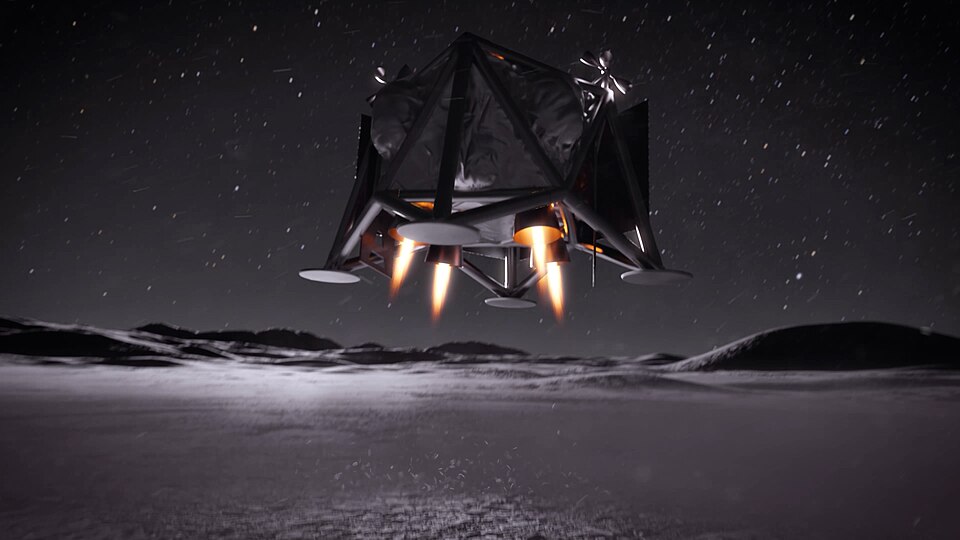
In April 2021, a 1.8 kg helicopter named Ingenuity lifted off from the floor of Jezero Crater on Mars. It was the first powered, controlled flight on another planet. Ingenuity was supposed to make five test flights. It made 72. Now the team at NASA’s Jet Propulsion Laboratory that built it is turning to the Moon, with a mission called MoonFall: four drones that will scout the lunar south pole before astronauts get there.
There’s one big difference. The Moon has no air, so a helicopter can’t fly there. MoonFall’s drones won’t use rotors at all. They’ll hop.
Rockets instead of rotors
Ingenuity flew by spinning its blades fast enough to push against Mars’s thin atmosphere. On the Moon there’s nothing to push against, so each MoonFall drone will use small rocket engines instead. It will fire them to lift off, arc over the terrain, and come back down somewhere new.
Each drone can make several of these propulsive flights, covering up to 50 kilometers in total. That doesn’t sound like much compared with a car trip, but it’s far more than any lunar rover has driven in such rough ground. Hopping lets a drone cross boulder fields, steep crater walls and deep shadows that would stop a wheeled vehicle.
Why the south pole needs scouts
NASA wants to build its first Moon base near the lunar south pole, and the crews of Artemis IV and V are expected to land there. The south pole is attractive for two reasons. Some of its higher ground gets sunlight for long stretches, which is good for solar power. Some of its craters never see the Sun at all. These permanently shadowed regions are among the coldest places in the solar system, and they’re thought to hold water ice that could one day be turned into drinking water, oxygen and rocket fuel.
The same features that make the south pole valuable also make it hard to explore. The Sun stays low on the horizon, so even sunlit ground is covered in long, shifting shadows. Orbiting spacecraft have mapped the region from above, but no one has seen much of it up close.
MoonFall’s drones are meant to change that. Using high-definition cameras and possibly other instruments, they’ll survey terrain, look into permanently shadowed regions, and map places where future landers can touch down safely and where resources like water ice might be found. NASA lists a “Lunar Dashcam” among the mission’s payloads to produce high-resolution terrain maps.
Carlos García-Galán, manager of NASA’s Moon Base program, has said the drones will also place markers at “key scientific objectives” and at places where the agency wants to build up the base.
Getting there
NASA announced MoonFall on March 24, 2026, the same day it laid out its plan to build a base on the Moon. JPL is designing and building the four drones and managing the mission.
To deliver them, JPL turned to Firefly Aerospace, the Texas company whose Blue Ghost lander made a successful Moon landing in 2025. In May 2026, Firefly won a $75 million subcontract to carry the drones on its Elytra spacecraft. Elytra is an orbital vehicle that reuses systems proven on Blue Ghost Mission 1, including its avionics, carbon composite structures and Spectre engines. For MoonFall, Firefly is building a configuration called Elytra Dark, designed to carry up to 1,000 kilograms of drones.
The plan goes like this. After launch on a rocket NASA will provide, Elytra will carry the drones on a 45-day trip to the Moon and enter lunar orbit. It will then drop out of orbit and slow down, releasing the four drones about 50 kilometers above the south pole. From there, each drone is on its own. It will descend, land and begin exploring independently.
Deploying drones this way has never been done before.
Two weeks of flying, months of listening
The drones are designed to operate for one lunar day, about 14 Earth days, before the long, frigid lunar night sets in. After their final flights, each drone carries a “survive-the-night” payload designed to keep working for several more months, collecting data long after the hopping is done.
Where things stand
On October 21, 2026, Firefly announced that Elytra had passed its preliminary design review, less than four months after the contract was awarded. Engineers from Firefly, NASA and JPL reviewed the spacecraft’s structure, propulsion, navigation, communications and test plans. Next comes the critical design review, followed by building and testing the hardware. Launch is targeted for late 2028.
That timing puts MoonFall on the Moon around the same time as Artemis IV, NASA’s first planned crewed landing of the Artemis era. It’s part of the first phase of NASA’s Moon Base plan, which calls for more than twenty robotic landings to prepare the way for crews.
The scouts go first
When Apollo astronauts landed on the Moon, they relied on maps made from orbiters and on robotic landers like Surveyor that had gone before them. MoonFall plays a similar role for the Moon Base era, with one advantage the Surveyors never had: it can move. If it works, the first astronauts to live and work at the lunar south pole will know where they’re going a little better, thanks to four small drones that hopped there first.