On June 30, 1908, something exploded above the Podkamennaya Tunguska River in a remote region of Siberia with the force of roughly 1,000 Hiroshima bombs. Whatever it was — most likely a rocky asteroid 50 to 80 meters across — it never reached the ground. It detonated in the atmosphere, flattening an estimated 2,000 square kilometers of forest and knocking people off their feet 60 kilometers away. Nobody saw it coming.
The Tunguska event remains the largest known cosmic impact in recorded history, caused by an object smaller than a city block. An asteroid 140 meters across — the size of a large sports stadium — would release energy roughly 50 times greater. One a kilometer across would be a civilization-altering catastrophe. We have found most of the kilometer-class asteroids whose orbits intersect Earth’s. We have found far fewer of the smaller ones. NASA’s NEO Surveyor is being built to change that, permanently.
A Congressional Mandate and a Twenty-Year Wait
The story of NEO Surveyor begins not with a spacecraft but with a law. In 2005, the United States Congress passed the NASA Authorization Act, directing NASA to discover and characterize 90 percent of all near-Earth objects larger than 140 meters in diameter by 2020. It was an ambitious target. Meeting it, most planetary scientists agreed, would require a space-based infrared telescope — a detector sensitive to the heat emitted by asteroids themselves rather than the sunlight they reflect, capable of finding both bright and dark objects with equal efficiency.
Ground-based telescopes have a fundamental limitation: they can only observe asteroids when those objects are in a dark sky and far enough from the Sun to be visible at night. Asteroids on trajectories that approach Earth from the direction of the Sun — exactly the direction from which the most dangerous impactors would come — are effectively invisible from Earth’s surface. A space telescope positioned at the Sun-Earth Lagrange Point 1, approximately 1.5 million kilometers toward the Sun, can look back toward the inner solar system and see objects that no ground-based telescope can ever detect.
The mission concept that became NEO Surveyor — then called NEOCam — was first proposed to NASA in 2006. It was submitted to NASA’s Discovery program competition five separate times over eleven years and rejected each time in favor of other science missions. Planetary defenders argued that NEOCam was being evaluated by the wrong criteria — competing for planetary science funding when it was really a national security and public safety mission. In 2019, under sustained pressure from Congress and the scientific community, NASA’s Planetary Defense Coordination Office agreed to fund the mission outside the planetary science competition. NEO Surveyor was officially born.
Then the budget problems started. NASA’s 2023 budget request cut NEO Surveyor’s funding by more than 30 percent, forcing a two-year slip from a 2026 launch to a June 2028 commitment. Congress pushed back — the 2022 CHIPS and Science Act explicitly directed NASA to launch by March 2026, a deadline the budget cut had already blown past. The mission’s cost nearly doubled, from early estimates of $600 million to a confirmed $1.2 billion. The project team, led by principal investigator Dr. Amy Mainzer of UCLA, kept building.
By May 2025 they had good news. Testifying before the House Space and Aeronautics Subcommittee, Mainzer reported that NEO Surveyor was ahead of schedule and targeting a late 2027 launch — pulling back several months from the 2028 commitment. As of September 2027 — no earlier than — remains the current target on NASA’s official mission page.
The Telescope
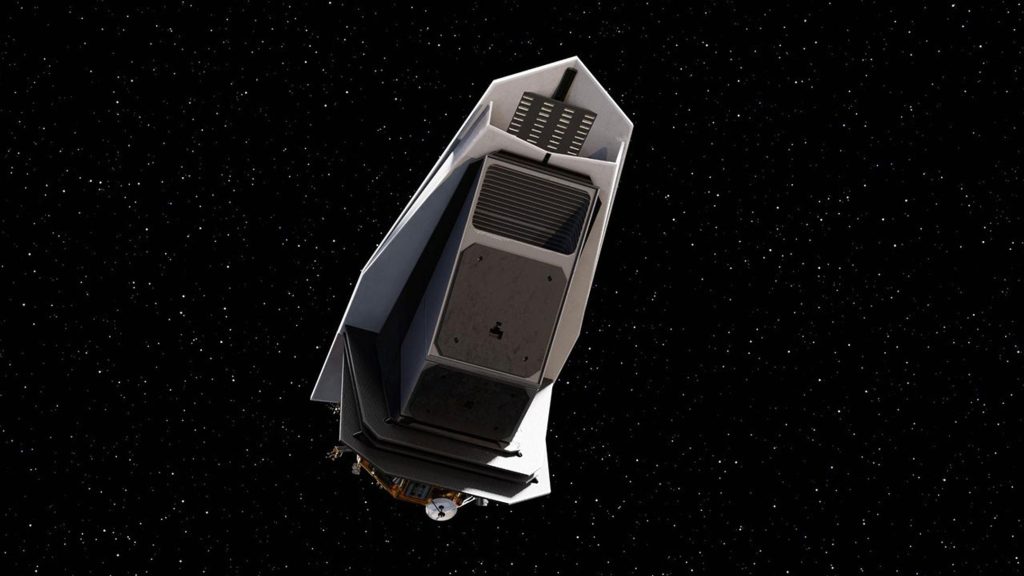
NEO Surveyor is a compact but capable instrument. Its primary mirror is 50 centimeters in diameter — modest by the standards of flagship observatories like Hubble or Webb, but more than sufficient for its survey mission. What distinguishes it is not its size but its detector: a mercury-cadmium-telluride infrared array operating in two thermal infrared bands between 4 and 10 microns. At these wavelengths, asteroids glow with their own heat — the same heat they absorb from sunlight and then re-radiate — regardless of whether their surfaces are bright or dark.
This is the mission’s crucial capability. Roughly half of all near-Earth asteroids are dark — coated with carbon-rich material that absorbs sunlight rather than reflecting it. These objects are essentially invisible to optical telescopes unless they happen to pass very close to Earth. An infrared telescope sees them just as clearly as brighter objects. Ground-based surveys like the Catalina Sky Survey and Pan-STARRS have been extraordinarily productive, but they systematically undercount dark asteroids. NEO Surveyor will not.
The spacecraft will also operate continuously — 24 hours a day, 7 days a week — scanning the sky in a systematic pattern that allows it to detect the motion of asteroids against the fixed star background. Multiple observations of the same object over days and weeks allow its orbit to be calculated with increasing precision, determining whether it poses any threat to Earth and characterizing its size, composition, and rotation rate.
The Science of Planetary Defense
NEO Surveyor’s primary mission is not science in the traditional sense — it is a survey, a census, an inventory. Its goal is to find objects, not study them in detail. But the mission’s data will be scientifically rich regardless.
Every asteroid NEO Surveyor detects will have a measured thermal emission, which constrains its diameter independent of its surface brightness — a significant improvement over optical size estimates that depend on assumed reflectivities. The mission will characterize the size distribution, orbital distribution, and thermal properties of the near-Earth object population with statistical precision never previously achieved. That data will feed directly into improved impact probability calculations, better models of the asteroid belt’s long-term dynamics, and a more complete understanding of the building blocks that assembled into the terrestrial planets.
For objects large enough to merit follow-up, NEO Surveyor’s detections will trigger ground-based observations from telescopes worldwide, and potentially future missions — characterization spacecraft, or, if necessary, deflection missions in the mold of DART and Hera.
The Stakes
Congress mandated 90 percent completeness for 140-meter-plus objects by 2020. That deadline has passed without the goal being met. NASA’s Planetary Defense Coordination Office estimated in January 2022 that at the current discovery rate — without NEO Surveyor — it would take more than 30 years to complete the survey. NEO Surveyor, once operational, will make significant progress toward the 90 percent threshold within five years and achieve it within ten to twelve.
The objects it will find are not hypothetical threats. Roughly 2,000 near-Earth asteroids larger than 140 meters are currently known. Models suggest there are between 25,000 and 30,000 such objects in total. That means we have found less than ten percent of the ones large enough to devastate a major city or trigger regional catastrophe. We do not know where most of them are. We do not know if any of them are headed our way.
NEO Surveyor will tell us. It will look outward in the infrared, sweeping the sky repeatedly, finding objects in orbits we cannot currently see, building the most complete catalog of near-Earth objects ever assembled. The asteroid that hit Tunguska in 1908 was never seen. The next one does not have to be a surprise.