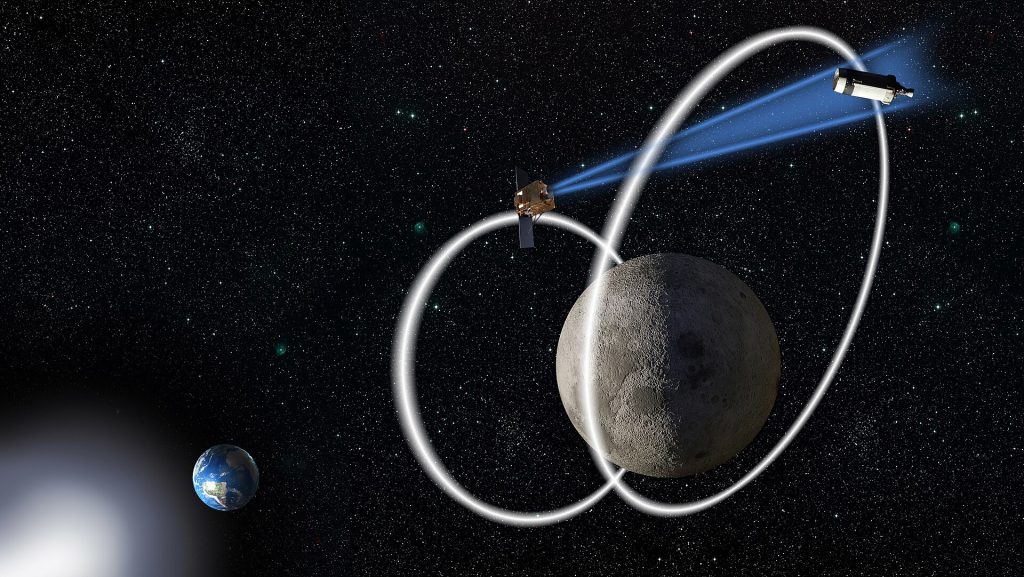
The space between Earth and the Moon is getting busy. NASA’s Artemis missions, commercial landers, relay satellites, and Chinese orbiters are all heading into a region that, until recently, saw a spacecraft or two every few years. Tracking objects close to Earth is a well-practiced job, but the tools built for it don’t reach very far. A small satellite near the Moon is faint and distant, and often lost in the glare of the Sun or the Moon itself. The U.S. Air Force Research Laboratory (AFRL) is building Oracle to fix that: a pair of experimental spacecraft designed to watch cislunar space, the region between Earth and the Moon, from inside it.
A name from Apollo
Oracle began as the Cislunar Highway Patrol System, or CHPS, a name that captured the idea but not much romance. AFRL renamed it Oracle, a choice it said was meant “to acknowledge the accomplishments of the Apollo program.” In Greek mythology, the god Apollo spoke through the famous oracle at Delphi.
In 2022, AFRL awarded Advanced Space, the Colorado company behind NASA’s CAPSTONE, a $72 million contract to develop the spacecraft. In December 2023, AFRL merged Oracle with a second program, the Defense Deep Space Sentinel, into one “Oracle family.” The smaller spacecraft became Oracle-M, for Mobility, and the original became Oracle-P, for Prime.
Oracle-M: the pathfinder
Oracle-M is the low-cost scout. Built by Blue Canyon Technologies under a $14.6 million contract awarded in 2021, it’s about the size of a small washing machine. It will launch to geostationary orbit, around 36,000 km up, and then use its own propulsion to head out into cislunar space.
Its job is to learn how to operate out there: to practice maneuvering and orbit changes, test navigation methods, and try out techniques for keeping track of known objects. As AFRL’s Andrew Williams put it, “We’ll learn many important lessons from Oracle-M that feed into Oracle-P.”
Oracle-M was originally scheduled for delivery in mid-2024. It completed a hot-fire test of its propulsion system in 2025 and, by February 2026, was ready to be integrated with its rocket. It is set to ride as a secondary payload on a U.S. Space Force launch, reportedly aboard a ULA Vulcan rocket, and could fly by the end of 2026, though the Space Force was reviewing the launch schedule.
Oracle-P: a watchtower at L1
Oracle-P is the main event. It’s designed to be the first satellite built for sustained operations at the Earth-Moon L1 point, a gravitational balance point between Earth and the Moon roughly 320,000 km from Earth, far beyond the ring of geostationary satellites.
From there it will scan for objects with two cameras: a wide-field sensor to find things, including objects that are unknown or have been lost track of, and a more sensitive narrow-field sensor to follow them. It will also test processing its images onboard, so it can send back only what matters rather than every picture. Principal investigator James Frith says the goals include advancing techniques to “detect small or distant objects.”
Advanced Space leads the Oracle-P effort. In 2023, it contracted General Atomics to build the spacecraft on its GA-500 platform, with an optical payload from Leidos. AFRL originally planned to fly an experimental “green” propellant system on Oracle-P but separated it from the mission to avoid delays.
Oracle-P was first targeted for launch in late 2025. AFRL later pushed it back, calling the early schedule “ambitious and aggressive” and citing the mission’s complexity and funding. Delivery is now expected in 2026, with launch in 2027 and a two-year demonstration to follow.
Why the military is looking at the Moon
“Like NASA we’re going to be operating in those same spaces,” said Col. Jeremy Raley, then director of AFRL’s Space Vehicles Directorate. Today, if a spacecraft near the Moon breaks apart, drifts off course or does something unexpected, there’s no reliable way to watch it happen. As traffic grows, so does the risk of collisions and confusion, and so does the interest in knowing who is out there and what they’re doing.
That interest is growing. In April 2026, the U.S. Space Force set up a task force on acquiring cislunar capabilities, with an eye on NASA’s planned Moon base. The data Oracle gathers will be shared through the military’s Unified Data Library, a common database of space tracking information.
What comes next
Oracle is an experiment, not an operational system. If it works, it will show how to find and follow small objects across hundreds of thousands of kilometers of space, and how future spacecraft might keep watch over the route to the Moon as it fills up.