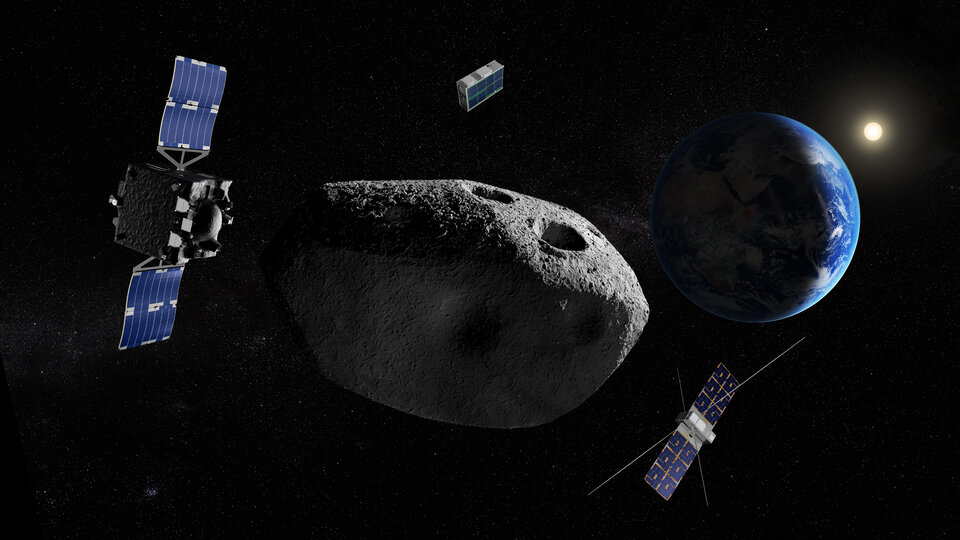
On April 13, 2029, an asteroid the size of several city blocks will pass closer to Earth than the satellites that broadcast our television. Apophis, about 375 meters across, will sweep within roughly 32,000 kilometers of Earth’s surface, bright enough to see with the naked eye from dark skies across Europe, Africa and western Asia. ESA estimates that an object this large passes this close only once every 5,000 to 10,000 years. The European Space Agency intends to be there waiting. Its Ramses mission will meet Apophis two months before the flyby and ride along with it as Earth’s gravity tugs at it.
The asteroid that once worried the world
Apophis was discovered on June 19, 2004, at Kitt Peak National Observatory in Arizona. Within months it became the most notorious asteroid in the sky. In December 2004, early calculations gave it a 2.7% chance of hitting Earth in 2029, the highest risk ever recorded at the time for an asteroid of its size. It reached level 4 on the Torino impact hazard scale.
The scare didn’t last. Older images found in archives that same December extended the asteroid’s observed path and ruled out a 2029 impact. Later observations eliminated a feared 2036 impact as well, and in 2021 NASA removed Apophis from its impact risk list entirely: no impact is possible for at least the next 100 years.
Its name fits its reputation. Apophis is the Greek name for Apep, the Egyptian serpent god of chaos who tried to swallow the sun god Ra.
Why go now?
Apophis no longer poses a danger, but its 2029 pass is a natural experiment scientists have never had the chance to watch. As ESA scientist Patrick Michel put it, “For the first time ever, nature is bringing one to us and conducting the experiment itself.”
Earth’s gravity will pull on Apophis as it passes. Scientists expect the encounter could alter the asteroid’s orbit and spin, and could shake its surface, perhaps triggering small landslides or quakes. Watching how a real asteroid responds to these forces will reveal what it’s made of inside: whether it’s a solid block or a loosely bound pile of rubble. That matters for planetary defense: a rubble pile reacts to being hit or pushed very differently from a solid rock.
The name says it all
Ramses stands for the Rapid Apophis Mission for Space Safety, and “rapid” is the key word. Asteroid missions usually take a decade or more to develop. To reach Apophis before April 2029, ESA had about four years.
The answer was to borrow heavily from Hera, ESA’s mission now arriving at the Didymos asteroid system to study the aftermath of NASA’s DART impact. Ramses reuses much of Hera’s design, technology, industrial team and science community. Its cameras, radio science experiment and several instruments come directly from Hera hardware or designs.
ESA approved preparatory work for Ramses in July 2024. Member states committed full funding at the ESA ministerial council in late November 2025. The mission passed its Critical Design Review on February 6, 2026, and four days later ESA signed an €81.2 million contract with OHB Italia to build, assemble and test the spacecraft. The core module was switched on for the first time on September 21, 2026.
Richard Moissl, head of ESA’s Planetary Defence Office, framed the deadline as part of the point: “Ramses will demonstrate that humankind can deploy a reconnaissance mission” quickly, the kind of capability needed if a dangerous asteroid is ever found heading our way.
A Japanese partnership
Japan is a key partner. JAXA will launch Ramses on an H3 rocket from Tanegashima Space Center between mid-April and mid-May 2028, sharing the ride with JAXA’s own asteroid mission, DESTINY+. JAXA is also supplying Ramses’ solar arrays and its thermal infrared imager. ESA and JAXA signed a cooperation agreement for the mission in May 2026.
The spacecraft and its helpers
After a roughly 10-month cruise, Ramses will arrive at Apophis around February 2029, no later than March 1. It will carry eight instruments, including two framing cameras, a color imager, a hyperspectral camera that reveals mineral composition, a laser altimeter for measuring the surface, and a plasma spectrometer. During the flyby, it will hold position about 5 kilometers from the asteroid, taking images roughly once a minute.
It will also release two CubeSats. Farinella will orbit Apophis with a radar that can see inside the asteroid, plus a dust analyzer and camera. Don Quijote will attempt to land on the surface, carrying a magnetometer, a gravimeter and a seismometer that could detect any shaking as Earth’s gravity tugs on the asteroid. ESA cautions that a successful landing isn’t guaranteed.
Before and after
Ramses won’t be alone. NASA’s OSIRIS-APEX, the spacecraft that returned samples from asteroid Bennu in 2023, will also visit Apophis, but it arrives after the close approach. Ramses gives scientists the “before” picture; OSIRIS-APEX helps complete the “after.” Together, they’ll show exactly what a brush with Earth did to an asteroid.
Legacy
Ramses is part science mission, part rehearsal. Apophis will pass safely in 2029. The next asteroid that comes our way might not, and when that happens, knowing how to reach it quickly, and understanding what it’s made of, could matter a great deal.