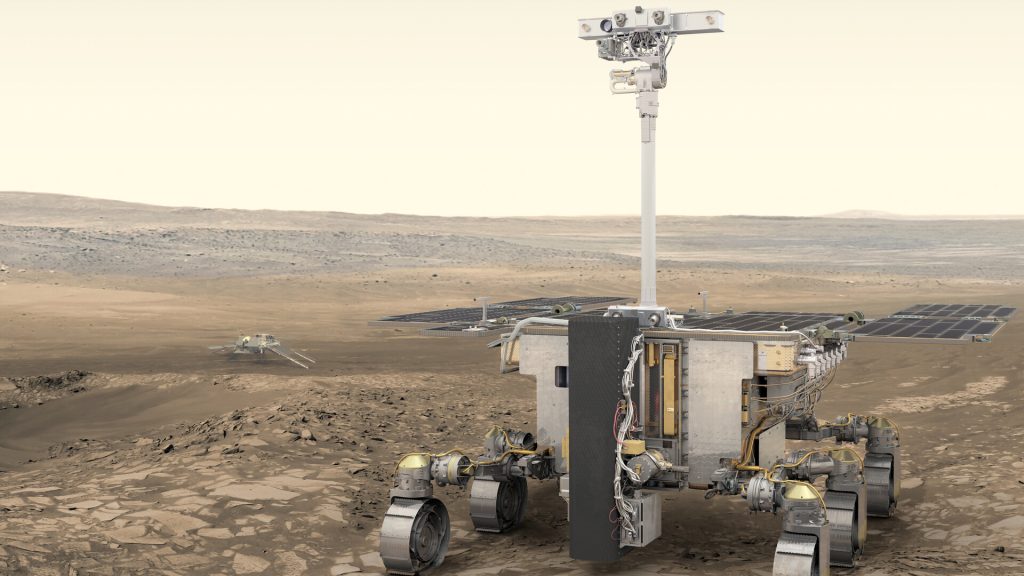
Most Mars rovers spend a few years in development. Europe’s Rosalind Franklin has spent a quarter of a century. It was proposed in 2001, nearly finished by 2022, and then stranded on the ground when its launch partner became a geopolitical impossibility. It survived that, survived a later budget scare, and is now scheduled to launch in late 2028. When it finally reaches Mars, it will carry a drill that can reach 2 meters below the surface, deeper than any Mars mission before it, to look for something no rover has found: evidence of life.
Why drill?
The surface of Mars is a hostile place for organic molecules, the chemical building blocks of life. With no global magnetic field and only a thin atmosphere, it is bathed in radiation that breaks those molecules apart over time. If Mars once hosted life, the best-preserved traces are likely buried, protected from radiation and extreme temperatures.
Curiosity and Perseverance can drill only a few centimeters. Rosalind Franklin’s drill is designed to reach 2 meters, retrieving samples from ancient ground and analyzing them inside the rover. Its largest instrument, the Mars Organic Molecule Analyzer (MOMA), is built to detect tiny amounts of organic material, and NASA has already delivered its mass spectrometer to Europe.
Named for a scientist who saw DNA’s shape
In February 2019, the rover was named after Rosalind Franklin (1920–1958), the British chemist whose X-ray images were critical to discovering the double-helix structure of DNA. A rover built to hunt for the chemistry of life carries the name of a scientist who helped reveal it.
A long road
The ExoMars rover began in 2001 under ESA’s Aurora exploration program. Its first plan was a 2009 launch. That slipped, and it was then tied to a joint mission with NASA for 2018, until NASA canceled its own partner rover in 2011.
In 2013, ESA turned to Russia. The Russian space agency, Roscosmos, would provide the rocket, the landing module and a surface platform called Kazachok. Launch was set for 2020, then delayed to 2022 after problems with parachute testing. By April 2022, the spacecraft was ready to ship to the Baikonur launch site.
It never went. After Russia invaded Ukraine in February 2022, ESA suspended the launch in March and ended cooperation with Roscosmos that July. The rover was finished, but it had no rocket and no way to land.
Rebuilding without Russia
Rather than abandon it, ESA decided to replace everything Russia had supplied and called the decision a step toward “European autonomy and leadership in Mars science.” European industry is building a new landing platform, reusing some existing equipment such as the onboard computer, radar altimeter and parachute system. In April 2024, ESA awarded Thales Alenia Space a €522 million contract to develop the replacement elements and keep the rest of the spacecraft in shape. Airbus is building the landing platform.
NASA came back in. Under a May 2024 agreement, NASA committed to provide the launch, the braking engines for the landing platform, and radioisotope heater units that use the heat of decaying plutonium to keep the rover’s systems warm through the frigid Martian nights. Those heaters were part of what Russia had originally supplied.
One more scare
In 2025, it looked like the rover might lose its partner again. The White House’s proposed 2026 budget eliminated about 20 NASA collaborations with ESA, Rosalind Franklin among them. The Planetary Society estimated NASA’s contribution at roughly $375 million.
At ESA’s ministerial council in Bremen in November 2025, ESA Director General Josef Aschbacher announced that NASA had confirmed in writing it would still provide all three elements. “These confirmations have been given to us in writing,” he said, “so this is a very important step.” ESA member states confirmed their own funding the same month.
In April 2026, NASA announced the rover would launch on a SpaceX Falcon Heavy from Kennedy Space Center, no earlier than late 2028. In June 2026, NASA delivered the first braking engines.
Destination: Oxia Planum
The rover will land at Oxia Planum, a broad plain just north of the Martian equator chosen in 2015 for its clay-rich rocks, around 4 billion years old. Clays form in water, and water-formed rocks are among the best places to look for preserved traces of life.
Rather than taking the quickest path, the spacecraft will follow a two-year transfer to arrive when landing conditions are favorable, with touchdown planned for 2030. The rover should roll off its platform within ten Martian days, and begin its first deep drilling about a month after landing. It will then drive about 4 kilometers over a mission of at least seven months.
Communication will run through ESA’s ExoMars Trace Gas Orbiter, which has been circling Mars since 2016, partly to serve as this rover’s relay. Because those relay passes are limited, Rosalind Franklin is designed to navigate on its own.
Europe’s first rover on Mars
ESA has tried to land on Mars before: the British-built Beagle 2 lander reached the surface in 2003 but never made contact, and the Schiaparelli test lander crashed in 2016. Rosalind Franklin would be Europe’s first rover on Mars, and, if it succeeds, its first fully successful landing there.
After 25 years of waiting, it may also be the mission that finally answers the question it was built for.