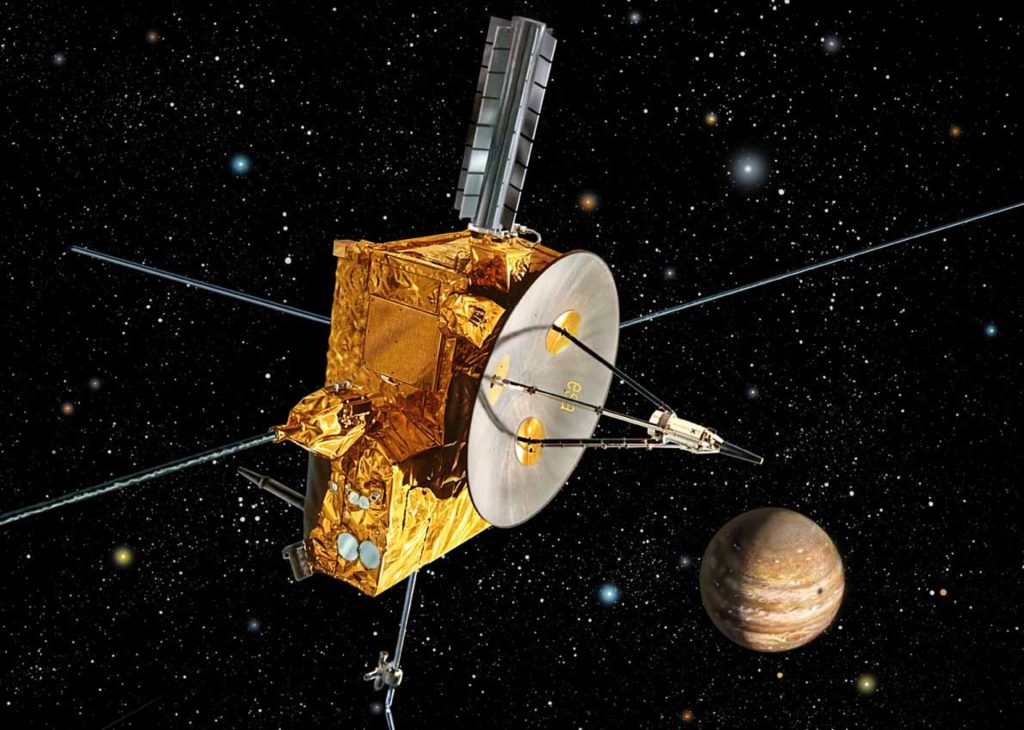
For all of human history, we have seen the Sun from one angle only. Earth and every other planet orbit in roughly the same flat plane, so every telescope and spacecraft before 1990 looked at the Sun’s equator and mid-latitudes. Its north and south poles — the regions that turned out to drive much of the solar wind — were effectively unexplored. Ulysses changed that.
Named for a wanderer
The name came from the legendary Greek hero who spent 20 years on an odyssey away from home. It proved fitting: the spacecraft spent almost as long exploring the unknown, and had its share of adventures along the way. ESA’s fact sheet draws the same parallel — like its namesake, Ulysses ventured into unexplored territory, charting the reaches of space above and below the Sun’s poles.
A long road to the launch pad
The mission began as the International Solar Polar Mission, a two-spacecraft partnership between NASA and ESA. It was approved in 1976, the instruments in 1977, with a provisional launch date of February 1983. Then budgets intervened. NASA canceled its spacecraft, a decision that significantly eroded international partners’ confidence in NASA’s reliability. ESA chose to go ahead with a single-spacecraft version, using a European spacecraft carrying half its instruments from the United States. Instruments from the canceled NASA probe were mounted on Ulysses, for twelve in total.
The division of labor shaped the mission for its entire life. ESA provided the spacecraft, built by Dornier Systems in Germany, and managed operations; NASA provided the Shuttle launch and the upper stages to reach the correct orbit. A joint ESA/NASA team at JPL in Pasadena ran the spacecraft day to day.
In January 1986, Ulysses was shipped to Kennedy Space Center for a May launch aboard Challenger on STS-61-F. The loss of Challenger on January 28, 1986 grounded the Shuttle fleet and pushed the launch back more than four years. When Shuttle flights resumed in 1989, Ulysses got a new slot. It finally flew aboard Discovery on STS-41, October 6, 1990. About 7.5 hours after launch, an Inertial Upper Stage and PAM-S motor fired in sequence to send it into heliocentric orbit.
Using Jupiter to leave the plane of the planets
No rocket could push a spacecraft directly into an orbit over the Sun’s poles — the energy required to turn that far out of Earth’s orbital plane is enormous. Ulysses borrowed it from Jupiter instead. On February 8, 1992, it became the fifth spacecraft to reach Jupiter, and the giant planet’s gravity flung it into an orbit far above and below the orbits of the planets.
From then on, Ulysses passed over both solar poles every 6.2 years, on a looping orbit that reached out to Jupiter’s distance and ran almost perpendicular to the ecliptic.
The spacecraft itself was modest — roughly the size of a large golf cart, with no camera at all. It was a fields-and-particles mission. Its instruments sampled what they flew through directly: SWOOPS studied the solar wind at all distances and latitudes in three dimensions, SWICS measured the composition, temperature and speed of solar wind ions, DUST measured interplanetary and interstellar dust grains, and the GAS experiment measured neutral helium from interstellar space leaking into the heliosphere.
The fast wind from the poles
The headline result came on the first polar pass in 1994–95. Near solar minimum, wind from the cooler regions near the poles fans out to fill two-thirds of the heliosphere at a uniform 750 km/s — far faster than the 350 km/s wind from the Sun’s equatorial zone. This turned the old picture on its head. Project scientist Richard Marsden summed it up: “this is really the normal solar wind.” The fast wind also matches the composition of the Sun’s visible surface more closely than the slow wind does.
The mission was expected to end in 1995. Instead it kept going, completing three passes over the Sun’s poles — two with the Sun quiet, and the 2000–2001 pass with the Sun at its most violent. At solar maximum, the steady fast wind disappeared along with the polar coronal holes that produce it. No other spacecraft has watched the polar wind across a full solar cycle.
Other discoveries filled in the picture. Ulysses found the magnetic flux leaving the Sun is the same at all latitudes, and identified energetic-particle “reservoirs” surrounding the Sun. Its data showed the Sun’s magnetic field resembles a bar magnet, with the activity cycle corresponding to that magnet rotating like the hands of a clock. And in September 2008, Ulysses reported the solar wind at a 50-year low.
Looking outward
Ulysses also measured what was coming in from beyond the solar system. It made the first direct measurements of interstellar gas, and showed the interstellar wind is fast enough to create a bow shock upstream of the heliosphere. It caught dust grains from outside the solar system — about 30 times more than expected — proving the heliosphere was not the impenetrable shield scientists had believed.
Chasing comet tails by accident
Ulysses had three unplanned encounters with comet tails. In 1996 it passed through the tail of comet Hyakutake. Then on February 3, 2007, it crossed the ion tail of comet McNaught — the Great Comet of 2007 — some 260 million kilometers from the comet’s nucleus. Even at that distance, the tail had slowed the solar wind from its usual ~700 km/s to under 400 km/s. Ulysses took nearly nine times as long to cross McNaught’s tail as Hyakutake’s, which had previously held the record for longest known tail.
A slow, graceful end
Ulysses ran on a radioisotope power source that weakened year after year. The mission was predicted to end in July 2008, when power was expected to fall below the minimum needed to keep its fuel lines from freezing — without which the spacecraft could not be controlled. A major communication glitch in early 2008 appeared to doom it, but engineers found a fix. Ulysses kept returning data into mid-2009, until competition for Deep Space Network time and falling science return led ESA and NASA to end the mission on June 30, 2009.
Its final tally: 6,842 days, or 18 years, 8 months and 24 days. That beat the previous ESA endurance record, held by the International Ultraviolet Explorer, by just 20 days. Ulysses still circles the Sun today, silent and frozen, on its comet-like path over the poles.
Legacy
Ulysses’s polar view of the Sun stood alone for more than a decade. Solar Orbiter, now tilting its orbit toward the poles, carries the cameras Ulysses never had — and will finally show us what Ulysses could only feel.