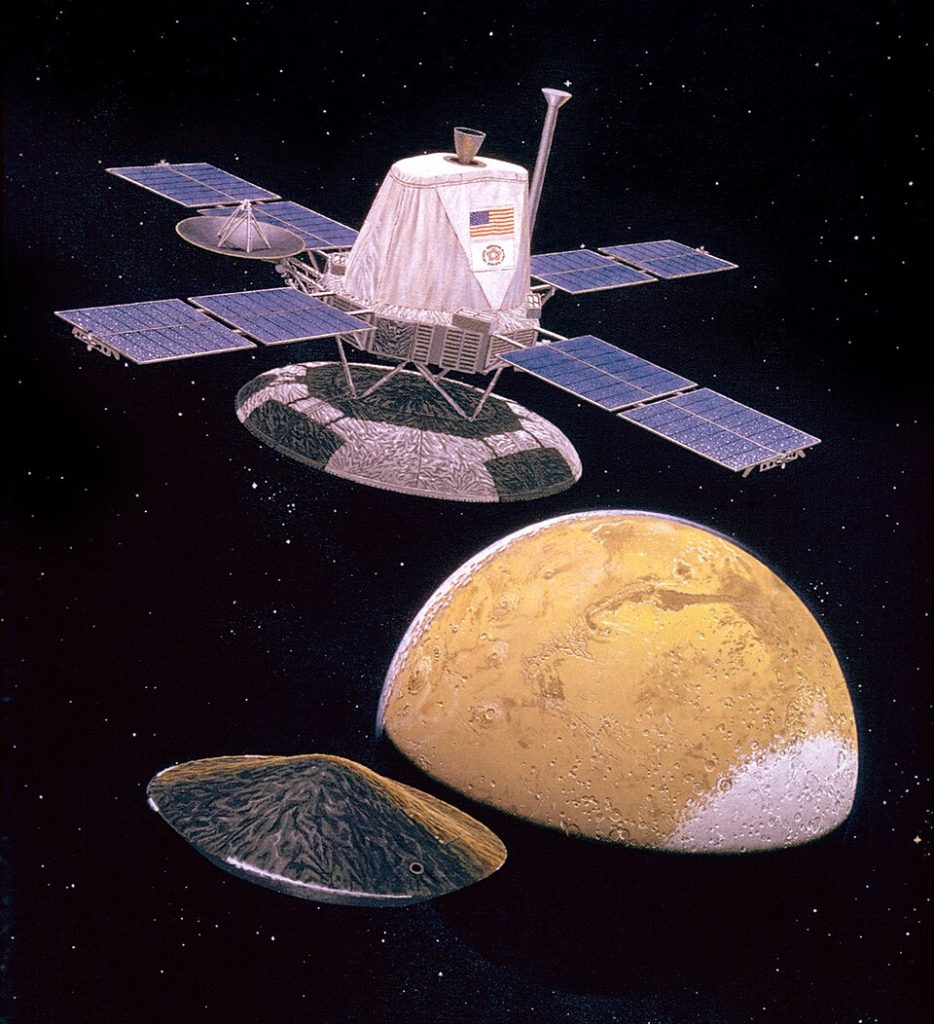
In the summer of 1976, two American spacecraft landed on Mars and asked the most profound question any mission has ever posed: are we alone?
They didn’t get a clear answer. Fifty years later, scientists are still arguing about what they found.
The Mission
Viking was NASA’s most ambitious planetary science program of the twentieth century — and remains the most expensive robotic planetary mission in its history. Two identical spacecraft, each consisting of an orbiter and a lander, launched in the summer of 1975 on Titan IIIE/Centaur rockets from Cape Canaveral. Viking 1 launched August 20, 1975; Viking 2 followed September 9. Each spacecraft weighed 3,527 kilograms at launch — enormous by the standards of the era — and carried a suite of instruments designed to address every major question about Mars that could be addressed from orbit and from the surface simultaneously.
The program had been in development since 1968, when NASA selected Martin Marietta to build the landers and JPL to manage the overall mission. The total cost through the end of mission operations was approximately $1 billion in 1970s dollars — roughly $5 billion in current terms. Nothing like it had been attempted before. Nothing like it has been attempted since.
Arrival and Landing
Viking 1 entered Mars orbit on June 19, 1976. Rather than landing immediately, mission controllers spent weeks in orbit photographing candidate landing sites — an approach forced on them by the discovery that Mars’s surface was far more rugged than earlier missions had suggested. The original primary landing site in Chryse Planitia was rejected after orbital images revealed dangerous terrain. A backup site was selected, photographed, and eventually cleared.
On July 20, 1976 — the seventh anniversary of Apollo 11’s Moon landing — Viking 1’s lander separated from the orbiter and descended through the Martian atmosphere. It was protected by an aeroshell during the initial hypersonic entry, deployed a parachute in the upper atmosphere, then fired retrorockets for the final descent. At 11:53:06 UTC, it touched down on the western slope of Chryse Planitia — the Plains of Gold. The first signals confirming a safe landing arrived at JPL 19 minutes later, the time required for radio waves to travel from Mars to Earth.
The first photograph arrived 25 seconds after landing — an image of one of the lander’s own footpads and the Martian soil around it, taken to ensure the spacecraft had landed safely on solid ground rather than sinking into loose material. When mission controllers saw the photograph — sharp, clear, showing actual rocks on an actual alien world — the room fell silent. Then it erupted.
Viking 2’s lander touched down at Utopia Planitia on September 3, 1976, approximately 6,460 kilometers from Viking 1. The landing site was near the edge of the Martian polar ice cap — chosen specifically because water ice had been detected in the subsurface there, making it a more promising location for any potential life.
What They Saw
The landers’ cameras returned panoramic images of the Martian surface in extraordinary detail — rock-strewn plains stretching to the horizon under a salmon-pink sky, the color caused by iron oxide dust suspended in the thin atmosphere. The landscape was ancient, heavily weathered, and completely barren of any visible macroscopic life. It looked like a desert — specifically, it looked like parts of the American Southwest, which Carl Sagan, who had advocated for the mission for years, noted with a mixture of wonder and disappointment.
The orbiters, meanwhile, mapped the Martian surface at resolutions between 150 and 300 meters — producing the first comprehensive global map of Mars. Selected areas were imaged at 8-meter resolution. The mapping campaign covered 97 percent of the planet’s surface and revealed in detail the volcanic province of Tharsis, the canyon system of Valles Marineris, ancient river channels that proved Mars had once had liquid water flowing across it, and the polar ice caps. The Viking orbiters’ global map remained the primary reference for Mars exploration for more than a decade.
The Biology Experiments
Each lander carried three biology experiments specifically designed to search for signs of microbial life in the Martian soil. They represented the most carefully thought-through life detection strategy ever deployed on another planet — and the results immediately divided the scientific community.
The Pyrolytic Release experiment incubated Martian soil in a closed chamber with carbon monoxide and carbon dioxide labeled with radioactive carbon-14, simulating a Mars-like environment and checking whether anything in the soil would incorporate the carbon — as living organisms would. The results were positive. Something in the soil was incorporating carbon.
The Labeled Release experiment added a nutrient solution containing radioactive carbon to Martian soil and looked for the release of radioactive carbon dioxide — the signature of microbial metabolism. The results were dramatically positive — far more radioactive gas was released than expected, and the reaction was rapid. The principal investigator, Gilbert Levin, believed then and maintains to this day that the results indicated life.
The Gas Exchange experiment humidified Martian soil and looked for gas exchange with the atmosphere — another biological signature. It also produced a positive result — oxygen was released upon humidification.
Any one of these results, from soil on Earth, would have been interpreted as strong evidence for microbial activity. But Viking carried a fourth instrument that cut through the apparent optimism: the Gas Chromatograph Mass Spectrometer, which could directly detect organic molecules in the soil. It found essentially none — not even the trace amounts expected from meteorite delivery over billions of years. If life was present and producing the biological signals seen by the other experiments, it should have left organic molecules in the soil. There were none.
The scientific consensus that emerged — and which most scientists still hold — is that the positive results from the biology experiments were produced not by life but by the highly oxidizing chemistry of the Martian soil. Mars’s surface is saturated with perchlorates and reactive oxygen compounds that can mimic the signatures of biology and would also destroy any organic molecules present, explaining their absence in the GCMS results. The chemistry of Martian soil was stranger and more reactive than anyone had anticipated — and stranger than life.
Gilbert Levin never accepted this interpretation. He continued to argue until his death in 2021 that Viking’s Labeled Release experiment had detected life, and that the scientific community’s consensus was built on an incorrect assumption about what the GCMS would or could detect. The debate generated by Viking’s biology results directly shaped the design of every subsequent Mars mission — shifting the focus from direct life detection to understanding Mars’s habitability and seeking environments where life might survive, rather than asking the yes-or-no question Viking had attempted.
Beyond the Biology
While the biology results dominated public attention, Viking’s other science was transformative. The landers carried weather stations that returned the first in-situ meteorological data from Mars — temperatures, wind speeds, and pressure measurements across multiple Martian seasons. Viking 2’s lander photographed water frost on the surface at Utopia Planitia in 1979 — the first water directly observed on Mars. Seismometers detected what may have been marsquakes, though the data was ambiguous due to lander vibrations.
The landers also performed detailed chemical analysis of the soil using X-ray fluorescence spectrometers, characterizing the elemental composition of the Martian regolith with a precision not matched until the Mars Exploration Rovers arrived in 2004. The soil composition — iron-rich, sulfur-rich, and highly oxidizing — established the baseline against which all subsequent Mars surface chemistry has been measured.
The Long Farewell
Both landers far exceeded their design lifetimes. Viking 2’s lander operated for 1,316 Earth days — nearly four years — before its batteries failed on April 11, 1980. Viking 1’s lander survived even longer, operating for 2,245 Martian sols — more than six Earth years — before a software upload error accidentally overwrote its antenna pointing software on November 19, 1982. With the antenna pointed incorrectly, Viking 1 could no longer communicate with Earth. All attempts to reestablish contact failed. The last signal from Viking 1 was received on November 13, 1982.
Both landers remain on the Martian surface. They are not lost — their locations are precisely known, and both have been photographed from orbit by Mars Reconnaissance Orbiter. They sit in their landing positions, tilted slightly, weathered by decades of Martian wind and dust, waiting for visitors who have not yet arrived.
The Question Remains
Viking asked whether there was life on Mars. The mission did not definitively answer the question — it answered it one way, with chemistry, while leaving open the possibility that the chemistry was wrong, or that the instruments were looking in the wrong place, or that the wrong question was being asked. Every Mars mission since has been shaped by what Viking found and what it didn’t find. The Curiosity and Perseverance rovers exist because Viking taught NASA that life detection requires understanding habitability first.
The surface of Mars is almost certainly inhospitable to life today. Whether it was hospitable in the ancient past — when liquid water flowed across it, when its atmosphere was thicker and its magnetic field stronger — is the question Perseverance is trying to answer by collecting samples that a future mission will return to Earth for laboratory analysis.
Viking started that conversation in 1976. It has not ended.