Jeff Bezos founded Blue Origin in 2000 with a single long-term vision: millions of people living and working in space. Twenty-six years later, the company he built is preparing to land on the Moon for the first time — not with a crew, but with a cargo lander named Endurance that will attempt to demonstrate the precision landing capabilities needed to eventually put astronauts on the lunar surface.
Moon Base I — officially NASA’s designation for the first Blue Moon MK1 mission — is the first in a planned series of Blue Origin lunar landings targeting the south pole of the Moon, the same region where NASA intends to land Artemis astronauts beginning in 2028. It is Blue Origin’s first lunar mission, its first attempt at a planetary landing, and the debut of the most capable commercial cargo lander ever built.
The Blue Moon MK1 Lander
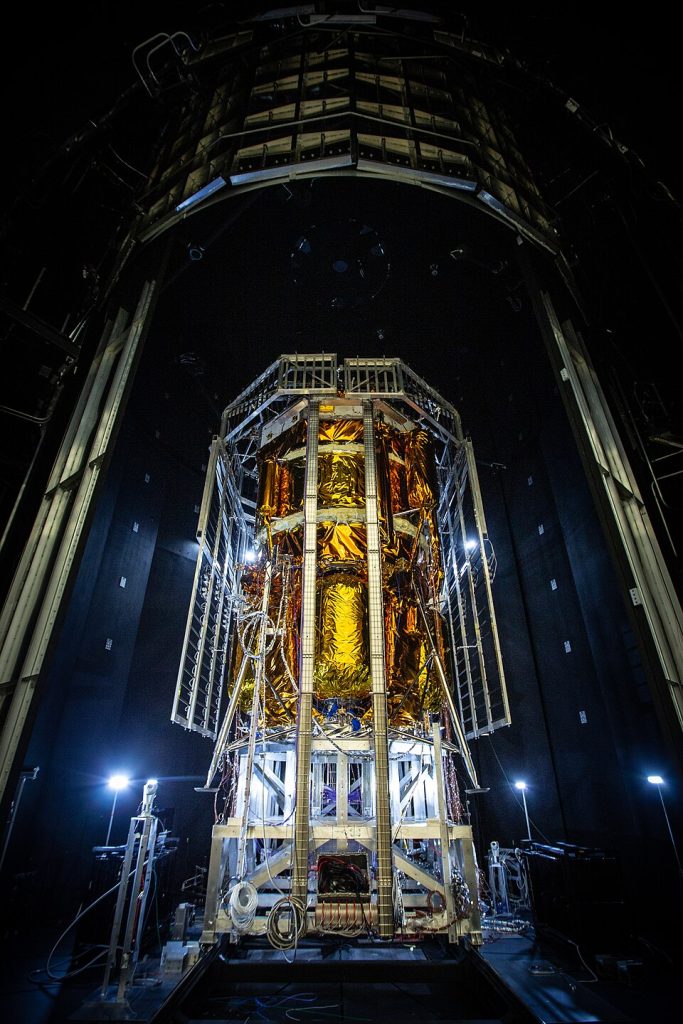
The Blue Moon Mark 1 is a single-launch, uncrewed cargo lander designed to deliver up to three metric tons of payload anywhere on the lunar surface — more than any previous commercial lunar lander. It stands significantly taller than the Apollo Lunar Module and is designed to fit within the seven-meter fairing of Blue Origin’s New Glenn rocket, which provides the launch capacity needed for a lander of this scale.
The lander’s propulsion system is built around the BE-7 engine — Blue Origin’s own liquid hydrogen and liquid oxygen engine, developed specifically for lunar landing applications. Liquid hydrogen is the most efficient chemical propellant available, offering higher specific impulse than the kerosene or hydrazine used by other landers, and is particularly well-suited for a heavy lander that must decelerate from lunar orbital velocity to a gentle touchdown. The BE-7 was developed over nearly a decade and test-fired extensively before being integrated into the lander.
The MK1 carries its own avionics, communications, power systems, and guidance for fully autonomous descent and landing — no real-time control from Earth is possible during the landing sequence due to the communication delay, so the lander must navigate the final descent entirely on its own. The precision landing system must bring Endurance down within the intended target zone at the Shackleton Connecting Ridge — a geologically significant region near the lunar south pole where permanently shadowed craters may harbor water ice within reach of future surface operations.
NASA Payloads
Moon Base I carries three NASA science and technology payloads under the Commercial Lunar Payload Services program:
The Stereo Cameras for Lunar Plume-Surface Studies — SCALPS — will image the interaction between the lander’s engine exhaust and the lunar surface during the final descent and touchdown. Understanding how rocket plumes disturb and redistribute lunar regolith is critical for designing landing pads and surface infrastructure for future crewed missions — a lander touching down near existing equipment or habitats cannot be allowed to sandblast them with high-velocity ejecta.
A Laser Retroreflective Array will be placed on the lunar surface, allowing orbiting spacecraft to precisely determine their position relative to a known fixed point by bouncing laser pulses off the array. Retroreflective arrays placed by Apollo astronauts are still used for lunar laser ranging today; this new array extends the network to the south pole region.
A third technology demonstration payload from Northrop Grumman will test systems relevant to future lunar surface operations.
The New Glenn Complication
Moon Base I was originally targeting launch in the first half of 2026 on Blue Origin’s New Glenn rocket — the company’s new heavy-lift vehicle that made its debut in January 2025. New Glenn suffered a second stage anomaly on a recent mission that placed a payload into an off-nominal orbit, prompting the FAA to open an investigation. The investigation has grounded New Glenn pending its findings, pushing Moon Base I’s launch to no earlier than Q1 2027.
The delay is frustrating but not mission-threatening. The Blue Moon MK1 lander completed rollout from Blue Origin’s Merritt Island facility in January 2026 and has been undergoing extensive testing — structural, thermal, radio frequency compatibility, and vibration — at facilities across the country. The lander itself is ready; the launch vehicle needs to resolve its issues before the mission can proceed.
The Bigger Picture
Moon Base I is the first of four planned Blue Moon MK1 missions. The second — MK1-102 — will carry NASA’s VIPER rover to the lunar south pole to prospect for water ice, a mission that was previously planned for Astrobotic’s Griffin lander before being reassigned to Blue Origin. Two subsequent MK1 missions will deliver Lunar Terrain Vehicles — the pressurized and unpressurized rovers that Artemis astronauts will use to explore the south pole surface.
Beyond the MK1, Blue Origin is under contract to NASA for the Blue Moon MK2, a crewed lunar lander that could carry Artemis astronauts to the surface as early as 2028. The MK1 missions are explicitly pathfinders for the MK2: every landing at the south pole, every demonstration of precision guidance, every science payload delivered, reduces the risk that attends putting humans on the lunar surface for the first time since Apollo 17 in 1972.
Blue Origin named the first lander Endurance — after Ernest Shackleton’s ship, which survived being crushed by Antarctic ice and brought its entire crew home safely. The landing site is named for Shackleton himself, the crater that dominates the lunar south pole bearing his name. The connection is deliberate: the south pole of the Moon, like the south pole of Earth, is a place of extreme cold, permanent shadow, and extraordinary scientific and strategic significance. Endurance went there once. Now it is going again.