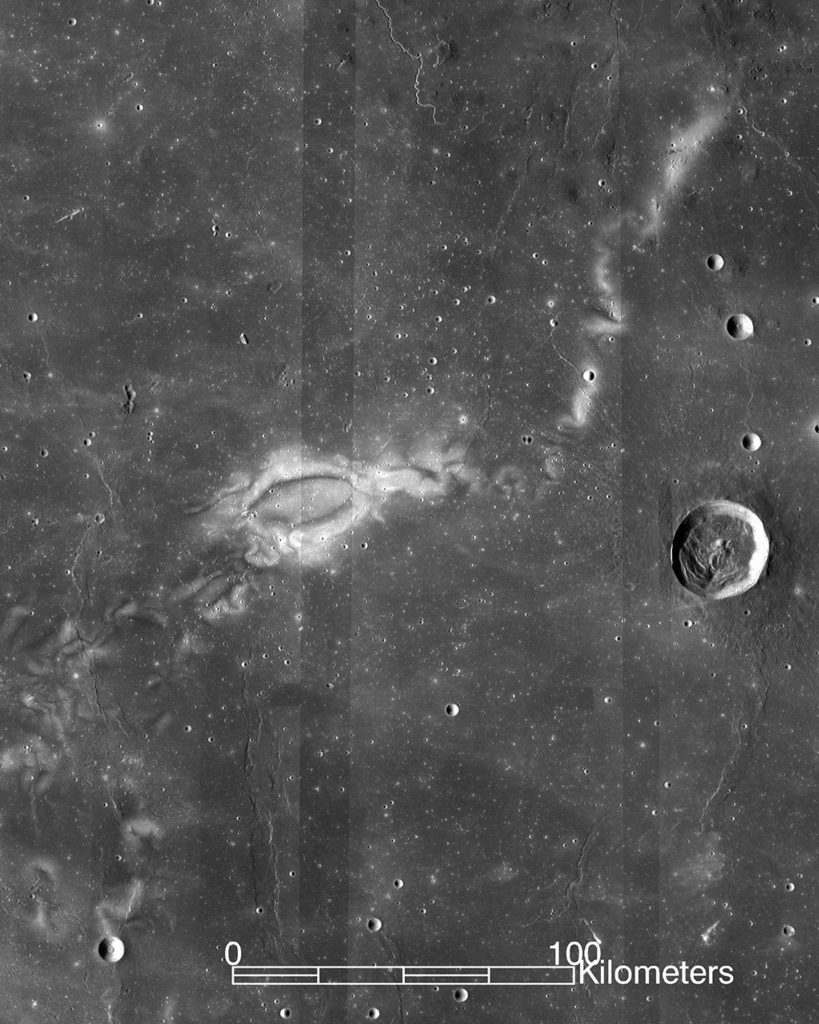
From Earth, Reiner Gamma is visible to the naked eye as a bright swirling pattern on the western edge of Oceanus Procellarum (the largest lunar mare on the Moon) — the Ocean of Storms. It looks like a comet frozen in the lunar surface, a pale swooping shape against the darker mare basalt, roughly 70 kilometers across. Amateur astronomers notice it immediately when it swings into view. And nobody knows what it is.
Reiner Gamma is a lunar swirl — one of about 120 known across the Moon’s surface, each characterized by the same puzzling combination: an unusually bright albedo marking, a sinuous shape that cuts across topography without following it, and a localized magnetic field far stronger than the surrounding terrain. The Moon has no global magnetic field. Yet these swirls sit atop magnetic anomalies — concentrations of magnetized rock — that deflect the solar wind and may be responsible for the bright surface markings by reducing the space weathering that normally darkens the lunar regolith.
What created them is debated. Leading theories include ancient asteroid impacts that magnetized the crust on impact, volcanic activity, or — for the most prominent swirls like Reiner Gamma — the magnetic signature left by a comet that impacted or flew close to the Moon billions of years ago, magnetizing the crust from the outside in. No spacecraft has ever landed at a lunar swirl. No instrument has ever made direct in-situ measurements of the magnetic field, plasma environment, and surface properties of one.
Intuitive Machines’ IM-3 mission — carrying the lander Trinity, with the motto MAGNETICAM LUNAM (“Magnetic Moon”) — is going to change that.
The Mission
IM-3 is Intuitive Machines’ third lunar delivery mission under NASA’s Commercial Lunar Payload Services program, awarded as CLPS task order CP-11 for approximately $77.5 million. It uses a Nova-C class lander — the same basic vehicle that carried IM-1 Odysseus to the lunar south pole in February 2024 and IM-2 to the south pole in 2025. The Nova-C is a hexagonal aluminum structure standing approximately 4 meters tall with six landing legs, powered by a single LOX/methane main engine for the powered descent and a thruster system for attitude control and hovering.
Trinity launches on a SpaceX Falcon 9 from Launch Complex 39A at Kennedy Space Center, no earlier than the second half of 2026. It carries 12 payloads in total — five NASA science instruments, six commercial payloads, and one international payload — making it one of the most diverse commercial lunar missions ever flown. A rideshare dispenser ring on the Falcon 9 upper stage will also deploy Intuitive Machines’ first lunar data relay satellite (Altus-1) into a lunar transfer orbit — the beginning of a commercial communications infrastructure for cislunar space.
Lunar Vertex — The Primary Science Payload
The centerpiece of IM-3’s science package is Lunar Vertex, designed and built by the Johns Hopkins University Applied Physics Laboratory — the same institution behind the New Horizons, MESSENGER, and DART missions. Lunar Vertex is a three-component system: a fixed lander-mounted magnetometer and plasma spectrometer, and a small rover that will drive away from the lander to conduct measurements at multiple locations across the Reiner Gamma swirl.
The magnetometer will measure the strength and direction of the magnetic field at the surface with precision that no orbital measurement can match — orbital instruments average over large areas and cannot resolve the fine structure of a magnetic anomaly at the surface scale. The plasma spectrometer will characterize how the solar wind interacts with the magnetic anomaly — whether it is truly deflected by the local field, creating a mini-magnetosphere above the swirl, or whether the interaction is more complex than current models predict. The rover will extend the measurement baseline away from the lander, providing the spatial context needed to understand how the magnetic field varies across the swirl’s structure.
Together these instruments will provide the first comprehensive ground truth dataset for a lunar swirl — observations that will be used to test every competing theory about how swirls form and why they look the way they do.
CADRE — Cooperative Autonomous Distributed Robotic Exploration
IM-3 carries a second robotic system that has nothing to do with Reiner Gamma’s magnetic mystery but represents one of the most technically ambitious demonstrations in the history of lunar exploration. CADRE — the Cooperative Autonomous Distributed Robotic Exploration system, developed by NASA’s Jet Propulsion Laboratory — is a network of three small rovers, each approximately the size and weight of a briefcase, that will operate autonomously as a team without direct human control from Earth.
The three CADRE rovers will be deployed from Trinity’s payload deck, navigate independently across the lunar surface, coordinate their movements through onboard communication, and collectively map the subsurface using ground-penetrating radar. No rover system has ever operated cooperatively on another world before — every previous planetary rover has been a single vehicle controlled by a human team. CADRE will demonstrate that a distributed network of small autonomous robots can work together to cover more ground and gather more data than any single vehicle could achieve, a capability that has profound implications for future planetary exploration where large distances and communication delays make centralized control impractical.
The International Passengers
IM-3 carries payloads from three international partners reflecting the growing globalization of lunar science.
ESA’s MoonLIGHT payload — the Moon Laser Instrumentation for General relativity High-accuracy Tests — is a retroreflector pointing actuator that will place a precision laser reflector on the lunar surface, extending the network of lunar laser ranging stations that has been used since Apollo to measure the Earth-Moon distance and test theories of gravity. ESA’s contribution builds on fifty years of laser ranging heritage and will improve the precision of future measurements.
The Korea Astronomy and Space Science Institute’s LUSEM — Lunar Space Environment Monitor — will measure the radiation and plasma environment at the Reiner Gamma landing site, contributing to the global characterization of the lunar surface environment that future crewed missions will need to account for.
Additional commercial payloads include experiments from Aegis Aerospace, Felix and Paul Studios, and Lunaria One — an Australian company carrying what it describes as a lunar memorial payload.
Why Reiner Gamma
The decision to send IM-3 to Reiner Gamma reflects a deliberate choice by NASA’s lunar science community. The 2023–2032 Planetary Science Decadal Survey identified lunar swirls as a high-priority science target — specifically because understanding them has implications far beyond the Moon itself. Localized magnetic anomalies, mini-magnetospheres, and the interaction between solar wind plasma and small-scale magnetic fields are phenomena relevant to Mercury, asteroids, and potentially the early Earth before its global magnetic field fully developed. Reiner Gamma, as the largest and most prominent lunar swirl, is the ideal natural laboratory.
It is also genuinely mysterious in a way that makes it scientifically compelling regardless of what the answer turns out to be. If the magnetic anomaly was created by an ancient comet impact, it carries a record of an event that occurred billions of years ago and left a permanent mark on the lunar surface. If it was created by a volcanic process or impact event from within the Moon, it reveals something about the Moon’s internal history that cannot be read from any other feature. The answer matters — and IM-3 is the first mission designed to find it.
Trinity’s motto says it directly. Magneticam Lunam. The Magnetic Moon.