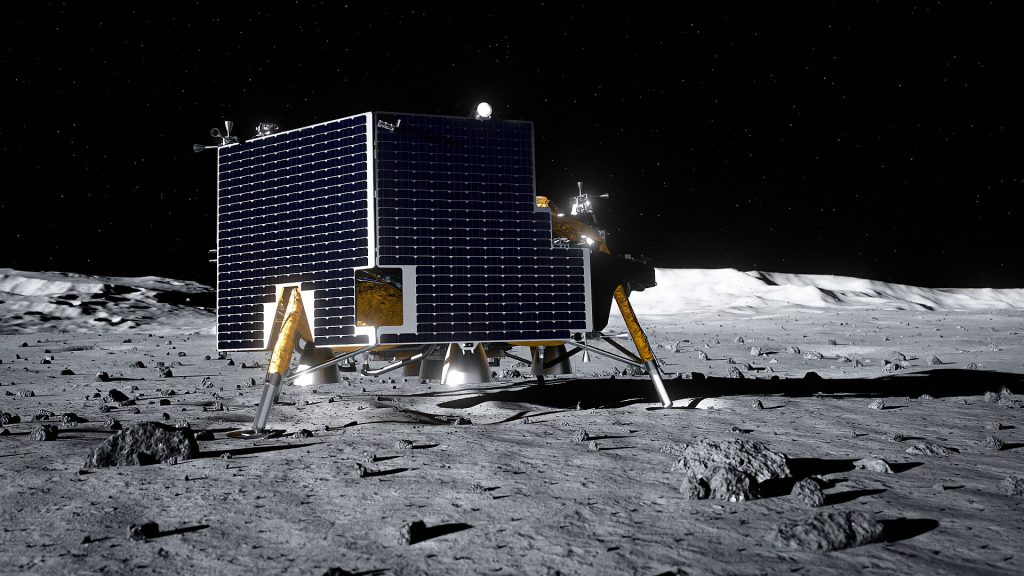
In January 2024, Astrobotic’s Peregrine lander launched toward the Moon and never arrived. A propellant leak sprang soon after launch, and the spacecraft spent its short life drifting through space before burning up in Earth’s atmosphere. Nearly three years later, the same team is preparing a second attempt, with a lander twice as wide, carrying far more cargo, and a new name on the hull. NASA calls it Moon Base II. If it launches on schedule, it will be the only Moon Base landing mission to fly in 2026.
From the Moon Base program to Moon Base II
When NASA refocused its Artemis program on a permanent lunar outpost in March 2026, it began giving its robotic lunar missions a shared identity. On May 26, 2026, the agency designated its next three landers Moon Base I, II and III. Moon Base I is Blue Origin’s Blue Moon lander Endurance; Moon Base III is Intuitive Machines’ IM-3 mission to the Reiner Gamma swirl. Moon Base II is Griffin Mission One.
All three are delivered under NASA’s Commercial Lunar Payload Services program, CLPS for short. Instead of building its own landers, NASA buys delivery services from companies, which own and operate the spacecraft and are free to sell extra space to other customers. NASA’s role is the anchor customer.
A lander built for a rover
Griffin’s story began in 2020, when NASA picked it to carry the VIPER rover, which was designed to prospect for water ice at the lunar south pole. Griffin was sized for that job. Then, in July 2024, NASA canceled VIPER over cost and schedule problems. VIPER was later revived and reassigned to a Blue Origin lander for 2027, but Griffin kept its contract and its task: delivering a big payload to the south pole.
The replacement is Astrolab’s FLIP rover. At about 500 kg, FLIP can carry another 30 kg of instruments of its own, including four NASA payloads. NASA calls it the largest commercial payload ever delivered to the Moon. FLIP is a stepping stone to Astrolab’s larger FLEX rover, and the company is one of the contenders to build the vehicles Artemis astronauts will drive. NASA hopes that what engineers learn from driving FLIP on the Moon will help shape how the astronauts’ rovers are designed and operated.
The spacecraft
Astrobotic unveiled Griffin-1 on June 15, 2026, in Pittsburgh. The lander stands about 2 meters tall and spans nearly 4.5 meters across, roughly twice as wide as Peregrine. NASA puts its mass at 1,265 kg. Astrobotic advertises the ability to land up to 625 kg on the lunar surface, at a price of about $1.2 million per kilogram. For this flight, Griffin carries more than 455 kg of cargo. “This is the first infrastructure-class lander going to the surface of the moon,” Astrobotic CEO John Thornton said at the unveiling.
Griffin is designed to navigate and avoid hazards on its own during descent. One of its passengers helps with that job: LandCam-X, an optical navigation camera built in Belgium for the European Space Agency, will test technology for precise landings.
Ten payloads, six countries
Besides FLIP and LandCam-X, Griffin carries a mix of science, technology and keepsakes. Astrobotic’s small BEACON CubeRover will test mobility on the surface. The Galactic Library nanofiche repository holds an archive of human knowledge etched into nickel, designed to last for millions of years. A plaque from Japan’s Nippon Travel Agency carries messages from Japanese children, and a MoonBox capsule holds items submitted on microSD cards.
Destination: Nobile Crater
Griffin is headed for the region near Nobile Crater and Mons Mouton, close to the lunar south pole. The south pole is the focus of the Moon Base program because some of its craters stay in permanent shadow and may hold water ice, a resource that future crews could turn into drinking water, oxygen and rocket propellant. Its long periods of sunlight on nearby high ground also make it attractive for solar power.
A new owner
The company behind Griffin changed hands this year. On June 2, 2026, Voyager Technologies announced it would acquire Astrobotic, and it completed the deal in July. Astrobotic now operates as Voyager Lunar Systems, still based in Pittsburgh and still led by John Thornton. Weeks after the acquisition, NASA awarded Voyager a $298 million task order for Peregrine-2, a follow-up mission planned for 2028 near the Gruithuisen Domes.
Ready to ship
Over the summer and fall, Griffin went through its final environmental tests at NASA’s Jet Propulsion Laboratory in California. Engineers spun it on a table to check its balance, shook it in three directions, blasted it with up to 153 decibels of sound to mimic launch, and cycled it between 75°C and −100°C in a vacuum chamber for about two weeks. Testing wrapped up on October 13, 2026.
Griffin now returns to Pittsburgh for final assembly before shipping to Florida, where FLIP will be integrated. Launch on a SpaceX Falcon Heavy is targeted for no earlier than November 2026. In September, NASA said it expected Griffin to be the only CLPS mission to launch this year, after Moon Base I and IM-3 slipped into 2027.
What’s riding on it
For Astrobotic’s team, Moon Base II is a chance to finish what Peregrine started. For NASA, it’s an early test of how much cargo commercial landers can reliably deliver to the place where astronauts will live and work. And for FLIP, it’s the first drive of a rover that may one day carry astronauts across the Moon.