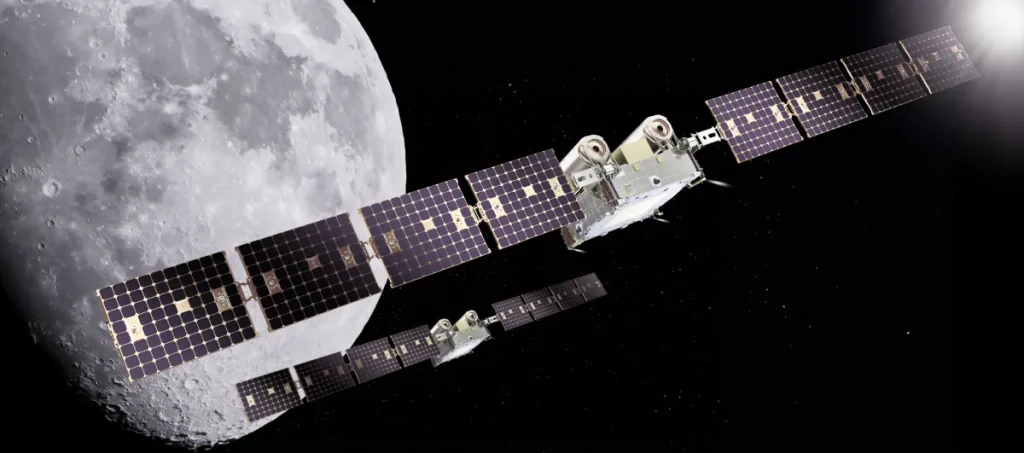
In 2022, a spacecraft about the size of a microwave oven spent four months taking the long way to the Moon. CAPSTONE, short for Cislunar Autonomous Positioning System Technology Operations and Navigation Experiment, became the first spacecraft to fly the unusual orbit NASA had picked for its Gateway space station. Now NASA is sending its successor. CAPSTONE 02 carries two spacecraft instead of one, each roughly sixteen times heavier than the original, and they’ll be practicing something every future Moon base will depend on: finding each other and flying close together, with little or no help from Earth.
What the first CAPSTONE proved
The original CAPSTONE launched on June 28, 2022, on a Rocket Lab Electron rocket from New Zealand. It weighed just 25 kilograms. Advanced Space, a small company in Colorado, managed the mission and still operates the spacecraft for NASA.
The mission was a test drive for Gateway’s planned orbit, a near-rectilinear halo orbit. That’s a long, stretched loop that swings close over one lunar pole and far out over the other, staying balanced between the gravity of the Earth and the Moon. CAPSTONE reached it on November 14, 2022, the first spacecraft ever to do so.
It wasn’t easy. A week after launch, controllers lost contact for a day. Later, a thruster valve stuck partly open and sent the spacecraft into a spin that took weeks of work to stop. But CAPSTONE recovered, completed its six-month primary mission in May 2023 and kept working long after. Along the way, its navigation software, the Cislunar Autonomous Positioning System or CAPS, measured CAPSTONE’s position by talking directly to NASA’s Lunar Reconnaissance Orbiter, without relying on stations on the ground.
Why a second mission
When NASA paused Gateway in March 2026 and shifted toward a base on the lunar surface, the space around the Moon didn’t become less important. It became busier. NASA’s Moon Base plan calls for more than twenty robotic landings in just its first phase, along with relay satellites, orbiters and, eventually, crews arriving every six months. All of those spacecraft will need to know exactly where they are, communicate with each other and sometimes meet up.
Today, most deep-space navigation depends on NASA’s Deep Space Network, the giant antennas in California, Spain and Australia that track spacecraft from Earth. The network is already in heavy demand. A Moon base with dozens of spacecraft will need some of them to navigate on their own.
CAPSTONE 02 is NASA’s test of how to do that. NASA announced the mission in July 2026. The Human Spaceflight Mission Directorate is paying for it, and NASA’s Small Spacecraft and Distributed Systems office at Ames Research Center in California is managing it. Advanced Space won the contract again, and Terran Orbital is building both spacecraft. Lawrence Livermore National Laboratory and Space Dynamics Laboratory are also partners.
Two spacecraft, two roles
The two CAPSTONE 02 spacecraft are identical, each weighing about 400 kilograms. At the Moon, they’ll take turns. One acts as the “chaser,” finding and approaching the other, which plays the “target.” Then they switch. Swapping roles lets the team test more navigation scenarios with the same hardware.
The spacecraft will practice:
- Rendezvous and proximity operations: approaching another spacecraft and flying near it safely. Future cargo ships, landers and crewed spacecraft will need to do this all the time.
- Formation flying and loitering: holding position with each other in the gravitational balance between the Earth and the Moon, in what engineers call three-body orbits.
- Autonomous navigation: combining tracking from the ground with optical sensors and observations of stars and other celestial objects so one spacecraft can find the other. An optical imaging payload from Lawrence Livermore will support navigation and take pictures of the Moon.
- Communications: testing ways for spacecraft near the Moon to talk to Earth and to each other.
The mission will also serve as a testbed for three navigation software packages developed by NASA, and it will keep measuring radiation near the Moon, which matters for both electronics and astronauts.
The long way to the Moon, again
Like the first CAPSTONE, CAPSTONE 02 will take a low-energy route. Instead of flying straight to the Moon in a few days, it will travel far past the Moon and let the Sun’s gravity bend its path back. The trip takes months, but it uses much less fuel, so more of the spacecraft’s mass can go to useful equipment.
NASA hasn’t announced which rocket will launch the mission.
Where things stand
In August 2026, Advanced Space and Terran Orbital completed the mission’s Critical Design Review, the milestone that confirms the design is ready to build. Launch is targeted for 2027.
“This mission represents an important step in the maturation of cislunar capabilities,” said Sean Fuller, NASA’s Moon Base CAPSTONE manager.
If CAPSTONE 02 works, it won’t make headlines the way a Moon landing does. But the skills it’s testing, spacecraft finding each other, keeping track of where they are and working together without constant help from Earth, are the kind of everyday operations a permanent Moon base will need.