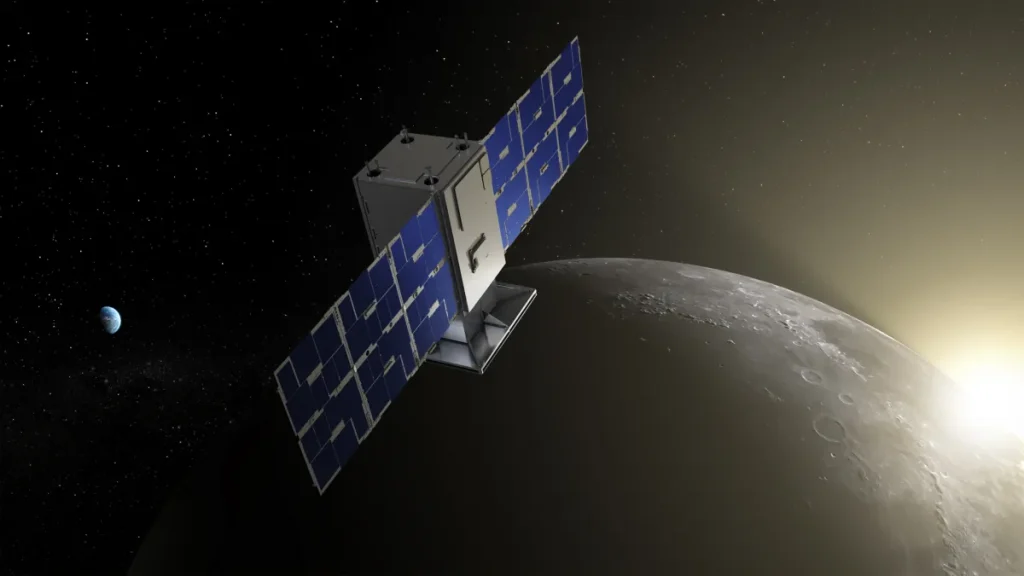
Most missions on this site weigh tons and cost billions. CAPSTONE weighs 25 kilograms and is about the size of a microwave oven. Yet it was the first spacecraft ever to fly in a strange, stretched-out lunar orbit that NASA once planned to make the centerpiece of its return to the Moon — and four years later, it’s still out there.
A scout for a space station
CAPSTONE stands for Cislunar Autonomous Positioning System Technology Operations and Navigation Experiment. Its job was to test a near-rectilinear halo orbit, or NRHO, around the Moon. This orbit is highly elongated and sits at a precise balance point between Earth’s and the Moon’s gravity, giving stability for long missions while needing very little energy to maintain. Each week, it swings within 1,000 miles of one lunar pole on its close pass and 43,500 miles from the other pole at its peak. It also keeps an unobstructed view of Earth and covers the lunar south pole.
NASA had chosen this orbit for Gateway, a small space station that would serve as a research platform and a transfer point where astronauts boarded landers for the lunar surface. Before committing a multibillion-dollar station to an orbit no spacecraft had ever flown, NASA wanted a real spacecraft to test it.
Built by small companies, fast
CAPSTONE was a commercial experiment as much as a technical one. Advanced Space of Westminster, Colorado developed and operated it, Terran Orbital built the CubeSat platform, Stellar Exploration provided the propulsion system, and Rocket Lab provided the launch.
It launched on June 28, 2022, on a Rocket Lab Electron from the company’s launch site in New Zealand. Electron’s Lunar Photon upper stage then fired repeatedly to send CAPSTONE on its way.
Rather than flying straight to the Moon, CAPSTONE took a ballistic lunar transfer — a long, looping path using gravity that took four months but dramatically reduced the fuel the tiny spacecraft needed.
Two near-disasters
The journey nearly ended twice. In July 2022, a flight software bug cut CAPSTONE off from Earth; the team restored contact after about 24 hours.
The second crisis was worse. On September 8, 2022, during or just after its third trajectory correction maneuver, CAPSTONE began tumbling beyond what its reaction wheels could control, and the team declared an operational emergency. The culprit turned out to be a partially open valve on one of its eight thrusters, which fired whenever the propulsion system was pressurized.
The team spent weeks diagnosing and recommissioning the propulsion system, writing new control software for detumbling. They recovered the spacecraft from spin rates exceeding 120 degrees per second, and it went on to complete all its future maneuvers with that valve still stuck open.
On November 13, 2022, CAPSTONE fired its engine and entered the NRHO, followed by two clean-up maneuvers to refine its track. Advanced Space described it as the first CubeSat to fly to and operate at the Moon.
Navigating without Earth
Beyond testing the orbit, CAPSTONE carried a second flight computer and radio to work out its own position. It talked directly to NASA’s Lunar Reconnaissance Orbiter, which has circled the Moon since 2009, measuring the distance between them and how fast it changed.
The software behind this, called CAPS, lets spacecraft determine their location without relying entirely on tracking from Earth. That frees up ground antennas for science data rather than routine tracking — a big deal as more spacecraft crowd around the Moon.
Mission accomplished — and then some
CAPSTONE completed its six-month primary mission on May 18, 2023. It confirmed that the power and propulsion needed to stay in the NRHO matched NASA’s models, and it proved its spacecraft-to-spacecraft navigation worked.
Then it kept going. NASA granted an extension after CAPSTONE had circled the Moon more than 100 times, adding experiments with artificial intelligence software to detect anomalies and learn autonomous maneuvering. A further extension in February 2025 added ranging tests with LRO and NASA’s Deep Space Network, plus demonstrations of autonomous and interoperable communications in lunar space. The enhanced phase, which wrapped up in May 2026, demonstrated autonomous onboard planning of the maneuvers needed to stay in orbit.
Outliving Gateway
In a twist, CAPSTONE outlasted the station it was built to scout. On March 24, 2026, NASA Administrator Jared Isaacman announced NASA was pausing Gateway and redirecting its components toward a $20 billion base on the lunar surface.
The NRHO data is not wasted — CAPSTONE’s orbital insights continue to feed operations planning for Artemis missions — but the orbit no longer has a space station waiting for it.
On June 26, 2026, NASA announced CAPSTONE had achieved all primary and extended objectives and that its own activities would conclude that month. The spacecraft itself flies on, with Advanced Space operating it as a technology testbed for future missions.
Legacy
A mission planned for 10 months has now run more than four years. CAPSTONE proved that a small company, a small rocket and a small spacecraft can do real work in deep space — and that may be its most lasting result.